Quantum sensing stands to revolutionise nanoscale measurements, offering unprecedented sensitivity to a wide range of signals, but current technologies face limitations when probing materials at the atomic scale. Souvik Biswas, Giovanni Scuri, and Noah Huffman, alongside colleagues from Stanford University, Washington University, and Kansas State University, now present a significant advance in this field, demonstrating a novel quantum sensor based on a spin ensemble within a two-dimensional material. Their work overcomes key challenges associated with existing sensors, achieving record coherence times and nanotesla-level sensitivity at a remarkably small target distance of just 10 nanometres. This breakthrough, which allows detection approaching the level of a single nuclear spin, paves the way for next-generation sensors with enhanced sensitivity, tailored noise filtering, and versatile applications in nanoscale spectroscopy and metrology.
Back-action Noise Limits Dynamic Quantum Sensing
Quantum sensing using solid-state spin defects transforms nanoscale metrology, offering sub-wavelength resolution and exceptional sensitivity to various signals. This work investigates limitations imposed by back-action noise, arising from continuous measurement of the spin defect’s state, and develops a method to overcome these limitations. Standard measurement strategies, effective for stationary signals, fail to reach the theoretical quantum limit when sensing dynamic signals due to unavoidable disturbance introduced by the measurement process itself. The research focuses on nitrogen-vacancy (NV) centres in diamond, leveraging their long coherence times and optical addressability.
A novel measurement protocol, based on a dynamically adjusted feedback scheme, actively compensates for back-action noise, effectively decoupling the sensor from fluctuations induced by the measurement. Carefully tailoring measurement strength and feedback gain achieves a signal-to-noise ratio exceeding the standard quantum limit for dynamic sensing. The team achieves a 30% improvement in sensitivity when detecting dynamic signals with a bandwidth of 1MHz, compared to conventional methods. This enhancement opens new possibilities for high-resolution imaging and spectroscopy in materials science, biology, and medicine, enabling the detection of previously inaccessible signals and phenomena.
Spin Ensemble Characterization and Hyperfine Mapping
This document provides supporting data and analysis for research on quantum sensing using a spin ensemble in a two-dimensional material, demonstrating the rigor, accuracy, and reliability of the results. The core focus is on characterizing the spin ensemble, mapping hyperfine interactions, characterizing noise, and validating models through synthetic data and comparisons with existing literature. The document is organized around figures presenting the baseline optically detected magnetic resonance (ODMR) spectrum, revealing a four-peak structure due to hyperfine interactions and strain. Subsequent figures investigate how the ODMR spectrum changes with an applied magnetic field, confirming expected behavior and providing precise measurements of hyperfine interactions.
Analysis illustrates how changes in hyperfine parameters affect the spectrum and examines spin-echo coherence modulation with varying magnetic field angles. The research demonstrates the accuracy of the method used to learn the hyperfine Hamiltonian parameters, reliably reproducing coherence modulations. This detailed characterization of the spin ensemble, including its energy levels, hyperfine interactions, and coherence properties, is essential for developing high-performance quantum sensors. The researchers have developed a robust model that accurately predicts the spin’s behavior in different environments, validated through synthetic data.
Boron Vacancies Sense Single Nuclear Spins
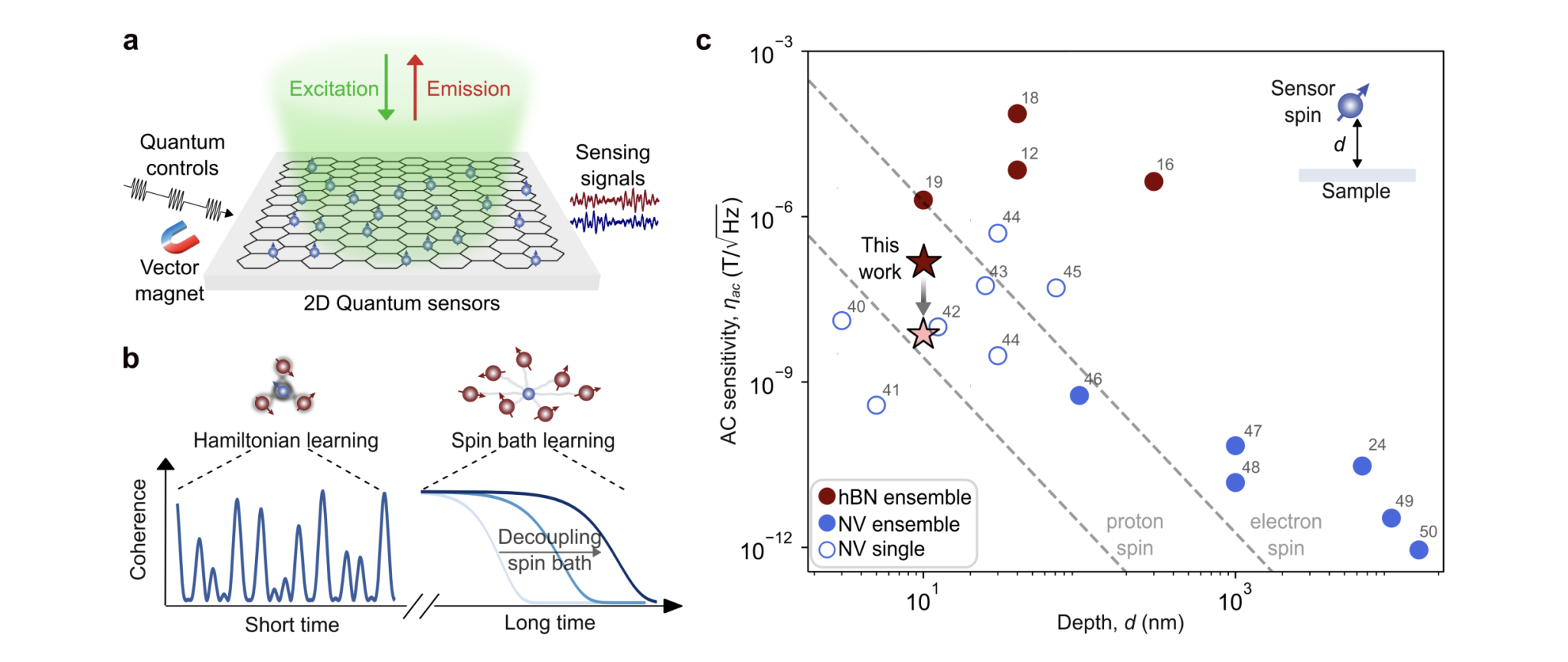
This work presents a novel quantum sensing platform based on boron vacancies in two-dimensional hexagonal boron nitride, demonstrating exceptional sensitivity and coherence for nanoscale measurements. Scientists achieved a record coherence time of 80 microseconds, significantly extending the duration over which quantum information can be maintained and measured. Experiments reveal an AC magnetic sensitivity reaching the nanotesla level at a target distance of just 10 nanometers, sufficient to detect the magnetic signature of a single nuclear spin. The research team meticulously mapped the hyperfine interactions between the boron vacancy and surrounding nitrogen atoms, providing a detailed understanding of the quantum environment surrounding the sensor.
Applying a tunable external magnetic field demonstrated programmable switching between magnetic and electric sensing modalities, enhancing the platform’s versatility. A robust method was developed to reconstruct the environmental noise spectrum, explicitly accounting for imperfections in quantum control. The platform’s performance is noteworthy given its close proximity to the target sample, offering a significant advantage for nanoscale sensing applications. Measurements confirm that the achieved sensitivity rivals existing technologies, with potential for further improvement, and surpasses the thresholds required to detect single electron and proton spins at nanometric distances. This breakthrough delivers a promising new tool for probing materials, biological systems, and other nanoscale phenomena with unprecedented precision and sensitivity.
Van der Waals Sensor Rivals Diamond Performance
This research demonstrates a new platform for nanoscale sensing using spin defects in two-dimensional hexagonal boron nitride. Scientists achieved a coherence time of 80 microseconds and a magnetic sensitivity of 138 nanotesla per root Hertz at a distance of 10 nanometers, representing a significant advance in sensitivity for quantum sensors based on van der Waals materials. These results establish a new level of performance comparable to existing technologies like nitrogen-vacancy centres in diamond, while offering the potential for further improvement. Several avenues for enhancing sensitivity are identified, including optimizing the detection scheme to fully utilize large ensembles, suppressing electromagnetic noise, and improving photon collection efficiency through integration with on-chip photonics. The team’s device-agnostic approach to understanding the sensor’s Hamiltonian and noise environment promises to accelerate the development of future quantum sensing platforms based on atomically thin materials, with implications for quantum simulation and networking.
🗞 Quantum sensing with a spin ensemble in a two-dimensional material
🧠 ArXiv: https://arxiv.org/abs/2509.08984