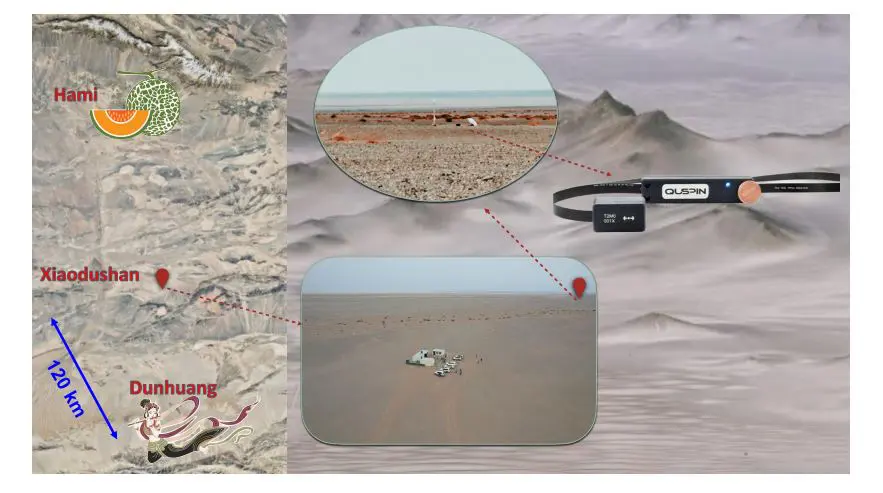
The elusive nature of dark matter continues to challenge our understanding of the universe, and scientists are actively pursuing a range of potential candidates, including ultralight particles like axions and dark photons. Ariel Arza, Yuanlin Gong, and Jun Guo, alongside their colleagues, investigate these possibilities by exploiting a unique natural phenomenon, the Earth’s resonant cavity, which amplifies faint electromagnetic signals. This team, based in China, developed a highly sensitive atomic magnetometer, known as the Geomagnetic Probe for nEw physiCS (GPEX), and deployed it in the remote desert of XiaoDushan to search for evidence of these particles interacting with magnetic fields. While their initial analysis of one hour’s worth of data reveals no direct detection of axion or dark photon signals, the research establishes the viability of ground-based magnetometry for this search, paving the way for future detector networks that promise even greater sensitivity and the potential to unlock the secrets of dark matter.
Chi-Squared Noise Validates Signal Search
This analysis details the characteristics of experimental noise, demonstrating its alignment with a chi-squared distribution, crucial for confidently identifying potential weak signals like those from ultralight dark matter. Deviations from this expected behavior would complicate the search for subtle signals. Histograms illustrating the power spectral density of the noise at various frequencies were analyzed, with overlaid best-fit chi-squared distributions and key parameters provided for each frequency. The resulting p-values, consistently ranging from 0. 60 to 0. 84, suggest the observed noise amplitudes align well with the expected chi-squared distribution, reinforcing the validity of the data analysis and the reliability of any conclusions drawn from the experiment. Further analysis confirmed the consistency of this noise behavior throughout the measured spectrum.
Earth’s Cavity Resonances Detect Ultralight Dark Matter
This study pioneered a new approach to detecting ultralight dark matter candidates, such as axions and dark photons, by harnessing the Earth’s resonant cavity to amplify expected electromagnetic signals. Researchers deployed a highly sensitive quantum magnetometer, the Geomagnetic Probe for nEw physiCS (GPEX), in China to search for these faint signals, focusing on one hour of data seeking magnetic signals induced by dark matter interaction with photons. To interpret the data, scientists developed a theoretical framework describing how ultralight dark matter interacts with electromagnetic fields, treating the dark matter field as a classical current incorporated into Maxwell’s equations and using vector spherical harmonics to model expected magnetic field signals. The team specifically accounted for the unique properties of the Earth-ionosphere cavity, recognizing that the dark matter induced magnetic field is uniquely determined by the radial component of the effective current.
The experimental setup centered on a pulsed, optically pumped rubidium magnetometer utilizing a Free Induction Decay detection scheme, measuring subtle changes in magnetic fields by detecting the precession of rubidium atoms. Researchers carefully considered the bandwidth of the expected signal, determined by the velocity distribution of dark matter particles, and accounted for fluctuations in the dark matter field. By analyzing the collected data and comparing it to theoretical predictions, the study established constraints on the axion-photon coupling and the dark photon kinetic mixing parameter, demonstrating the feasibility of ground-based magnetic searches for ultralight dark matter.
Dark Matter Search Constrains Axion and Dark Photon
This work details a search for ultralight dark matter candidates, specifically axions and dark photons, which may interact with electromagnetic fields and produce detectable signals. Researchers employed the Geomagnetic Probe for nEw physiCS (GPEX) in China to search for these faint signals, analyzing one hour of collected data and demonstrating the potential of ground-based magnetic searches for ultralight dark matter. The team established constraints on the axion-photon coupling constant and the dark photon kinetic mixing parameter, achieved through exceptional magnetometer sensitivity and a quiet experimental environment. The study models the interaction of dark matter with electromagnetic fields, treating it as an effective classical current incorporated into Maxwell’s equations and deriving expressions for the expected dark matter-induced magnetic field at the Earth’s surface, accounting for the geometry of the Earth-ionosphere cavity.
Axion and Dark Photon Search Constraints Established
This research presents the first geomagnetic observations undertaken by a dedicated collaboration to search for evidence of axion and dark photon dark matter, leveraging the Earth’s natural resonant cavity and a highly sensitive quantum magnetometer. Analysis of one hour of data revealed no detectable signals, allowing the team to establish new constraints on the strength of interactions between these potential dark matter candidates and photons, exceeding the performance of previous experiments. While no signal was detected, the work demonstrates the feasibility of using ground-based magnetic measurements for searching for ultralight dark matter, with current limitations stemming primarily from the magnetometer sensitivity rather than background geomagnetic noise. Future plans involve deploying a network of highly sensitive quantum magnetometers, which could enhance sensitivity by several orders of magnitude with extended observation times. This network could not only improve the search for dark matter but also allow for confident discrimination of signals from various noise sources and potentially surpass existing limits derived from astrophysical observations, with extending the search to higher frequencies through the use of multi-sensor arrays promising to broaden the scope of this innovative approach.
🗞 Search for Ultralight Dark Matter with Quantum Magnetometry in the Earth’s Cavity
🧠 ArXiv: https://arxiv.org/abs/2511.16553