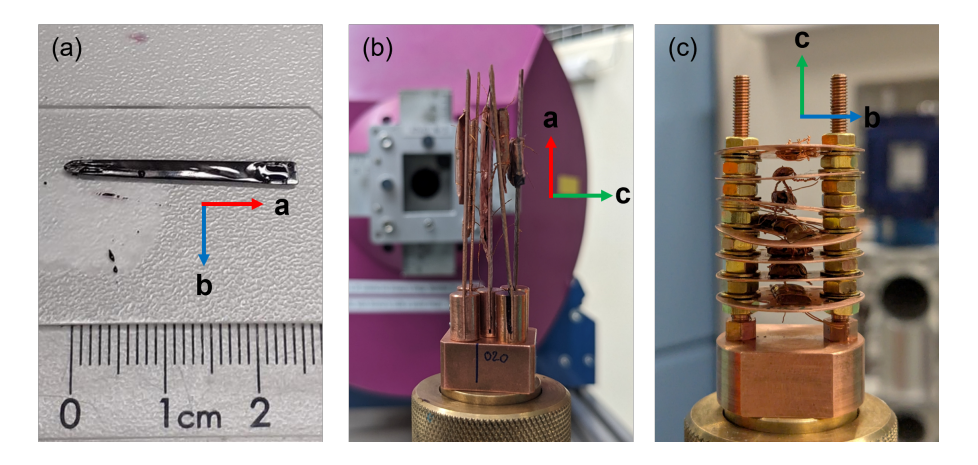
The interplay between magnetism and lattice vibrations typically flows in one direction, with structural changes influencing magnetic behaviour, but a reciprocal relationship remains elusive. J. Philippe, F. Elson, T. Arh, and colleagues now demonstrate a significant coupling between these properties in the quantum magnet (C5H9NH3)2CuBr4, a material where magnetic interactions and lattice dynamics occur on comparable energy scales. Through high-resolution neutron spectroscopy of large, carefully prepared crystals, the team reveals how a recently discovered structural change affects both the magnetic and vibrational spectra, identifying two distinct magnetic energy gaps and a surprisingly low-energy vibrational mode. Crucially, they demonstrate that the frequency of this vibrational mode shifts measurably as magnetic correlations strengthen with decreasing temperature, establishing a direct link between the spin system and the arrangement of the organic molecules within the material’s structure. This research provides a rare insight into a system where magnetism and lattice dynamics are intimately connected, offering a new perspective on the behaviour of quantum materials.
Quantum Spin Ladder Magnetic Excitations Studied
Research on quantum spin ladders investigates the unique magnetic properties of these one-dimensional materials, serving as models for more complex magnetic phenomena. Researchers characterize magnetic excitations, such as spin waves, using neutron scattering to reveal details about their energy and momentum. These materials exhibit strong electron correlations, requiring advanced theoretical approaches to understand their complex behavior. This work contributes to the broader field of low-dimensional magnetism, exploring materials with reduced dimensionality and quantum mechanical properties, including magnetic ordering, phase transitions, and the coupling between magnetic excitations and lattice vibrations, known as magnetophononics.
Theoretical studies provide a foundation for understanding spin ladders, with early work predicting topological phases and comprehensive frameworks developed by Auerbach and others. Experimental investigations rely heavily on neutron scattering facilities, with studies utilizing these techniques to investigate spin dynamics, emergent phenomena, and quantum spin liquids and solids. Recent advancements include commissioning new neutron spectrometers and developing software for analyzing neutron scattering data, facilitating more detailed investigations of these materials. Materials-specific studies focus on synthesizing and characterizing spin ladder compounds, with emerging research exploring the coupling between spin and lattice vibrations, known as magnetophononics. Key research directions include determining the ground state of spin ladders, mapping their excitation spectrum, investigating coupling between ladders, exploring the effects of pressure and magnetic field, developing new materials, and utilizing time-resolved techniques to study the dynamics of spin and lattice vibrations. This body of work comprehensively advances our understanding of low-dimensional magnetism and quantum materials.
Spin Gaps Reveal Structural Phase Transitions
Detailed investigation of the metal-organic framework Cu-CPA reveals a strong connection between its magnetic and vibrational properties, demonstrating sensitivity to structural changes. High-resolution neutron spectroscopy, performed on large deuterated single crystals, separates the contributions from the spin and lattice subsystems, identifying two distinct, gapped branches in the low-energy magnetic excitation spectrum. The spin gaps, differing by 34%, align with previously estimated structural distortions within the material, confirming a two-ladder spin Hamiltonian model for Cu-CPA and allowing for the deduction of magnetic interaction parameters for each ladder. Measurements of sound velocities within Cu-CPA confirm the material’s relatively low acoustic velocities, expected for a soft organic compound. High-resolution neutron spectroscopy, performed on large deuterated single crystals, separates the contributions from the spin and lattice subsystems, confirming a two-ladder spin Hamiltonian model and allowing for the deduction of precise magnetic interaction parameters for both ladders. Importantly, the study identifies a highly localized, low-energy phonon mode, exhibiting a frequency decrease as magnetic correlations develop with decreasing temperature, linked to the structure and location of the cyclopentylammonium rings within the material. This detailed understanding results from careful separation of magnetic and lattice contributions to the neutron scattering spectrum and reanalysis of existing specific heat data. The analysis relies on accurately separating the magnetic and lattice contributions, a process requiring careful consideration of the experimental data. Future research could explore the extent to which this coupling between magnetism and lattice vibrations occurs in other structurally soft systems, potentially revealing a broader phenomenon with implications for materials design.
🗞 Magnetic and phononic dynamics in the two-ladder quantum magnet (C5H9NH3)2CuBr4
🧠 ArXiv: https://arxiv.org/abs/2510.24556