

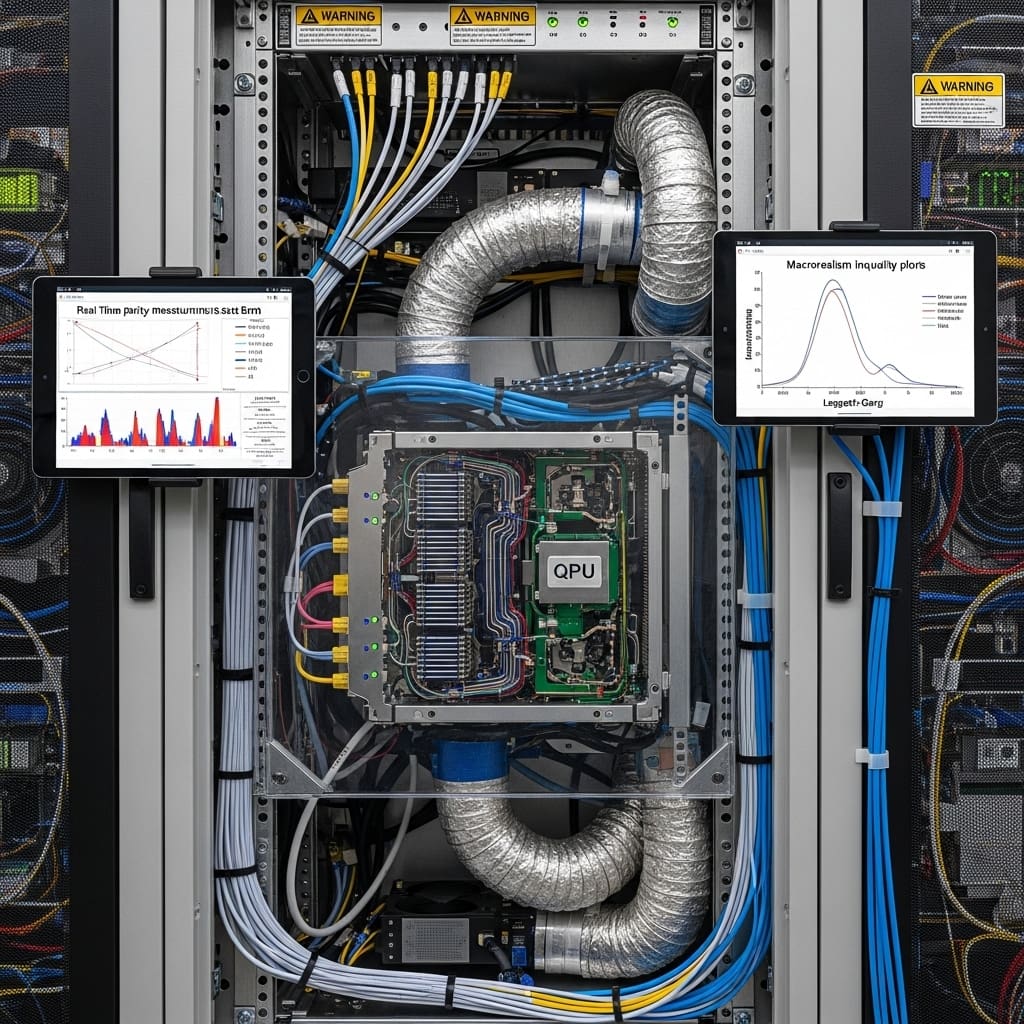
The pursuit of increasingly powerful quantum computers demands effective methods to verify their performance as they grow in complexity, a challenge that Ben Zindorf, Lorenzo Braccini, and Debarshi Das, alongside Sougato Bose and colleagues from University College London and the Shiv Nadar Institution of Eminence, now address with a novel benchmarking approach. Their work investigates the degree to which quantum computers truly exhibit quantum behaviour, by testing a fundamental principle called macrorealism, the idea that objects possess definite properties even when not measured. The team demonstrates that violations of macrorealism, revealed through carefully designed parity measurements, provide a scalable metric for assessing quantum computer performance, independent of specific computational tasks. Crucially, they detect this violation on a quantum computer with up to qubits, representing a significant advance over previous tests, and show a threefold improvement in performance between different generations of quantum hardware.
Detecting Classical Disturbances in Quantum Circuits
Scientists have developed methods to identify and mitigate unwanted classical behaviour in quantum computers, which can degrade performance. The research focuses on designing quantum circuits sensitive to these disturbances and revealing their presence through careful optimization and comparison of different circuit implementations. These optimized circuits are particularly sensitive to disturbances in control electronics, allowing scientists to quantify their impact and explore techniques for cancellation and removal of mid-circuit measurement influences, enhancing the accuracy and reliability of quantum computations. The core of this work lies in two circuit optimization strategies, the H-method and the M-method. These methods simplify complex quantum circuits while preserving functionality, reducing operations and increasing resilience to errors. By carefully controlling circuit complexity and connectivity, the team aims to create circuits sensitive to classical disturbances, paving the way for improved error mitigation strategies.
Scalable Macrorealism Test of Quantum Computers
Scientists have created a new protocol to quantitatively assess the quantum nature of quantum computers, treating each computer as a single macroscopic quantum system. The research centers on testing macrorealism, a foundational concept concerning whether systems possess definite properties independent of measurement, using the No-Disturbance Condition. Experiments conducted using IBM quantum computers successfully detected violations of macrorealism on systems of up to 38 qubits, representing a significant improvement over previously established results. To ensure accurate results, the team designed methods to address potential experimental errors arising from disturbances in classical systems, meticulously controlling for unwanted influences and ensuring statistical accuracy. The study benchmarked two quantum computers, revealing a three-fold improvement in quantumness between successive generations of hardware, demonstrating a transition from quantum to classical behaviour as the number of qubits increases.
Macrorealism Violation Confirms Quantum Computation Scale
Scientists have achieved a breakthrough in benchmarking quantum computers by demonstrating a method to quantitatively assess their quantumness as a collective macroscopic entity. The research introduces a scalable protocol based on the principles of macrorealism and the no-disturbance condition, providing a new way to certify the quantum behaviour of increasingly complex quantum computers. Experiments detected violations of macrorealism on up to 38 qubits, representing a significant improvement over previously established limits. The core of this achievement lies in a novel benchmarking metric that probes the collective coherence of a quantum computer alongside the discontinuous collapse of its wave function during mid-circuit measurements. Comparative analysis using two generations of IBM quantum computers, the Marrakech and Brisbane systems, demonstrated a three-fold improvement in quantumness, confirming the effectiveness of the metric in tracking advancements in quantum computing technology.
Quantum Benchmarking Via Macrorealism Violation
This work demonstrates a new approach to benchmarking quantum computers by investigating the violation of macrorealism through parity measurements. Researchers successfully treated entire quantum computers as macroscopic quantum entities, establishing a foundationally motivated metric for assessing their performance. The team predicted, and then observed, that violation of the No Disturbance Condition should remain independent of the number of qubits involved, under ideal conditions, arising from the irreversible collapse of the quantum computer’s wavefunction during intermediate parity measurements. The implemented methods not only measure the quantumness of a computer but also simultaneously benchmark its quantum coherence, parity measurement quality, mid-circuit measurement capabilities, and ability to perform universal quantum computation. Through experiments on IBM quantum computers, the team achieved a significant advancement, demonstrating an order of magnitude improvement in the maximum number of qubits for which a violation of macrorealism can be detected. Comparisons between different generations of computers and measurement methods revealed consistent performance improvements.
👉 More information
🗞 How “Quantum” is your Quantum Computer? Macrorealism-based Benchmarking via Mid-Circuit Parity Measurements
🧠 ArXiv: https://arxiv.org/abs/2511.15881


