The accurate pricing of financial derivatives remains a significant challenge in quantitative finance, traditionally tackled with computationally intensive methods. Fernando Alonso, Álvaro Leitao, and Carlos Vázquez, researchers at CITIC Research Center and the University of A Coruña, Spain, now present a novel approach using quantum machine learning to estimate probability distributions and, crucially, improve option pricing. Their work introduces hybrid classical-quantum methods that reconstruct Fourier series representations from the outputs of quantum models, offering a potentially faster and more accurate alternative to conventional techniques. By analysing the impact of data size and model complexity, the team demonstrates remarkable accuracy in extracting key Fourier coefficients, positioning these new methods as a competitive solution for derivatives valuation and advancing the field of quantum finance.
Quantum Computing Accelerates Derivative Option Pricing
This research explores the application of quantum computing to financial derivative pricing, focusing specifically on option valuation. Traditional methods, such as Monte Carlo simulations and Fourier-based techniques, can be computationally demanding, particularly for complex options. Quantum computing offers the potential to significantly accelerate these calculations, and researchers investigated various quantum algorithms and techniques to improve efficiency, including Quantum Amplitude Estimation (QAE) and Variational Quantum Circuits (VQCs). Efficient data encoding and circuit optimization are also central to the work.
The study demonstrates the potential of quantum algorithms to speed up option pricing calculations and explores the trade-offs between different quantum approaches for various option types. The research highlights the importance of efficient data encoding and circuit optimization for achieving practical speedups and provides a comprehensive overview of the current state of quantum finance, including challenges and opportunities for future research. This research contributes to the growing field of quantum finance by providing insights into the potential of quantum computing for solving real-world financial problems. It identifies promising quantum algorithms and techniques that could lead to more efficient and accurate option pricing models in the future, while acknowledging the limitations of current quantum hardware and emphasizing the need for further research and development.
Quantum Fourier Reconstruction for Derivative Pricing
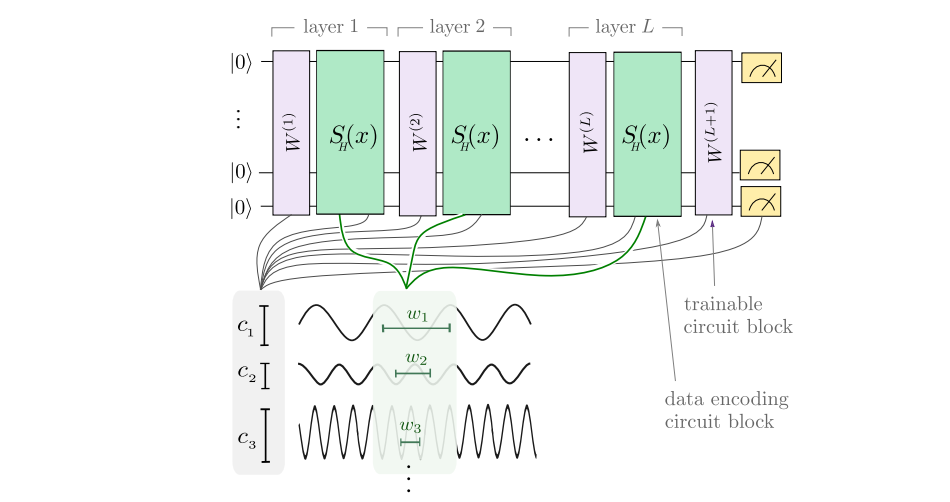
Scientists developed two novel hybrid classical-quantum methods to address the computationally intensive challenge of financial derivative pricing, traditionally reliant on Monte Carlo integration. The study pioneers a new approach by reconstructing Fourier series representations of statistical distributions using outputs from Quantum Machine Learning (QML) models built upon Parametrized Quantum Circuits (PQCs), allowing for more efficient and accurate valuation of derivatives. This work lies in the application of Quantum Machine Learning, specifically utilizing Parametrized Quantum Circuits (PQCs). Scientists constructed quantum circuits containing adjustable parameters, optimizing these parameters to minimize a cost function and achieve the most accurate representation of the desired function.
The team meticulously analyzed the impact of both data size and PQC dimensionality on the performance of these models, establishing a clear understanding of the factors influencing accuracy and efficiency. To rigorously assess the proposed methods, scientists employed Quantum Accelerated Monte Carlo (QAMC) as a benchmark, comparing the computational cost and accuracy of Fourier coefficient extraction between the new hybrid methods and the established QAMC algorithm. Through numerical experiments, the team demonstrated that the developed methods achieve remarkable accuracy in derivative valuation, positioning them as competitive alternatives to traditional approaches.
Quantum Circuits Accurately Price Financial Derivatives
Scientists have developed novel hybrid classical-quantum methods for pricing financial derivatives, achieving remarkable accuracy in valuation problems. The work centers on reconstructing Fourier series representations of statistical distributions using outputs from Parametrized Quantum Circuits (PQCs), offering a competitive alternative to traditional Monte Carlo integration techniques. Experiments reveal the ability to accurately model the price of an underlying asset and its associated option using the developed methods. The team formulated two distinct approaches, both leveraging PQCs to learn the Fourier coefficients of the probability distribution, and then integrating these coefficients to estimate the option price.
Through rigorous testing, scientists confirmed the accuracy of these methods in extracting Fourier coefficients, a critical step in derivative valuation. The performance of the new methods was assessed by comparing them to Accelerated Monte Carlo (QAMC), a benchmark technique. Results demonstrate that the PQC-based approaches achieve comparable accuracy while offering potential computational advantages. Investigations into the impact of data size reveal that increasing the amount of training data consistently improves the accuracy of the PQC models, and increasing the dimensionality of the PQC enhances performance, allowing for more complex function approximation.
Quantum Fourier Series for Option Pricing
This research introduces two new hybrid classical-quantum methods for pricing financial derivatives, specifically European options. The team successfully reconstructed Fourier series representations of statistical distributions using outputs from Parametrized Quantum Circuits (PQCs), offering a competitive alternative to traditional Monte Carlo integration techniques. The core achievement lies in accurately approximating option prices by leveraging the capabilities of quantum machine learning models. Through numerical experiments, the researchers demonstrated that their methods achieve remarkable accuracy in extracting Fourier coefficients, a crucial step in option pricing calculations.
The performance was rigorously assessed by comparing the results against Accelerated Monte Carlo simulations, confirming the viability of this new approach. The authors acknowledge that the performance of these methods is influenced by the size of the data used and the dimensionality of the PQC employed. Future work could focus on optimizing these parameters to further enhance accuracy and computational efficiency, and exploring the application of these techniques to more complex financial instruments and market scenarios.
🗞 Quantum Machine Learning methods for Fourier-based distribution estimation with application in option pricing
🧠 ArXiv: https://arxiv.org/abs/2510.19494