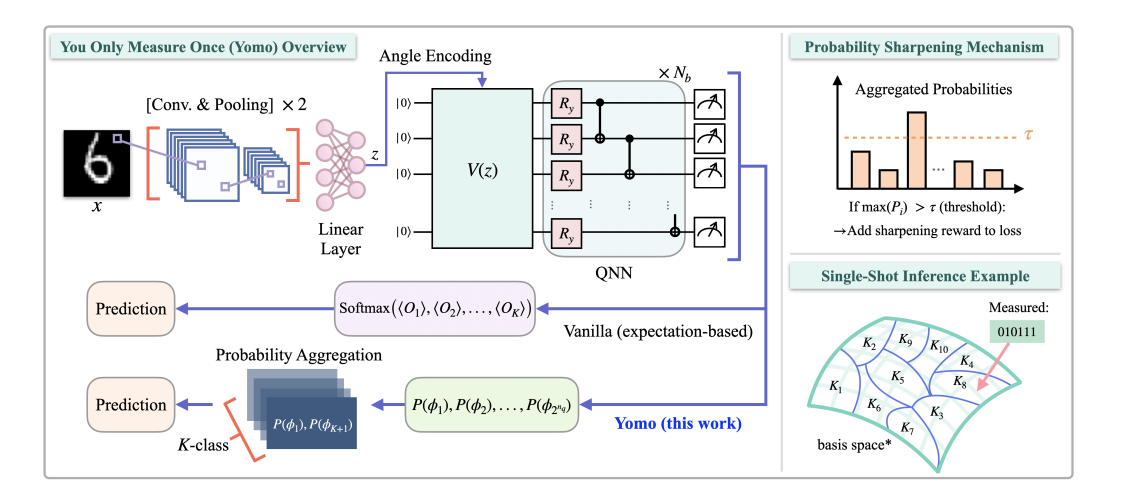
Quantum machine learning holds immense promise, but current models typically demand numerous measurements to generate reliable predictions, creating significant cost and time barriers to widespread use. Chen-Yu Liu, Leonardo Placidi, and Kuan-Cheng Chen, working at Quantinuum and Imperial College London, alongside Samuel Yen-Chi Chen from Brookhaven National Laboratory and Gabriel Matos, present a new approach called You Only Measure Once (Yomo) that dramatically reduces this measurement burden. Yomo achieves accurate inference with far fewer measurements, even down to a single measurement, by replacing conventional output methods with a probability aggregation technique and employing loss functions that promote clear predictions. This innovative design overcomes limitations inherent in existing quantum machine learning models, consistently outperforming them on image recognition tasks and paving the way for more affordable and accessible quantum computation.
Traditionally, quantum machine learning algorithms rely on repeated measurements, or shots, of observables to obtain reliable predictions. This dependence on large shot budgets leads to high inference cost and time overhead, particularly as quantum hardware access is typically priced proportionally to the number of shots. Yomo replaces Pauli expectation-value outputs with a probability aggregation mechanism and introduces loss functions that encourage sharp predictions. Experiments demonstrate that Yomo consistently outperforms existing QML models across varying shot budgets and under simulated noise conditions. The team rigorously tested the model on the MNIST and CIFAR-10 datasets, achieving high classification accuracy even in the single-shot regime. Specifically, the research confirms Yomo’s ability to surpass conventional expectation-based QML models in shot efficiency, a result formally proven through theoretical bounding of the required measurement shots to achieve a target error probability.
This achievement directly addresses a key barrier to practical quantum machine learning adoption by substantially reducing financial and computational costs. The team validated the model’s performance under realistic conditions, simulating noise derived from current single-qubit and two-qubit error rates of existing quantum hardware. Yomo replaces traditional expectation-value outputs with a probability aggregation mechanism and employs loss functions designed to encourage precise predictions. Experiments on image datasets, including MNIST and CIFAR-10, demonstrate that Yomo consistently outperforms existing methods across various measurement budgets and under simulated conditions with hardware noise. The team’s analysis shows Yomo avoids the limitations of models dependent on a large number of measurements, enabling accurate inference even with only a single measurement.
The authors acknowledge that Yomo is best suited to a workflow where model training occurs using classical simulation of quantum states, with deployment then taking place on quantum devices. They also note that a future investigation is needed to pinpoint the specific number of qubits where quantum inference with Yomo may surpass classical simulation in runtime, offering valuable guidance for practical applications. The team suggests this crossover point will be an important factor in determining when quantum inference becomes advantageous.
👉 More information
🗞 You Only Measure Once: On Designing Single-Shot Quantum Machine Learning Models
🧠 ArXiv: https://arxiv.org/abs/2509.20090