Photonic quantum machine learning holds immense promise for accelerating artificial intelligence, but establishing clear performance benchmarks has remained a significant hurdle. To address this, Cassandre Notton, Vassilis Apostolou, Agathe Senellart, and their colleagues at Quandela and Universite Paris Cite launched the Perceval Challenge, an open, collaborative initiative designed to evaluate photonic approaches to machine learning rigorously. The challenge attracted 64 teams globally, culminating in a unified baseline for photonic machine learning and revealing the complementary strengths of different algorithmic approaches. This work not only establishes crucial benchmarks for near-term photonic processors but also demonstrates the power of open science and interdisciplinary collaboration in advancing hybrid, quantum-enhanced artificial intelligence workflows.
Static Boson Sampling Fails Image Classification
Researchers investigated the potential of using fixed-boson-sampling layers within a machine learning pipeline for classifying handwritten digits, specifically from the MNIST dataset. The central finding is that these static boson-sampling layers, as implemented in this study, do not improve performance over purely classical models and often perform worse. While the quantum component allows for more than random guessing, it fails to provide a substantial benefit. The team attributes this to several key factors, including the misalignment between classical convolutional neural networks and the fixed, linear transformations of the boson sampling layer.
Both methods used to encode classical image features into the quantum state, a linear classical layer and direct phase encoding, proved ineffective at preserving relevant information. The lack of trainability in the boson sampling layer is a significant limitation, and adaptive quantum circuits that allow gradient-based optimization are needed. The static boson sampling layer does not align well with the hierarchical features learned by classical neural networks, and the performance gap between hybrid and classical models is more pronounced in complex multi-class classification tasks. In essence, this study provides a cautionary tale about the challenges of integrating static quantum components into complex machine learning pipelines. Simply adding a quantum layer to a classical model is not sufficient to achieve performance gains; more sophisticated architectures, trainable quantum components, and effective encoding strategies are needed to unlock the full potential of quantum machine learning.
Photonic Machine Learning Benchmark via Global Hackathon
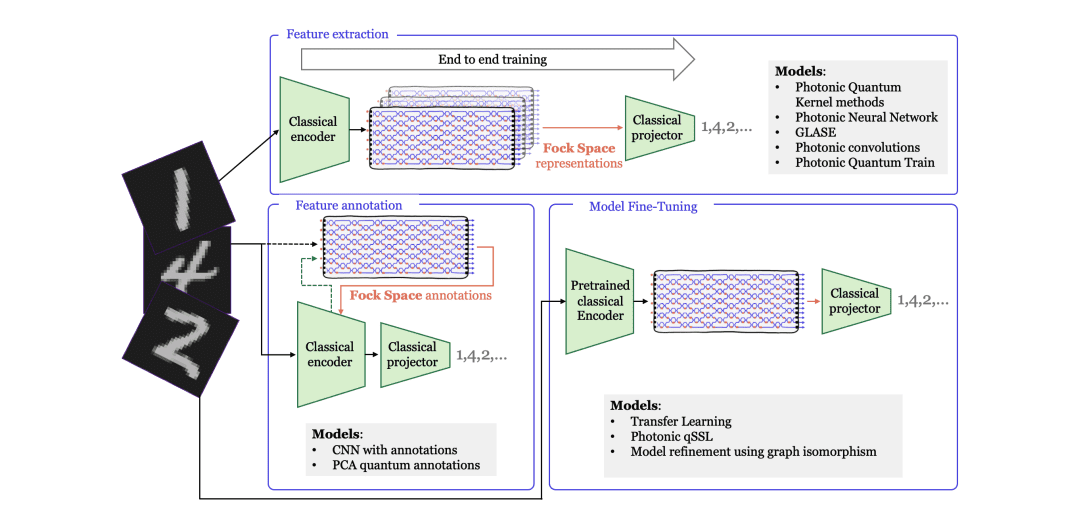
The Perceval Quest represents a significant methodological advance in photonic quantum machine learning, establishing a reproducible benchmark for evaluating performance on the MNIST digit classification task. Researchers engineered a six-month-long hackathon attracting 64 teams worldwide, ultimately selecting 11 finalists for access to both GPU resources for large-scale simulation and cloud-based execution on Quandela’s linear-optical quantum processor and its companion simulation framework, Perceval. This setup enabled a systematic comparison of diverse approaches to quantum machine learning within a hardware-compatible framework, moving beyond theoretical models to practical implementation and evaluation. The research pioneered a comprehensive evaluation of three distinct methodological categories: photonic kernels, neural networks, and convolutional models functioning as end-to-end feature extractors; enhanced convolutional neural networks and hybrid feature extractors utilizing the interferometer as a quantum annotator; and transfer learning and self-supervised learning paradigms supporting model fine-tuning.
Participants explored a wide range of models, and the research team consolidated all 64 implementations into a single, publicly available repository, ensuring transparency and facilitating cumulative research. This emphasis on reproducibility addresses a critical need in the field, allowing researchers to build upon existing work and rigorously validate claims of quantum advantage. Furthermore, the study highlights a migration of methods from non-photonic quantum machine learning paradigms to photonic implementations, noting that several ideas were further developed and submitted as independent articles. Researchers also proposed a novel method exploiting the computational properties of photonic quantum processors through permanent-based computation, demonstrating innovation beyond simply adapting existing algorithms. This systematic approach and open-source resource represent a substantial contribution to the field, accelerating progress toward hybrid, quantum-augmented AI workflows.
Photonic Machine Learning Performance Benchmarked Globally
The Perceval Quest, a six-month-long hackathon, established a systematic framework for evaluating photonic quantum machine learning, attracting 64 teams worldwide in its initial phase and culminating in 11 finalist teams granted access to substantial GPU resources for both large-scale simulation and photonic hardware execution. This work delivers the first unified baseline of photonic machine learning performance, revealing complementary strengths between variational, hardware-native, and hybrid approaches to digit classification using a reduced version of the MNIST dataset. Researchers organized the diverse approaches into three methodological categories: photonic kernels, neural networks, and convolutional models functioning as end-to-end feature extractors; enhanced convolutional neural networks and hybrid feature extractors utilizing the interferometer as a quantum annotator; and transfer learning and self-supervised learning paradigms supporting model fine-tuning. The study highlights a migration of methods from non-photonic quantum machine learning paradigms to photonic implementations, with several ideas developed further and submitted as independent articles.
A novel method was also proposed, exploiting the computational properties of photonic quantum processors through permanent-based computation. Researchers consolidated all implementations into a unified, open-source repository, ensuring transparency and facilitating cumulative research, and emphasizing reproducibility as a core principle. This work demonstrates how systematic, collaborative experimentation can map the current landscape of photonic quantum machine learning and pave the way toward hybrid, quantum-augmented AI workflows. The challenge underscores the importance of open experimentation and interdisciplinary collaboration, accelerating progress in quantum-enhanced learning.
Photonic Machine Learning Benchmark Reveals Progress
The Perceval Challenge establishes a unified baseline for evaluating photonic machine learning performance through a focused, reproducible benchmark based on digit classification. By employing a reduced version of the MNIST dataset, retaining all ten classes and full image resolution while limiting sample size, the challenge rigorously assesses photonic approaches against classical models, avoiding oversimplifications common in other quantum machine learning benchmarks. Results from over sixty teams demonstrate complementary strengths between variational, hardware-native, and hybrid photonic methods, revealing the potential of this emerging technology for machine learning tasks. This collaborative effort underscores the importance of open experimentation and interdisciplinary research in advancing photonic computing.
Participants benefited from access to substantial computational resources, including both GPU and photonic hardware via cloud platforms, enabling exploration of models beyond current hardware limitations. While acknowledging the inherent challenges in comparing nascent photonic systems with mature classical algorithms, the Perceval Challenge provides a valuable framework for future research and development. The authors note that the reduced dataset size, while necessary for feasibility, represents a limitation, and future work could explore scaling the challenge to larger datasets and more complex tasks. The publicly available implementations and detailed results contribute to a growing body of knowledge, paving the way for hybrid, photonics-augmented AI workflows.
👉 More information
🗞 Establishing Baselines for Photonic Quantum Machine Learning: Insights from an Open, Collaborative Initiative
🧠 ArXiv: https://arxiv.org/abs/2510.25839