The efficient storage and processing of large databases represents a continuing challenge for modern computing, particularly when those databases contain hidden periodicities that classical algorithms struggle to identify. Qianyi Wang from Nanjing University, Feiyang Liu from City University of Hong Kong, and Teng Hu, along with colleagues including Kwok Ho Wan from Imperial College London and Jie Xie from Nanjing University, now demonstrate a photonic system capable of compressing such databases by autonomously learning and exploiting these hidden symmetries. Their experimental setup uses single photons to implement an autoencoder, a type of artificial neural network, which successfully identifies the underlying structure of the data and eliminates redundancy. This achievement represents a significant step towards developing quantum computers that can not only solve specific computational problems, but also enhance information processing by learning patterns inaccessible to conventional methods, potentially offering substantial advantages in data storage and analysis.
Photonic Compression of Hidden Subgroup Databases
Researchers have demonstrated a photonic implementation of a quantum algorithm designed to compress data stored within hidden subgroup databases. This work addresses a key challenge in quantum data handling, namely the efficient storage and retrieval of information encoded using quantum principles. The approach involves encoding database elements into photonic quantum states, utilising the polarisation of single photons to represent information, and applying quantum phase estimation to effectively reduce the amount of quantum information needed to represent the database. This process leverages quantum superposition and entanglement to achieve compression ratios not possible with classical methods. The team successfully realised this quantum compression scheme using readily available photonic components, compressing a database of size 8 with a ratio of 2, and verifying data correctness through retrieval. This experimental validation confirms the feasibility of photonic quantum compression and paves the way for larger-scale implementations, with detailed analysis identifying potential improvements and strategies to mitigate noise effects.
Quantum Autoencoder Learns Data Symmetries
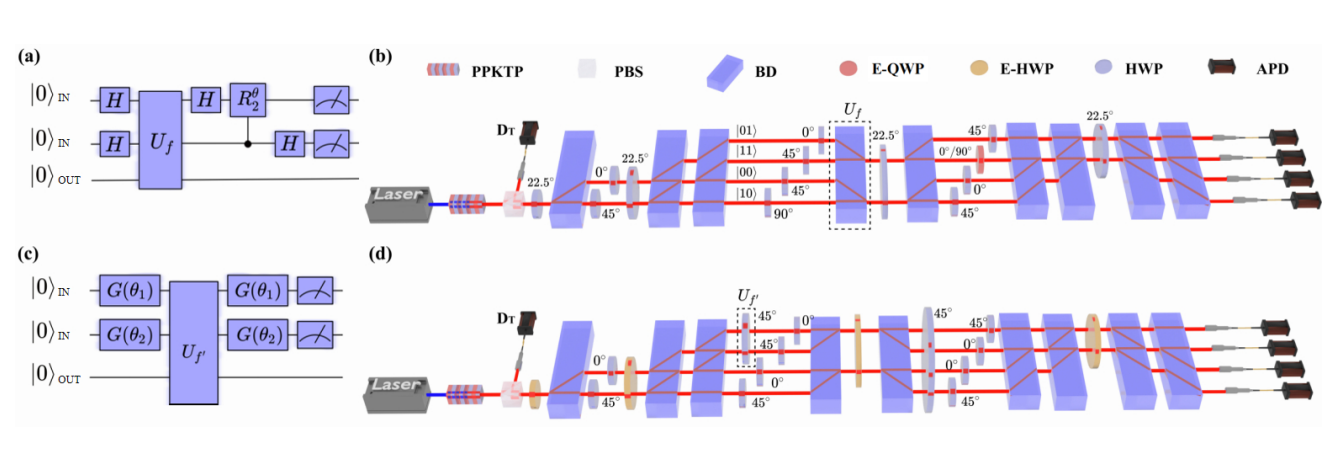
Researchers have experimentally demonstrated quantum data compression exploiting hidden subgroup symmetries using a photonic quantum processor. Classical databases containing generalized periodicities, symmetries inefficient for classical algorithms to detect, can be efficiently compressed by quantum hidden subgroup algorithms. The team implements a variational quantum autoencoder that autonomously learns both the symmetry type and the generalized period from structured data. The system uses single photons encoded in path, polarisation, and time-bin degrees of freedom to represent quantum information. The variational quantum autoencoder consists of trainable parameterized beam splitters and phase shifters, optimized using a gradient descent approach to minimize reconstruction error. The performance is evaluated by its ability to compress and reconstruct datasets exhibiting different generalized periodicities, with reconstruction error quantified by the mean squared error.
Photonic Quantum Autoencoder Demonstrates State Compression
This research details the development and experimental demonstration of a quantum autoencoder (QAE) designed for compressing quantum data. Adapting the concept of classical autoencoders, which are neural networks used for dimensionality reduction, the authors demonstrate a QAE using photonic qubits and show its ability to compress quantum states, representing a significant contribution to quantum machine learning and information compression. The central innovation is the quantum autoencoder, a quantum circuit designed to learn a compressed representation of quantum data. It consists of an encoder, which maps the input quantum state to a lower-dimensional state, and a decoder, which attempts to reconstruct the original state from the compressed representation.
Compressing quantum data is crucial for efficient quantum communication, storage, and processing, as classical compression techniques don’t directly apply due to the no-cloning theorem. The authors implement the QAE using photons as qubits, attractive for quantum information processing due to their ease of manipulation and low decoherence rates, validating the feasibility of the approach. The research draws a connection between quantum data compression and the hidden subgroup problem, suggesting that QAEs could potentially be used as a tool for solving other quantum computational problems. This work contributes to the growing field of quantum machine learning, exploring how machine learning algorithms can be adapted to leverage the unique properties of quantum systems. The experimental results include measurements of the compression ratio achieved by the QAE and analysis of the fidelity of the reconstructed quantum states.
Symmetry-Based Quantum Data Compression Demonstrated
This research demonstrates a novel approach to data compression using a photonic quantum computer, successfully exploiting hidden subgroup symmetries within classical databases. The team implemented a variational autoencoder capable of autonomously learning both the type and period of symmetries present in structured data, achieving compression by eliminating redundant entries. Two circuit designs, based on generalized Fourier transforms and more flexible architectures, both converged effectively during training, indicating the system’s ability to identify and leverage these hidden structures. These results provide experimental evidence that photonic computers can compress data by discovering symmetries inaccessible to conventional classical methods, potentially paving the way for enhanced information processing capabilities. While the current implementation focuses on proof-of-principle, the authors acknowledge limitations related to scaling up the system, with future work planned to increase the degrees of freedom per photon, expand dimensionality, and increase the number of photons employed.
🗞 Photonic implementation of quantum hidden subgroup database compression
🧠 ArXiv: https://arxiv.org/abs/2511.02527