Predicting future climate change demands increasingly sophisticated Earth system models, and researchers are now exploring the potential of quantum machine learning to enhance these crucial tools. Mierk Schwabe, Lorenzo Pastori, and Valentina Sarandrea, alongside colleagues at the Deutsches Zentrum für Luft- und Raumfahrt e. V. and the University of Bremen, demonstrate a significant step forward by developing a quantum neural network capable of accurately predicting cloud cover. Their work shows this quantum approach achieves performance comparable to classical neural networks, but importantly, reveals a capacity for establishing more consistent relationships within the data, potentially leading to more reliable and robust climate projections. This achievement highlights the promise of integrating quantum computing with traditional climate modelling techniques, paving the way for more accurate and insightful predictions of our changing world.
Machine learning improves climate model parameterization
Scientists are leveraging machine learning, and exploring quantum machine learning, to refine how climate models represent complex physical processes, particularly cloud cover. Traditional methods often rely on simplifying assumptions, introducing uncertainty, while machine learning offers the potential to learn directly from data, leading to more realistic and reliable simulations. This research focuses on improving the accuracy of climate models, crucial for understanding and predicting climate change. The core idea involves replacing or enhancing existing, physics-based parameterizations with machine learning models.
Researchers are investigating quantum machine learning algorithms, which utilize the principles of quantum mechanics to potentially achieve performance gains over classical methods. Specific models explored include quantum neural networks and generative adversarial networks. Explainable AI is proving crucial for understanding and trusting machine learning-based parameterizations, and the choice of data encoding significantly impacts model performance. Classical surrogates provide a viable way to approximate quantum models, making them more practical. Future research will focus on developing more robust quantum machine learning algorithms, exploring new data encoding schemes, and improving explainable AI techniques.
Scaling up these models to handle more complex tasks, combining quantum and classical machine learning, and thoroughly validating these parameterizations in realistic climate models are also key priorities. Leveraging Earth Virtualization Engines will streamline development and deployment, and continued advancements in quantum hardware are essential to overcome current limitations. This research utilizes tools like Pennylane, a quantum machine learning library, and JAX, a high-performance numerical computation library. Shapley values are used for model explainability, and Earth Virtualization Engines provide a framework for testing and deploying machine learning-based parameterizations. In summary, this work represents a promising step towards leveraging the power of machine learning, and potentially quantum machine learning, to improve the accuracy and reliability of climate models.
Cloud Cover Prediction with Quantum Machine Learning
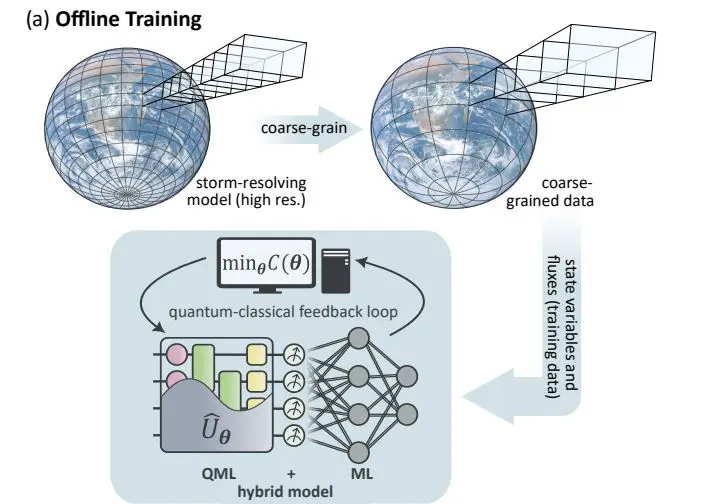
Scientists are developing quantum machine learning models to improve climate prediction, seeking advantages in expressivity and generalizability over classical approaches. This work focuses on a quantum machine learning model designed to parameterize cloud cover within an Earth system model, a crucial component for accurate climate forecasting. The team trained and tested their model using high-resolution climate data generated by the ICON model from the DYAMOND project, providing realistic training data. The quantum machine learning models learn to predict cloud fraction based on coarse-state variables including specific humidity, cloud water content, cloud ice content, air temperature, pressure, horizontal wind magnitude, geometric height, and latitude.
A parameterized quantum circuit serves as the model, with the number of qubits matching the number of input features. Data reuploading techniques enhance the model’s ability to capture complex relationships. These encoding layers are interleaved with variational blocks containing entangling operations, allowing for adaptable parameter optimization. The architecture utilizes rotation gates applied in a defined sequence to manipulate the qubits. Expectation values of Pauli Z operators are measured on the output state, and a weighted average is computed to represent the predicted cloud cover. The models are numerically simulated using the Pennylane library and optimized with JAX, employing a quantum-classical feedback loop for training. The networks were trained for 200 epochs using 2 × 10⁵ training data points, updating parameters via gradient descent and utilizing the parameter-shift rule to calculate gradients.
Quantum Machine Learning Improves Cloud Cover Prediction
Scientists have achieved a significant breakthrough in climate modeling by developing a quantum machine learning model capable of predicting cloud cover with performance comparable to classical neural networks, and substantially better than traditional parameterization schemes. The research demonstrates that a quantum machine learning model, containing 200 to 201 trainable parameters, accurately predicts cloud cover, achieving results similar to a classical neural network with 203 free parameters. Both quantum and classical models significantly outperform the commonly used Xu-Randall parameterization scheme, as demonstrated by improved accuracy across various altitudes. Experiments revealed that the quantum machine learning model’s performance remains stable with a sufficient number of quantum shots, exceeding 10,000 shots, closely mirroring the results obtained in noiseless simulations.
Analysis of the model’s behavior with varying numbers of shots showed a rapid degradation in performance when fewer than 10,000 shots were used, but stable results were maintained with higher shot counts. The team successfully trained quantum machine learning models from the same initial parameters, even with different noise realizations, confirming the robustness of the approach. Further investigation involved applying Shapley values, a model-agnostic explainability method, to determine the importance of input features. This analysis allows researchers to understand which factors most influence the model’s predictions, providing insights into the relationships discovered within the data. The results demonstrate the potential of quantum machine learning to not only improve the accuracy of climate models but also to enhance our understanding of the complex processes governing cloud formation and climate change. The team’s work establishes a foundation for future research exploring the application of quantum machine learning to address critical challenges in climate science.
Quantum Machine Learning Improves Climate Model Accuracy
This research demonstrates the successful development of quantum machine learning models designed to represent cloud cover within a climate model, a crucial component for accurate climate prediction. The quantum neural networks achieved performance comparable to classical neural networks with the same complexity, and significantly outperformed traditional parameterization schemes currently used in climate modelling. Importantly, the quantum models exhibited greater robustness during training, consistently identifying the most relevant factors influencing cloud cover.
🗞 Quantum Machine Learning for Climate Modelling
🧠 ArXiv: https://arxiv.org/abs/2512.14208