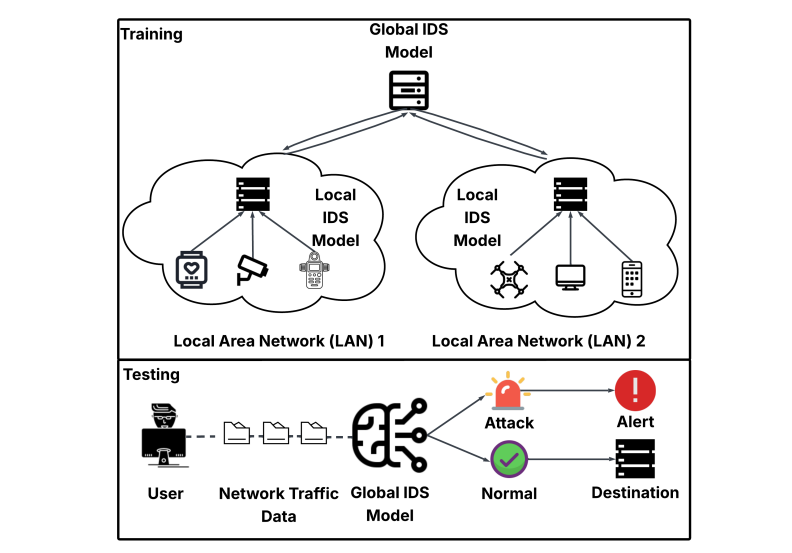
Network security faces increasing challenges as cyberattacks grow in sophistication and volume, demanding innovative approaches to intrusion detection. Devashish Chaudhary, Sutharshan Rajasegarar, and Shiva Raj Pokhrel from Deakin University lead a comprehensive survey exploring how federated learning can revolutionise network intrusion detection systems. Their work systematically examines the potential of this distributed machine learning technique to enhance data privacy, a crucial consideration when analysing sensitive network traffic. The researchers not only detail existing federated learning architectures and strategies, but also pioneer an exploration of quantum-enhanced federated learning, promising significant speedups in identifying complex threats like DDoS attacks and botnets. This survey establishes a clear roadmap for both researchers and industry professionals seeking to build more robust, efficient, and privacy-preserving network security systems for the future.
Quantum Federated Learning for Distributed Systems
This research explores the convergence of federated learning, quantum computing, and network security, addressing the growing need for privacy-preserving machine learning in distributed systems. Federated learning enables collaborative model training without centralizing sensitive data, making it ideal for resource-constrained devices in areas like the Internet of Things and vehicular networks. Researchers investigate how quantum technologies can enhance federated learning, potentially offering faster processing, improved security, and novel algorithmic approaches. A central focus is mitigating security and privacy vulnerabilities inherent in federated learning, such as data leakage and malicious attacks.
The team explores quantum-enhanced privacy techniques and post-quantum cryptography to safeguard data and ensure the integrity of the learning process. This research is particularly relevant to applications in IoT, vehicular networks, and industrial IoT, where data security and efficiency are paramount. Blockchain technology is also considered as a means to provide a secure and auditable framework for model aggregation and incentivize participation. The research details key technologies, including decentralized training, model aggregation, and communication efficiency techniques like model compression.
Incentive mechanisms, often leveraging blockchain, are explored to reward participants in the federated learning process. Quantum computing contributes potential advancements through quantum gradient descent, quantum data compression, and secure communication protocols like quantum key distribution. Quantum differential privacy further enhances data protection. Researchers also investigate adversarial machine learning defenses to protect against attacks that attempt to manipulate learning models. Several research directions and challenges are identified, including improving communication efficiency, addressing security vulnerabilities, and developing quantum-enhanced algorithms.
Designing effective incentive mechanisms and ensuring fairness in federated learning are also crucial. Scalability, robustness to malicious actors, and the integration of blockchain technology are further areas of investigation. This work highlights the potential of federated learning and quantum technologies to create more secure, efficient, and robust distributed machine learning systems.
Federated Learning Secures Distributed Network Detection
This study introduces an approach to network security by integrating federated learning with network intrusion detection systems, overcoming limitations of traditional centralized methods. Researchers developed a system where model training occurs across distributed devices, preserving data privacy by eliminating the need to transfer raw data to a central server. This method addresses bandwidth constraints and detection delays, crucial for networks generating vast amounts of sensitive data, such as those found in modern IoT deployments. The team engineered a solution that dynamically updates a global model, synthesizing knowledge from all participating devices without requiring constant connectivity.
To facilitate this distributed learning, scientists implemented a system where only model parameters, rather than raw sensor measurements, are communicated to a central server, significantly reducing communication costs and bolstering data privacy. Recognizing the limitations of IoT devices with restricted computational power and intermittent network access, the research team designed a system that accommodates deferred transmission of local model updates. Devices can postpone sending updates until network connectivity and sufficient power are restored, ensuring continuous model improvement even in challenging environments. Furthermore, the study explores quantum federated learning, investigating quantum feature encoding and quantum machine learning algorithms to potentially achieve faster pattern recognition within network traffic. Researchers are actively investigating quantum-specific aggregation methods to enhance efficiency.
Federated Learning Enhances Network Intrusion Detection Privacy
This work details a comprehensive exploration of federated learning integrated with network intrusion detection systems, revealing how collaborative model training can be achieved while preserving data privacy, a critical need in network security. Researchers demonstrate that federated learning enables multiple clients to train local models on their individual data, sharing only model parameters with a central server for aggregation, rather than raw data. This approach minimizes privacy risks while building robust intrusion detection capabilities. The study defines the objective of federated learning as minimizing the difference between the loss function of the global model in both federated and centralized learning scenarios.
Researchers established that the goal is to achieve performance as close as possible to traditional centralized learning, while simultaneously addressing data privacy and security concerns. Investigations into the federated learning lifecycle revealed a six-stage process, beginning with task bidding and client selection based on available resources like computing power and bandwidth. Clients then receive the global model and perform local training using their data, iterating towards specific targets such as model accuracy. The server aggregates these local updates using methods like Federated Averaging to refine the global model, which is then redistributed to clients for further training. This process allows for collaborative learning without compromising data privacy, paving the way for more secure and efficient network intrusion detection systems.
Federated Quantum Learning for Intrusion Detection
This survey presents a thorough examination of federated learning techniques integrated with network intrusion detection systems, with a particular focus on deep learning and quantum approaches. Researchers systematically analyzed various architectures, deployment strategies, communication protocols, and aggregation methods suitable for enhancing intrusion detection while preserving data privacy. The work extends to an exploration of quantum federated learning, investigating feature encoding, algorithms, and aggregation techniques that offer potential speed improvements for complex pattern recognition. Through comparative analysis and evaluation of real-world deployments, the study identifies key research gaps and outlines a roadmap for practical implementation of federated intrusion detection systems.
Researchers acknowledge that challenges remain in areas such as continual learning, transfer learning, and the integration of real-time threat intelligence to further improve system responsiveness. Future work should focus on addressing these challenges to create scalable, robust, and secure intrusion detection solutions capable of protecting against evolving cyber threats in diverse network environments. This survey provides a comprehensive and up-to-date overview of the field, offering researchers a solid foundation for further study and innovation in federated learning for network security.
🗞 Towards Adapting Federated & Quantum Machine Learning for Network Intrusion Detection: A Survey
🧠 ArXiv: https://arxiv.org/abs/2509.21389