Computational Fluid Dynamics (CFD) underpins numerous scientific and engineering disciplines, yet its computational demands escalate rapidly when modelling complex, turbulent flows, often becoming intractable with traditional methods. Cesar A. Amaral, Vinícius L. Oliveira, Juan P. L. C. Salazar, and Eduardo I. Duzzioni, all from Universidade Federal de Santa Catarina, survey recent advances exploring whether computing and computing-inspired algorithms can overcome these limitations. Their review examines how techniques originally developed for computing, such as Variational Algorithms and Neural Networks, are being adapted to create more efficient CFD solvers, offering potential improvements in both speed and accuracy. Furthermore, the team investigates the application of tensor network methods, initially designed for complex quantum systems, as a means of compressing data and accelerating calculations in high-dimensional flow simulations, demonstrating significant reductions in computational cost while maintaining solution fidelity.
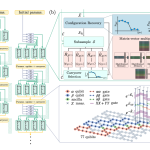
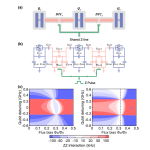
Quantum computing and quantum-inspired methods offer promising alternatives. This review surveys advances at the intersection of quantum computing, quantum algorithms, machine learning, and tensor network techniques for CFD. The work discusses the use of Variational Quantum Eigensolver (VQE) algorithms for solving linear systems, demonstrating potential speedups compared to classical iterative methods. Furthermore, it explores quantum machine learning techniques, specifically quantum neural networks, for turbulence modelling and surrogate modelling, aiming to reduce computational cost while maintaining accuracy. The review also investigates tensor network methods, such as the Multi-scale Entanglement Renormalisation Ansatz (MERA), as a means to efficiently represent and simulate high-dimensional fluid flows. The study demonstrates that these quantum-inspired methods offer significant improvements in both memory usage and runtime. Experiments with Tensor Networks yielded particularly striking results, achieving a 103 reduction in runtime and a 106 reduction in memory consumption when compared to dense solvers.
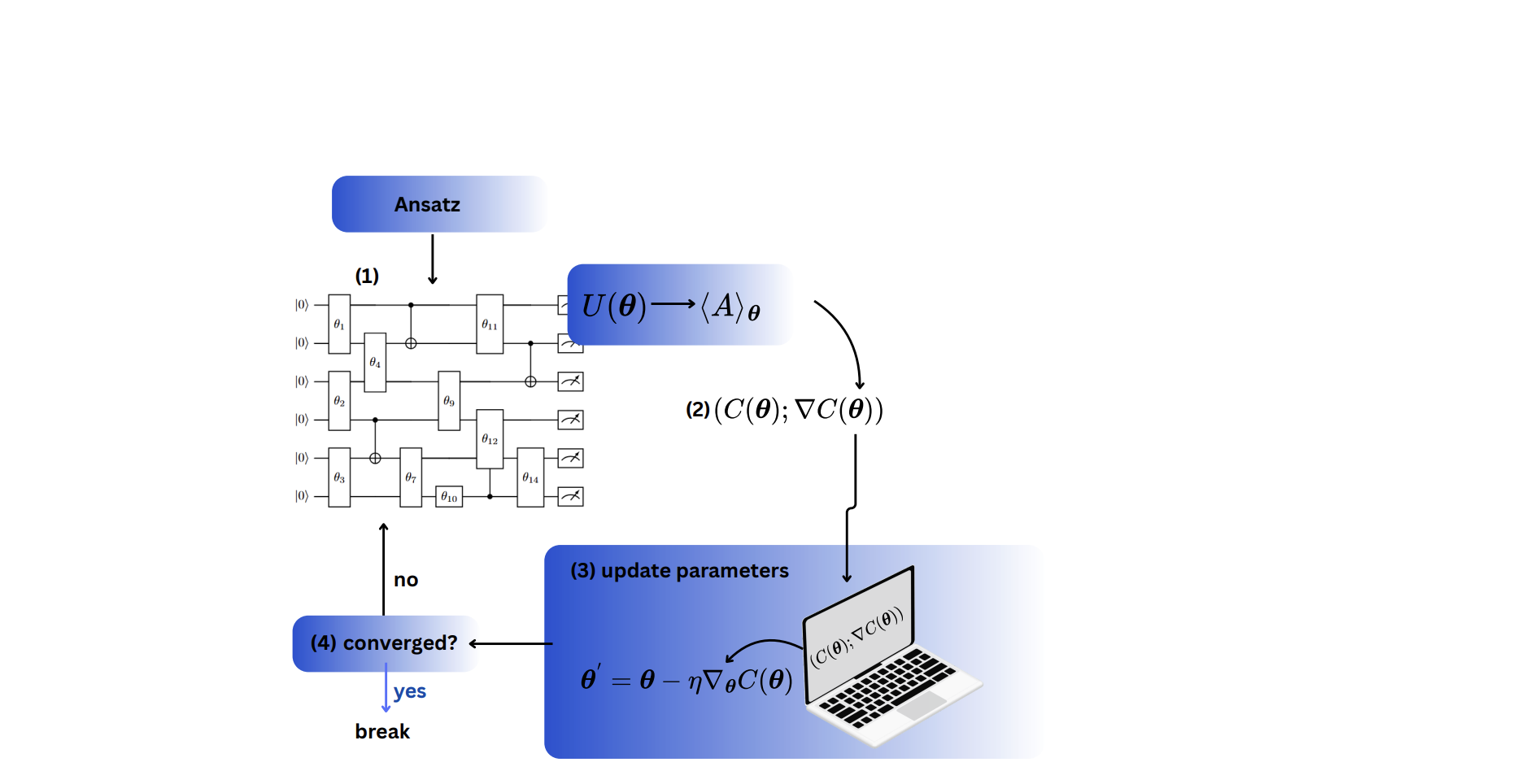
Further validation showed that TN-based solvers delivered 97% compression and up to a 17-fold increase in speed, consistently outperforming Finite Element, Finite Volume, and Finite Difference methods in comparative tests. The research details how physical fields are mapped onto tensor structures, enabling efficient simulations, especially in high-resolution domains. VQAs, employing hybrid quantum-classical optimization, were also explored, utilizing parameterized quantum circuits to prepare states and delegating parameter optimization to classical computers. This approach circumvents hardware limitations and leverages established optimization tools. The team constructed cost functions based on expectation values of observables, simplifying readout and leveraging the exponential capabilities of quantum systems. The team showcases how these approaches offer strategies for improving the efficiency of CFD solvers, particularly when dealing with complex, high-dimensional problems like turbulent flows. Results indicate that tensor networks, originally developed for many-body systems, can achieve substantial reductions in both memory usage and runtime while maintaining acceptable accuracy, even when implemented on classical hardware. The study highlights a pragmatic approach to overcoming current limitations, acknowledging that fully quantum solutions remain beyond reach in the current era of noisy intermediate-scale quantum technology.
Instead, the team focuses on quantum-inspired methods, which
Instead, the team focuses on quantum-inspired methods, which leverage the representational efficiency of quantum concepts within classical computing frameworks. These techniques complement existing numerical methods, such as finite element, finite volume, and finite difference methods, and offer immediate benefits in terms of computational speed and memory efficiency. The most promising near-term strategy involves developing hybrid algorithms that combine tensor network compression with established numerical schemes and modern hardware acceleration, paving the way for a transition toward quantum-inspired computing paradigms.
🗞 Quantum machine learning and quantum-inspired methods applied to computational fluid dynamics: a short review
🧠 ArXiv: https://arxiv.org/abs/2510.14099