Quantum error correction remains a significant hurdle in the development of practical quantum computers, as maintaining the integrity of quantum information is incredibly challenging. Yariv Yanay from the University of Maryland, alongside colleagues, now demonstrates a novel approach to designing better error-correcting codes by integrating classical and quantum computing. Their research builds upon the Quantum Lego formalism, a method for constructing codes from fundamental building blocks, and employs reinforcement learning to automate the code generation process. This work is particularly noteworthy as it utilises commercial quantum devices to search for codes tailored to specific hardware limitations and induced errors, representing a crucial step towards fault-tolerant quantum computation. By combining the strengths of both classical and quantum algorithms, the team hopes to accelerate the discovery of robust and efficient error correction strategies.
Their research builds upon the Quantum Lego formalism, a method for constructing codes from fundamental building blocks, and employs reinforcement learning to automate the code generation process. This work is particularly noteworthy as it utilises commercial quantum devices to search for codes tailored to specific hardware limitations and induced errors, representing a crucial step towards fault-tolerant quantum computation.
Blocks of digital quantum computation necessitate robust error correction, and the Quantum Lego formalism offers a systematic method for constructing new stabilizer codes from fundamental building blocks. Previous research has demonstrated the use of this formalism to generate improved error correcting codes through an automated reinforcement learning process. This work extends that research by showcasing the application of a hybrid classical-quantum algorithm, further advancing the field of quantum error correction and scalable quantum computing.
Reinforcement Learning for Hardware-Aware Code Discovery
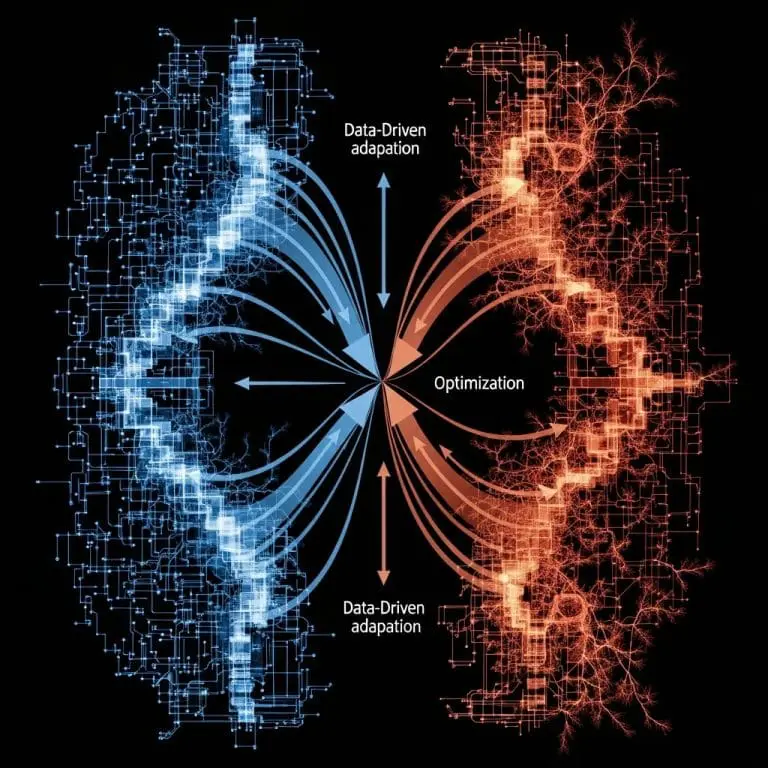
The study pioneered a hybrid classical-quantum algorithm to discover quantum error correcting codes tailored to specific hardware limitations. Building upon the Quantum Lego framework, which represents codes as tensors enabling systematic construction through concatenation, the researchers moved beyond purely classical approaches to code evaluation. Their work leverages reinforcement learning, framing code construction as a game where an agent iteratively builds codes by adding and contracting tensor building blocks, aiming to maximise a defined reward.
This process allows the algorithm to efficiently search the vast space of possible quantum error correction codes. Crucially, the team innovated by integrating calls to commercial quantum devices, Quantinuum’s trapped ion processor and IBM’s superconducting chip, into the reward function assessment. Previously, code utility was evaluated classically, a computationally intensive task. Now, the quantum devices directly assess a code’s response to both native device noise and intentionally induced photon loss, providing a natural and efficient metric for performance. The experimental setup involved preparing qubits in a logical state, encoding Pauli operators, and then benchmarking the resulting circuit performance via stabilizer measurements.
The research employed the QL formalism, identifying tensors representing the encoding map of a QECC, where logical and physical qubits are related through tensor contractions. These tensors, acting as ‘lego’ blocks, are combined to create larger codes, inheriting symmetries and adhering to specific constraints. The team’s reinforcement learning routine uses this framework to learn new stabilizer codes, prioritising outcomes like codes protecting against biased noise through a carefully designed reward function. This approach circumvents the exponential complexity of classically calculating code distance and logical error rates. To quantify performance, the study details a procedure for calculating uncorrected error rates directly on the quantum hardware.
Beginning with an initial logical qubit state, the algorithm encodes Pauli operators and then measures the resulting stabilizers to determine the error rate. This direct quantum measurement of the error rate, combined with the classical reinforcement learning loop, represents a significant methodological advance, enabling the search for effective error correction even on devices operating below the conventional error-correction threshold. The technique reveals the potential for optimising QECCs for specific quantum platforms, paving the way for more robust and scalable quantum computation.
Optimal Pauli Correction via Hybrid Algorithm
Scientists have achieved a significant breakthrough in quantum error correction by implementing a hybrid classical-quantum algorithm that leverages both reinforcement learning and commercial quantum devices. The research team systematically constructed new stabilizer codes using the Quantum Lego formalism, automating the process of generating improved error correcting codes tailored to specific device characteristics and induced loss errors. This work does not perform error correction within the quantum machine, but instead focuses on identifying the optimal logical Pauli correction to maximize the recovery of the initial logical state from a final, potentially corrupted state.
Experiments involved collecting data sets comprising initial logical states, measured syndromes, and final logical states, assigning a logical Pauli correction to each syndrome to return the maximum number of runs to the correct initial state. The team quantified performance using pND, the rate of uncorrected errors to total runs, and sought to minimize this value through the learning process. For example, analysis of a simple two-qubit code revealed specific output distributions for various initial states, with |+X⟩ yielding 27.3% for 00, 28.0% for 01, 1.8% for 10, and 0.8% for 11, while |+Y⟩ and |+Z⟩ exhibited distinct distributions. These measurements were crucial in determining the effectiveness of the chosen correction strategies.
Results demonstrate that the learning process, initially tested with the STIM simulator, successfully generated optimal codes for both isotropic noise (Pr(X) = Pr(Y) = Pr(Z) = 0.01) and biased noise (Pr(X) = Pr(Y) = 0.01, Pr(Z) = 0.05), reducing qubit error by 97% and 85% respectively. Further implementation on Quantinuum’s H1-1 trapped ion system and IBM’s superconducting heavy-hex system allowed for evaluation on real quantum hardware. The team observed that, due to the natural error rates exceeding the error correction threshold on these devices, the optimal code consistently converged to a two-qubit solution. To further refine the process, a code distance minimization stage was appended to the classical learner for the IBM machine, prioritizing stabilizers with the shortest inter-qubit distance.
By employing a skewed reward function to simulate higher-fidelity quantum computers, scientists were able to demonstrate the potential for this hybrid approach to generate increasingly robust and effective error correction codes, paving the way for more reliable quantum computation. The work confirms the feasibility of automating stabilizer code design, adapting to the unique constraints of specific quantum architectures.
Automated Code Discovery via Quantum Reinforcement Learning
Researchers have demonstrated a hybrid classical-quantum algorithm for discovering quantum error correcting codes. Building upon the Quantum Lego framework, which constructs codes from basic tensor building blocks, the team integrated classical reinforcement learning with evaluations performed on commercial quantum computers. This approach allows for the automated search for stabilizer codes tailored to specific device characteristics and induced error types, moving beyond purely classical evaluation methods.
The study successfully implemented a system where a classical reinforcement learning agent designs candidate codes, and a quantum computer assesses their performance by measuring error rates. This represents a significant step towards practical quantum error correction, as calculating these rates is computationally demanding for classical computers but more readily achievable with quantum hardware. The authors acknowledge limitations in the current scale of quantum devices and the complexity of evaluating code distance, which remains a classically intensive process. Future work will focus on refining the algorithm and exploring more sophisticated reward functions to further optimise code performance. They also suggest investigating the potential of this hybrid approach with larger and more capable quantum processors, which could unlock the discovery of even more effective error correction strategies. This research offers a promising pathway for developing robust quantum computation by leveraging the strengths of both classical and quantum computing paradigms.
👉 More information
🗞 Learning Better Error Correction Codes with Hybrid Quantum-Assisted Machine Learning
🧠 ArXiv: https://arxiv.org/abs/2601.08014