

Solving and optimising differential equations underpins countless advances in science and engineering, and researchers continually seek faster, more efficient computational methods. Evan Philip, Julius de Hond, and Vytautas Abramavicius, along with colleagues at Pasqal, now demonstrate a significant step forward with the first experimental realisation of both differentiable circuits and quantum extremal learning. These techniques offer a novel approach to solving differential equations by creating machine-learnable approximations of solutions, and crucially, can identify extreme points within those solutions without requiring a full calculation. The team challenges the conventional expectation that these methods demand digital hardware, successfully implementing a closed-loop system on a commercial analog computer based on neutral atom technology, opening new avenues for rapid solution finding in complex systems.
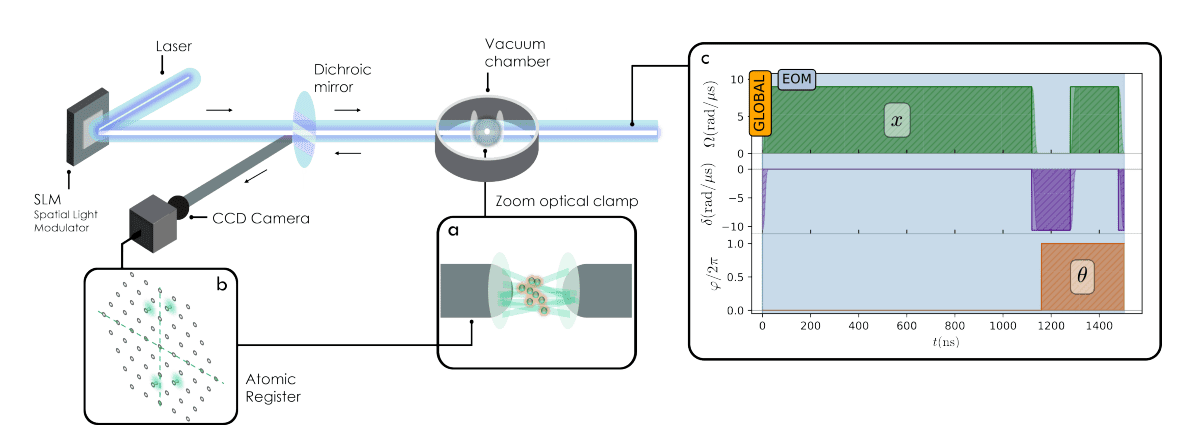
This work directly addresses the challenge of solving and optimizing differential equations, a cornerstone task in numerous scientific and engineering disciplines. The team harnessed a NA-QPU, utilizing individual Rubidium-87 atoms trapped and manipulated with laser-based optical tweezers, to perform analog quantum computations. This platform allows for flexible qubit arrangements and supports multiple computational modes, moving beyond traditional digital quantum computing paradigms.
Researchers constructed quantum circuits representing the solution to a differential equation and then employed specialized differentiation rules to compute gradients, facilitating the implementation of DQC. This allowed the output of parameterized quantum circuits to serve as a surrogate for the solution. Furthermore, the team successfully implemented QEL, a technique that identifies the extreme points of the learned model’s output without requiring an explicit solution. This work challenges the assumption that DQC and QEL require digital quantum hardware. By performing the computations on an analog NA-QPU, the study demonstrates the feasibility of these techniques on currently available quantum technology. This innovative approach opens new avenues for exploring scientific machine learning on quantum computers and offers a pathway towards solving complex differential equations with enhanced efficiency.
Neutral Atom Quantum Computing for Differential Equations
Scientists have demonstrated a successful hybrid classical-quantum approach to solving differential equations. The research team adopted an analog computing approach, leveraging the native analog operations of the NA-QPU to perform a closed-loop instance of both DQC and QEL. The team successfully solved and maximized a differential equation, invoking quantum hardware to perform the calculations. This work demonstrates the feasibility of implementing variational quantum algorithms on a digital-analog quantum computer, moving beyond the traditional quantum circuit model. The results confirm the potential of combining analog and digital approaches for tackling complex scientific problems and open new avenues for exploring quantum machine learning techniques on near-term quantum hardware.
Differentiable Quantum Circuits and Extremal Learning Demonstrated
Scientists have achieved the first experimental demonstration of both differentiable circuits (DQC) and quantum extremal learning (QEL), displaying their performance on a synthetic use case. The study utilized an NA-QPU based on individual Rubidium-87 atoms trapped and manipulated using laser-based optical tweezers. This platform supports flexible qubit topologies and operates in a ground-Rydberg qubit basis with global analog control. Researchers adapted algorithmic protocols, including the construction of an appropriate feature map and differentiation of the quantum circuits, to suit the analog implementation. Results indicate that the learned solution closely approximates the analytical solution, with the identified extremum exhibiting reasonable accuracy.
Learning Solutions with Neutral Atom QPU
Scientists have successfully implemented both differentiable circuits and quantum extremal learning on a neutral atom quantum processing unit. Researchers engineered pulses on this device to natively solve a differential equation and identify its extrema, employing variational methods with differentiable quantum circuits and quantum extremal learning protocols. The experiment focused on a first-order ordinary differential equation defined on a one-dimensional domain, showcasing the potential of these techniques for representing solutions to differential equations. Furthermore, the team highlighted the possibility of multiplexing these experiments using the large registers available in neutral atom systems, potentially reducing the number of required measurements. Future work will likely focus on implementing gradient descent optimization to replace the current grid search method, and exploring the benefits of open-loop control for improved efficiency.
👉 More information
🗞 Experimental differentiation and extremization with analog quantum circuits
🧠 ArXiv: https://arxiv.org/abs/2510.20713

