

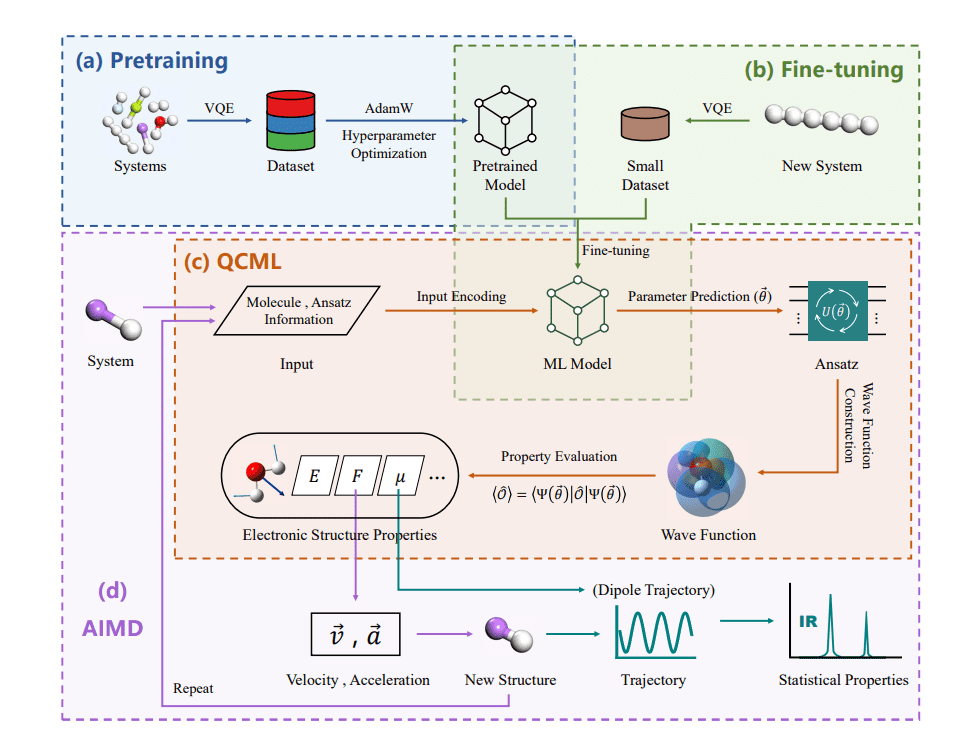
Predicting the behaviour of molecules accurately and efficiently remains a significant challenge in modern chemistry and materials science, demanding enormous computational resources. Yanxian Tao, Lingyun Wan, and Xiongzhi Zeng, along with their colleagues, have developed a new approach, quantum-centric machine learning, that tackles this problem by combining the power of quantum circuits with modern deep learning techniques. Their method learns to predict molecular wavefunctions and properties directly, bypassing the need for computationally expensive calculations at each step of a simulation. This innovative hybrid framework achieves remarkable accuracy in predicting key molecular characteristics, such as energy and forces, and opens the door to performing efficient molecular dynamics simulations with unprecedented speed and scalability, promising to accelerate discoveries in chemistry and materials science.
Transformers Accelerate Variational Quantum Eigensolver Calculations
Scientists are tackling a major challenge in quantum chemistry: the immense computational cost of accurately simulating molecules. This research introduces a new approach that uses machine learning, specifically Transformer models, to predict the optimal settings for Variational Quantum Eigensolver (VQE) calculations, dramatically reducing the need for computationally intensive quantum computations. The team focused on developing a system that could learn the relationships between a molecule’s structure and the parameters needed to accurately calculate its energy. By training a Transformer model on a large dataset of molecular properties, they created a system capable of predicting these parameters with high accuracy, significantly speeding up calculations and enabling simulations of larger molecules.
Detailed analysis revealed the importance of specific model settings, such as the number of attention heads and layers within the Transformer, in achieving optimal performance. The results demonstrate that the machine learning model accurately predicts the potential energy surfaces of several molecules, achieving a level of accuracy comparable to highly sophisticated methods. Furthermore, the team showed that initializing VQE calculations with the parameters predicted by the machine learning model drastically reduces the time required to reach a solution, representing a significant advancement in the efficiency of quantum chemistry calculations.
Predicting Molecular Wavefunctions with Quantum Transformers
Scientists have developed a novel quantum-centric machine learning (QCML) model that combines the strengths of quantum computing and machine learning to predict molecular wavefunctions and properties. This hybrid approach overcomes the computational limitations of traditional quantum chemistry methods by directly predicting parameters for parameterized quantum circuits using Transformer-based neural networks. The team constructed a comprehensive dataset encompassing six molecules and five different wavefunction ansatzes, providing a diverse training ground for the machine learning model. The Transformer network learns to relate molecular descriptors, such as the molecule’s name and internal coordinates, to the parameters defining the parameterized quantum circuit, significantly reducing the computational cost of calculations.
Experiments demonstrate that the hierarchical training strategy, involving pretraining on a diverse dataset and then fine-tuning for specific systems, eliminates the need for retraining from scratch and ensures rapid convergence. The model accurately predicts potential energy surfaces, atomic forces, and dipole moments across multiple molecules and ansatzes, achieving chemical accuracy in these key properties. The researchers addressed an imbalance in prediction error by weighting the loss function, improving training stability and preventing overfitting, paving the way for next-generation molecular simulation and chemistry applications.
Predicting Molecular Wavefunctions with Transformers
Scientists have introduced a new QCML framework that leverages a pretrained Transformer model to predict parameters defining molecular wavefunction ansatzes, streamlining the calculation of key electronic structure properties. This innovative approach bypasses the computationally expensive iterative optimization typically required in variational quantum eigensolver calculations, significantly reducing the number of quantum measurements needed and lowering the overall computational cost of molecular simulations. The researchers acknowledge that the overall error within the QCML framework stems from both the inherent approximations within the chosen wavefunction ansatz and the accuracy of the Transformer’s parameter predictions. They addressed this by weighting the loss function, improving training stability and preventing overfitting. This integration allows for the analytical calculation of atomic forces and the prediction of infrared spectra from time-dependent dipole moments, establishing a fully differentiable pipeline for ab initio molecular modeling and quantum-enabled spectroscopy. While the study demonstrates successful extension to new molecular systems through fine-tuning, ongoing work focuses on further enhancing the generalization capability of the QCML framework.
👉 More information
🗞 Quantum-centric machine learning for molecular dynamics
🧠 ArXiv: https://arxiv.org/abs/2511.07771