Maintaining reliable production equipment represents a significant challenge in modern manufacturing, often relying on human expertise to identify subtle anomalies. Takao Tomono from Keio University and Kazuya Tsujimura from TOPPAN Holdings Inc, alongside their colleagues, investigate a new approach to automated anomaly detection using quantum machine learning. Their research addresses the increasing computational demands of monitoring large numbers of machines, exploring whether quantum kernels can outperform traditional methods in classifying abnormal sounds. The team demonstrates a substantial improvement in accuracy and reliability using their quantum approach, successfully identifying both consistent, periodic anomalies and sudden, impulsive faults in experimental setups involving miniature racing cars and open-belt drives. These findings suggest a pathway towards more efficient and robust predictive maintenance systems, reducing downtime and improving overall manufacturing productivity.
Quantum Kernels Detect Industrial Machine Anomalies
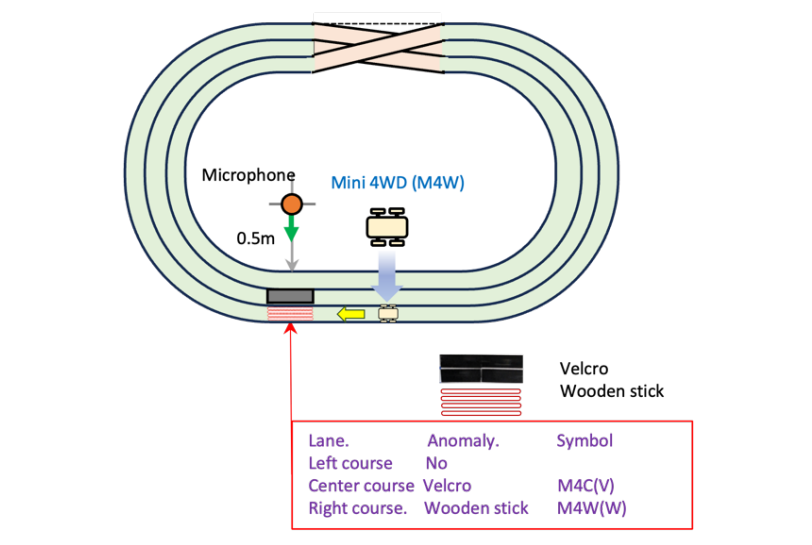
This study pioneered a quantum kernel-based anomaly detection method, addressing limitations in traditional machine learning approaches for industrial maintenance. Recognizing the increasing complexity of monitoring numerous machines, researchers moved beyond reliance on extensive sensor networks and computationally expensive models, instead focusing on mimicking human operators’ ability to identify anomalies through auditory perception. The core of their innovation lies in substituting classical kernels within one-class support vector machines with quantum kernels, enhancing feature expressiveness for improved anomaly detection. To create robust datasets for testing, the team engineered two distinct experimental setups: a miniature racing car track and an open-belt drive system.
The car track incorporated wooden sticks and hook-and-loop fastener strips to generate abnormal noises as the car passed over them, while the open-belt drive utilized wooden chopsticks strategically inserted into rotating belts to simulate sudden crushing sounds. Data acquisition involved recording five-minute audio streams from each setup, subsequently segmented into ten-second intervals, yielding thirty samples of normal operation for each system. This meticulous approach to data creation allowed for controlled experimentation and rigorous evaluation of the proposed quantum kernel method. Features were extracted from the audio recordings using autoregressive (AR) model coefficients, providing a compact representation of the sound characteristics.
The team then compared the performance of the quantum kernel-based one-class SVM to a conventional model utilizing a Gaussian kernel. Results demonstrated a significant advantage for the quantum kernel approach, achieving an accuracy and F1-score of 0. 82 on the miniature car track dataset, compared to 0. 64 and 0. 39 respectively for the Gaussian kernel.
Even more impressively, the quantum kernel achieved perfect accuracy and F1-score (1. 00) on the crushing device dataset, while the Gaussian kernel only reached 0. 64 accuracy and 0. 43 F1-score. These findings suggest that quantum kernels effectively enhance classification accuracy for diverse types of abnormal sound patterns, including both periodic and impulsive anomalies, paving the way for more robust and reliable industrial anomaly detection systems.
Quantum Kernels Detect Manufacturing Anomalies Accurately
This research demonstrates a novel approach to anomaly detection in manufacturing equipment, employing quantum kernels within a one-class support vector machine model. The team successfully applied this method to two experimental setups, a miniature racing car track and an open-belt drive, generating distinct abnormal sounds to simulate equipment malfunctions. Results clearly show that the quantum kernel classifiers outperform traditional Gaussian kernel methods in accurately identifying anomalies. Specifically, the quantum kernel achieved accuracy and F1-scores of 0. 82 on the car track dataset, significantly higher than the 0.
64 and 0. 39 respectively obtained with the Gaussian kernel. Perfect accuracy and F1-scores were also achieved on the open-belt drive dataset, compared to 0. 64 and 0. 43 for the Gaussian kernel.
These findings suggest that quantum kernels are capable of inducing feature space geometries that enhance the discrimination of complex anomaly patterns, offering improved performance over classical kernel methods. The researchers acknowledge certain limitations, including the potential for false negatives when anomaly types share similar acoustic signatures and the possibility that the 10-second data segmentation may miss longer-term degradation patterns. They also note that laboratory conditions may not fully reflect the complexities of real-world factory environments. Future work will focus on developing more robust quantum kernels for noisy environments and exploring methods to explicitly distinguish between different anomaly types within a unified model, moving towards the realization of quantum-enhanced smart factories.
🗞 Potential of multi-anomalies detection using quantum machine learning
🧠 ArXiv: https://arxiv.org/abs/2510.07055