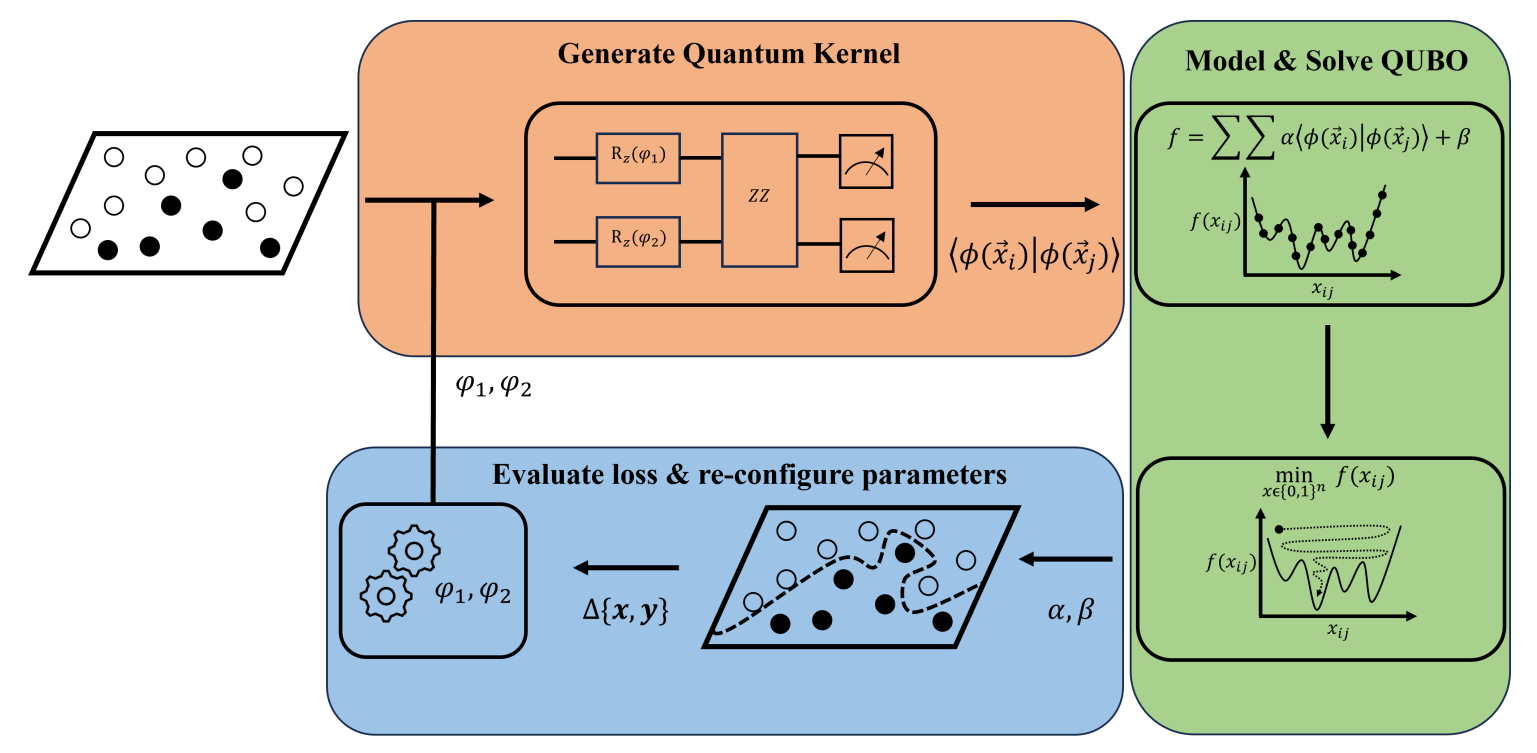
Machine learning promises substantial advances over traditional computational methods, but current computer limitations hinder its full potential. Juan C. Boschero, Ward van der Schoot, and Niels M. P. Neumann, all from The Netherlands Organisation of Applied Scientific Research (TNO), investigate a novel approach to overcome these challenges by integrating different computing paradigms. Their work introduces a triple-hybrid quantum support vector machine that combines classical computation with both gate-based quantum models and quantum annealing hardware. This innovative system achieves higher precision than existing support vector machines on complex datasets, and importantly, converges more rapidly, requiring fewer computational steps, demonstrating a significant step towards more efficient and powerful machine learning algorithms.
Quantum Algorithms for Machine Learning and Optimisation
This collection of research explores the rapidly evolving field of quantum computing and its application to machine learning and optimisation problems. Studies focus on harnessing the unique capabilities of quantum systems to accelerate and improve algorithms used in diverse areas. A central theme is the development of Variational Quantum Algorithms (VQAs), which combine quantum and classical computation to tackle complex challenges. Researchers are investigating the implementation, optimisation, and limitations of VQAs, including techniques like the Variational Quantum Eigensolver (VQE). The potential of quantum annealing, utilising specialised hardware, is also being explored for solving optimisation problems, with comparisons to traditional gate-based quantum computing approaches.
Furthermore, investigations into Quantum Support Vector Machines (QSVMs) demonstrate their potential for enhancing classification tasks. Many studies emphasise hybrid quantum-classical algorithms, combining the strengths of both computational paradigms. Researchers are also refining optimisation techniques used within quantum algorithms, including derivative-free optimisation and applying the Karush-Kuhn-Tucker (KKT) conditions. The research extends to the underlying hardware and software infrastructure, with software development kits being key tools for development. Investigations explore architectures for distributed quantum computing, connecting multiple quantum processors, and techniques for mitigating and correcting errors inherent in quantum computations.
Applications span diverse areas, including classification problems, optimisation challenges like drone routing, and specific use cases such as indoor-outdoor detection in mobile networks and financial modelling. The research builds upon fundamental principles of linear algebra and quantum mechanics, and leverages concepts from optimisation theory, including gradient descent and KKT conditions. Complexity analysis is also employed to assess the efficiency of quantum algorithms. This body of work provides a comprehensive snapshot of current research, highlighting both the potential and the challenges of integrating quantum computing with machine learning, and paving the way for future advancements in the field.
Hybrid Quantum Support Vector Machine Implementation
This study introduces a novel triple-hybrid quantum support vector machine, integrating quantum annealing hardware, gate-based quantum computation, and classical processing to improve data classification performance. Researchers implemented a quantum kernel using a gate-based quantum model, constructing a complex feature map to transform input data into a higher-dimensional quantum state suitable for classification. This quantum kernel forms the core of the support vector machine, enabling the algorithm to handle complex, non-linearly separable datasets. The resulting classification problem was then formulated as a quadratic unconstrained optimisation problem, specifically designed for execution on quantum annealing hardware.
Crucially, the study doesn’t rely solely on quantum computation; researchers evaluated the resulting losses on classical hardware and iteratively refined the model parameters, creating a synergistic hybrid approach. To assess performance, the triple-hybrid support vector machine was tested on three distinct datasets. The system achieves higher precision than both classical and other quantum support vector machines when classifying complex data, demonstrating the benefits of the hybrid approach. For these complex datasets, the triple-hybrid version converges faster, requiring fewer circuit evaluations than traditional methods. The study highlights that while the system excels with complex data, performance varies on simpler classical datasets, particularly when limited training data is available. This research represents a significant step towards harnessing the combined power of different computing paradigms for advanced machine learning applications.
Triple-Hybrid Quantum Support Vector Machine Excels
Scientists developed a novel triple-hybrid quantum support vector machine that combines quantum and classical computing resources to enhance data classification. This work explores the potential of integrating different computational paradigms to tackle complex machine learning tasks, specifically focusing on improving performance for challenging datasets. The team implemented a quantum kernel using a gate-based quantum model and a complex feature map, then formulated a quadratic unconstrained optimisation problem to be solved on quantum annealing hardware. Experiments demonstrate that the triple-hybrid system achieves higher precision than both quantum and classical support vector machines when classifying complex data.
For these datasets, the new approach converges faster, requiring fewer circuit evaluations to reach a solution. The researchers tested the system on three different datasets, revealing that the triple-hybrid model excels at classifying complex data while exhibiting varying performance on simpler, classical data with limited training. The results show that the quantum kernel effectively maps data to a higher-dimensional feature space, enabling linear separation even for non-linearly separable datasets. Furthermore, the team leveraged a feature map that exploits the norm of the original data points, enhancing the ability to achieve linear separation in the feature space. This innovative approach combines the strengths of quantum and classical computing, delivering a significant advancement in machine learning capabilities for complex data analysis.
Hybrid Quantum Support Vector Machine Achieves Gains
This research demonstrates a novel hybrid quantum support vector machine (HQSVM) that integrates quantum gate-based computing, quantum annealing, and classical computation to improve data classification. Benchmarking against quantum and classical methods using a quantum dataset reveals that the HQSVM requires fewer iterations to accurately classify data and establishes reliable classification boundaries with reduced training data. The team observed that the HQSVM also approximated complete classification maps more efficiently than both purely quantum and classical support vector machines. However, performance varied depending on the dataset, with the HQSVM not consistently outperforming other methods on non-quantum, real-world data.
While the HQSVM showed improved performance on a banknote authentication dataset, results remained modest, and it performed worse than classical and quantum methods on a breast cancer dataset. The researchers attribute these variations to the structure of the data, suggesting that datasets with inherent periodicity benefit most from this approach, and to inefficiencies in the annealing phase of the algorithm. Future work will focus on exploring these factors further, potentially incorporating additional features and larger datasets to refine the model. The authors acknowledge that current limitations in seamlessly integrating the three computational paradigms necessitate the use of simulations, which are computationally expensive. Realising the potential time-based performance gains of this algorithm requires a tightly coupled hardware infrastructure capable of supporting all three technologies. Despite these challenges, this work represents a significant step towards harnessing the combined power of different computing paradigms for complex classification tasks.
🗞 A Triple-Hybrid Quantum Support Vector Machine Using Classical, Quantum Gate-based and Quantum Annealing-based Computing
🧠 ArXiv: https://arxiv.org/abs/2511.05237