Scientists are increasingly investigating how to reconcile general relativity with quantum mechanics, and loop quantum gravity presents a promising theoretical framework. Mikhail Altaisky from the Space Research Institute RAS, alongside co-authors, address a fundamental conceptual challenge within this theory: defining spacetime itself when it originates from a matter-free Einstein-Hilbert action. Their research, detailed in a new paper, reformulates loop quantum gravity by exclusively utilising matter fields, following Penrose’s concept of combinatorial spacetime. This innovative approach potentially resolves the longstanding issue of spacetime’s ontological status within the loop quantum gravity framework and offers a novel pathway towards a complete quantum theory of gravity.
Spacetime geometry derived from relativistic matter field networks via combinatorial principles
Loop quantum gravity receives a significant reformulation with a new approach focusing on matter fields. Researchers have successfully constructed a framework where spacetime geometry emerges entirely from the relationships between these fields, addressing a long-standing conceptual challenge within the theory.
This work follows the principles of combinatorial spacetime, initially proposed by Roger Penrose, to redefine loop quantum gravity in a manner solely dependent on matter constituents. The study circumvents the traditional reliance on an initial “pure spacetime” by grounding all metric properties in measurable quantities associated with matter.
This innovative approach utilizes relativistic spin networks of matter fields to achieve a locally Lorentz-invariant realization of Penrose’s combinatorial spacetime. Instead of employing a continuous holonomy operator, commonly found in loop quantum gravity, the research introduces a Regge-like discretization.
This discretization concentrates all curvature effects at the interaction vertices of a graph, offering a novel method for defining spacetime geometry. The core of this development lies in defining direction and angle within non-relativistic quantum mechanics through the collective behaviour of multiple spin-ħ/2 particles.
The research demonstrates that direction can only be meaningfully defined when considering blocks of matter possessing sufficiently high total spin. By operationally comparing the directions of these blocks through qubit transfer, researchers establish a method for estimating angles between them as rational probabilities.
This process, represented diagrammatically as spin networks, effectively eliminates time as a fundamental parameter, relying solely on the angular momentum operator and Planck’s constant. The resulting framework provides a means to quantify spatial relationships based on the interactions and correlations between matter particles, potentially offering new insights into the quantum nature of gravity and its connection to matter content.
Discretisation of the Einstein-Hilbert action using Ponzano-Regge spin networks
Spin networks, initially conceived as quantum schemes for manipulating blocks of spin-ħ/2 particles, form the core of this work’s methodology. These networks graphically represent transformations on particles adhering to SU group representations, ensuring angular momentum conservation at each vertex, or intertwiner.
A spin network S = (Γ, jl, nr) comprises a graph Γ, edges {jl} labelled by Lie group G representations, and vertices {nr} forming a singlet with connected edges. Each edge connecting vertices is associated with a group element gij, where gij equals the inverse of gji. The research extends the original Penrose spin network concept by linking it to the Einstein-Hilbert action through a discrete summation over tetrahedra.
This Ponzano-Regge approach approximates the continuous gravitational action with a sum SPonzano−Regge = X tetrahedra 6X i=1 θi ji + 1 2, calculated across triangulations of a 3-manifold. Edge lengths li, taken in small units, are related to spin indices ji via the angle θi between outward-facing normals.
The methodology innovatively moves beyond purely mathematical constructs, assigning physical meaning to these spin indices as representations of length. To transition from a metric-based description to a connection-based one, the study employs tetrads eI μ to relate the metric gμν(x) to the Minkowski metric ηIJ, expressed as gμν(x) = eI μ(x)eJ ν (x)ηIJ.
Parallel transport is then defined using a covariant derivative DeI = deI + ωI J ∧eJ, incorporating a spin-connection ωI J. The Einstein-Hilbert action is reformulated using the complex-valued Ashtekar connection AIJ μ, derived from ω, resulting in a gauge theory form S[e, A] = 1 16πG Z d4xeμIeνJF IJ τσ [A]ǫμντσ. This transformation casts the quantum state of spacetime as a state of the SL(2, C) connection A, enabling a connectodynamic quantization approach.
Spacetime emergence from relativistic spin networks and qubit transfer correlations
Researchers have developed a locally Lorentz-invariant realization of Penrose’s combinatorial spacetime using relativistic spin networks of matter fields. The work focuses on reformulating loop theory solely in terms of matter fields, addressing a conceptual controversy regarding the definition of spacetime itself.
This approach utilizes matter fields to define all metric properties, moving away from the traditional starting point of pure spacetime in quantization procedures. The study introduces a method for defining direction and angle in non-relativistic quantum mechanics through the correlations of blocks of spin-ħ/2 particles.
For a system of N spin-ħ/2 particles, the maximal spin is ħN/2, resulting in N+1 possible projections of spin. By comparing the directions of large blocks, researchers establish an operational definition based on the interaction of these blocks through the transfer of a single qubit. This qubit transfer between N- and M-blocks yields two possible outcomes: either the M-block becomes an (M+1)-block or a (M-1)-block.
The probability of obtaining the (M+1)-block defines the angle θ between the directions of spins of two blocks, expressed as P(θ) = 1/2(1 + cos θ). Through sufficient repetitions, angles between blocks can be estimated as rational probabilities P = m/n, where m represents successful (M+1)-block outcomes and n is the total number of experiments.
This allows for the introduction of directions only when dealing with blocks of matter particles possessing sufficiently high total spin. Each spin-ħ/2 particle, or qubit, is represented by a solid line, with N-qubit blocks depicted as strands of N such lines, forming the basis for Penrose’s spin networks. The vertex structure within these spin networks ensures angular momentum conservation at each interaction point, adhering to the SU group representations.
Matter fields define spacetime geometry and cosmic evolution
Scientists have developed a construction of spacetime using only matter fields, aligning with a proposal originally made by Roger Penrose. This reformulation of loop theory departs from traditional approaches by beginning with the Einstein-Hilbert action and focusing on matter fields to define spacetime itself.
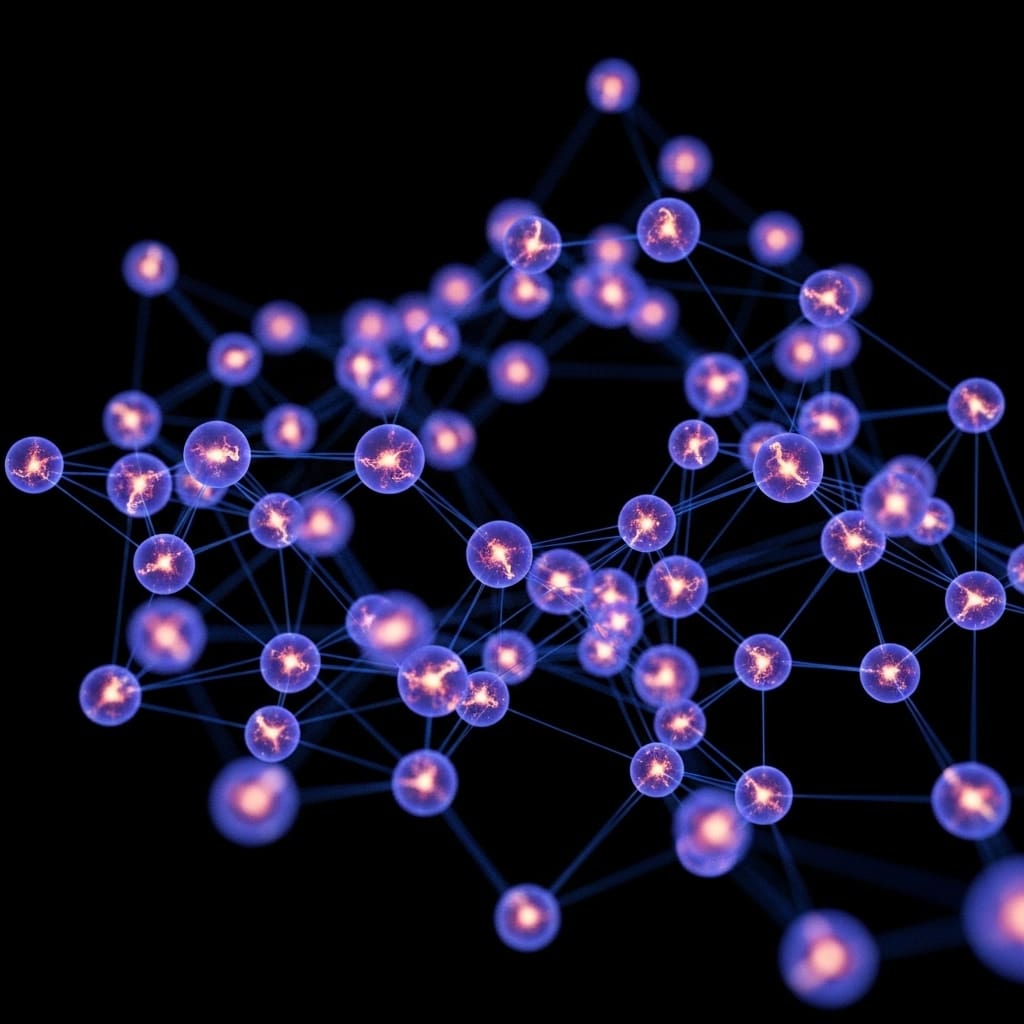
The model represents spacetime as a network where vertices correspond to physical events and edges represent matter fields, effectively creating a world history Feynman diagram. This implementation, based on the Regge idea of attributing spacetime curvature to the vertices of a triangulation graph, differs significantly from conventional loop quantum gravity formulations.
By utilising the triangulation graph directly, rather than its dual, the model offers a physically interpretable framework without inherent preferences for a specific time coordinate. The research suggests a potential for evolution to be governed by the changing number of degrees of freedom within the universe, potentially through a renormalization mechanism.
Simulations of small networks indicate similarities to random surface simulations, and the model allows for the possibility of a universe expanding in all four spacetime directions, with renormalization group coordinates potentially defining cosmological time. The authors acknowledge that the current model does not favour any particular time coordinate, a departure from standard spin network formalism.
Future research will focus on exploring the renormalization group evolution of these matter spin networks, potentially revealing a universe expanding in all four spacetime directions rather than the conventionally understood Friedmann, Lemaître, Robertson, Walker universe. This work establishes a novel approach to quantum gravity, offering a potentially tractable model based on matter fields and paving the way for further investigation into the nature of spacetime evolution.
🗞 Combinatorial Spacetime from Loop Quantum Gravity
🧠 ArXiv: https://arxiv.org/abs/2602.08341