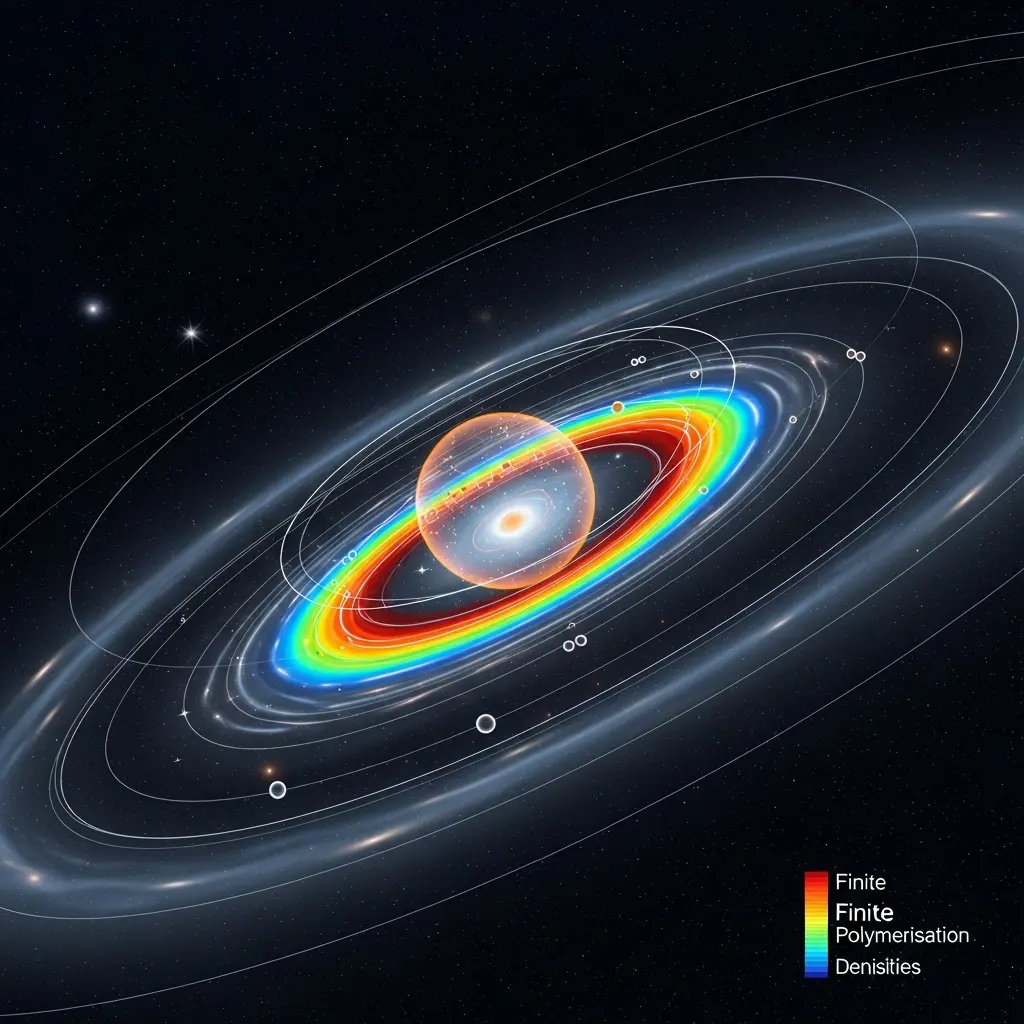
Loop Quantum Cosmology seeks to resolve the singularity at the beginning of the universe, replacing it with a ‘bounce’ to a contracting phase, and recent work by D. A. Cook, A. Olimpieri, and I. P. R. Baranov, alongside H. A. Borges and S. Carneiro, advances this understanding through the application of a specific polymerisation scheme. The team investigates how anisotropic models, representing universes with directional properties, behave under this approach, revealing crucial details about the conditions at the bounce itself. Their calculations demonstrate that the density remains positive throughout the process, while negative pressures successfully prevent the formation of a singularity, and importantly, they establish a link between the minimum possible area at the bounce and fundamental parameters of Loop Quantum Gravity. This research not only confirms the viability of a bouncing universe scenario in anisotropic space-times, but also suggests that singularity avoidance may occur even without the complexities of polymerisation in certain hyperbolic geometries.
leading to its replacement by bouncing surfaces on which the curvature and densities are finite. Their properties depend on the space-time symmetry and on the particular polymerisation scheme adopted. The authors investigate how these techniques can lead to non-singular solutions, replacing the initial singularity with a bounce. Key findings demonstrate that polymerisation acts as a regularization technique, modifying classical equations of motion and introducing a minimum length scale to prevent singularity formation. The study focuses on two specific spacetime geometries, Kantowski-Sachs (KS) and Bianchi III, with KS often used to model black hole interiors and Bianchi III representing a more general cosmological scenario.
Applying polymerisation leads to a bounce at the Planck scale, driven by quantum fluctuations of spacetime. The black hole interior is found to be isometric to Kantowski-Sachs space-times, suggesting a connection between black hole physics and cosmological models within this framework. In the KS model, the bounce is followed by re-collapse unless a positive cosmological constant is introduced, which prevents re-collapse and leads to an asymptotically de Sitter space. In the Bianchi III model, the bounce emerges solely from the LQG minimal area constraint, without requiring any polymerisation procedure.
This suggests a more direct connection between the geometry and the fundamental principles of LQG. The authors associate the bounce with an effective energy-momentum tensor, indicating that the bounce is driven by quantum effects and can be described within the framework of general relativity. This research contributes to the ongoing effort to develop a consistent theory of quantum gravity and to resolve the singularity problems that plague classical general relativity.
Bouncing Cosmologies and Finite Initial Density
This research presents a novel approach to resolving the initial singularity predicted by classical cosmology, replacing it with a bouncing surface where density and curvature remain finite. Scientists investigated anisotropic models using a specific polymerisation scheme, successfully quantising space-times isometric to Kantowski-Sachs (KS) and Bianchi III geometries. For the KS space-time, the calculations reveal a minimum radius of √2/2, alongside a positive density and negative pressures sufficient to avoid the singularity.
The solution exhibits oscillatory behavior, reaching a maximum radius before re-collapse, necessitating the inclusion of a positive cosmological constant to ensure eternal expansion into a late de Sitter phase. Around the bounce, the calculated density is 2, while pressures are -4√2M, demonstrating a repulsive force at the minimal radius. The curvature scalar reaches a finite maximum value of 6√2M at the bounce, decreasing as the space expands. In the Bianchi III space-time, which possesses negative curvature, the calculations show a minimum radius of √2/2, but without the re-collapse observed in the KS space-time. The minimal area condition does not impose constraints on the polymerisation parameter, indicating the bounce arises from the imposition of the LQG area gap rather than the polymerisation procedure itself. These findings demonstrate a pathway to resolving the initial singularity, offering a framework for understanding the very early universe and its evolution.
Singularity Resolution via Polymer Spacetime Models
This research demonstrates that polymerisation techniques, applied to models of spacetime, successfully resolve the singularity predicted at the heart of gravitational collapse. By employing the Gambini-Benítez-Pullin approach, the team replaced the singularity with a bouncing surface possessing finite curvature and density. Calculations reveal that the density at the bounce remains positive, while pressures become negative, preventing further collapse and ensuring a viable spacetime geometry. The study extends this success to anisotropic models, specifically Kantowski-Sachs and Bianchi III spacetimes, confirming the robustness of the approach.
In the Kantowski-Sachs case, the solution exhibits oscillatory behaviour with a tendency towards re-collapse, necessitating the inclusion of a positive cosmological constant to achieve sustained expansion and a late de Sitter phase. Interestingly, the Bianchi III spacetime evolves towards an asymptotically flat state, eliminating the re-collapse scenario. A key finding is that, in the hyperbolic Bianchi III space, the minimal area constraint alone is sufficient to avoid the singularity, independent of the polymerisation procedure itself. This research represents a significant step towards a consistent quantum description of gravity and offers a compelling alternative to the classical singularity theorems.
🗞 Anisotropic models in LQC with GBP polymerisation
🧠 ArXiv: https://arxiv.org/abs/2511.15660