
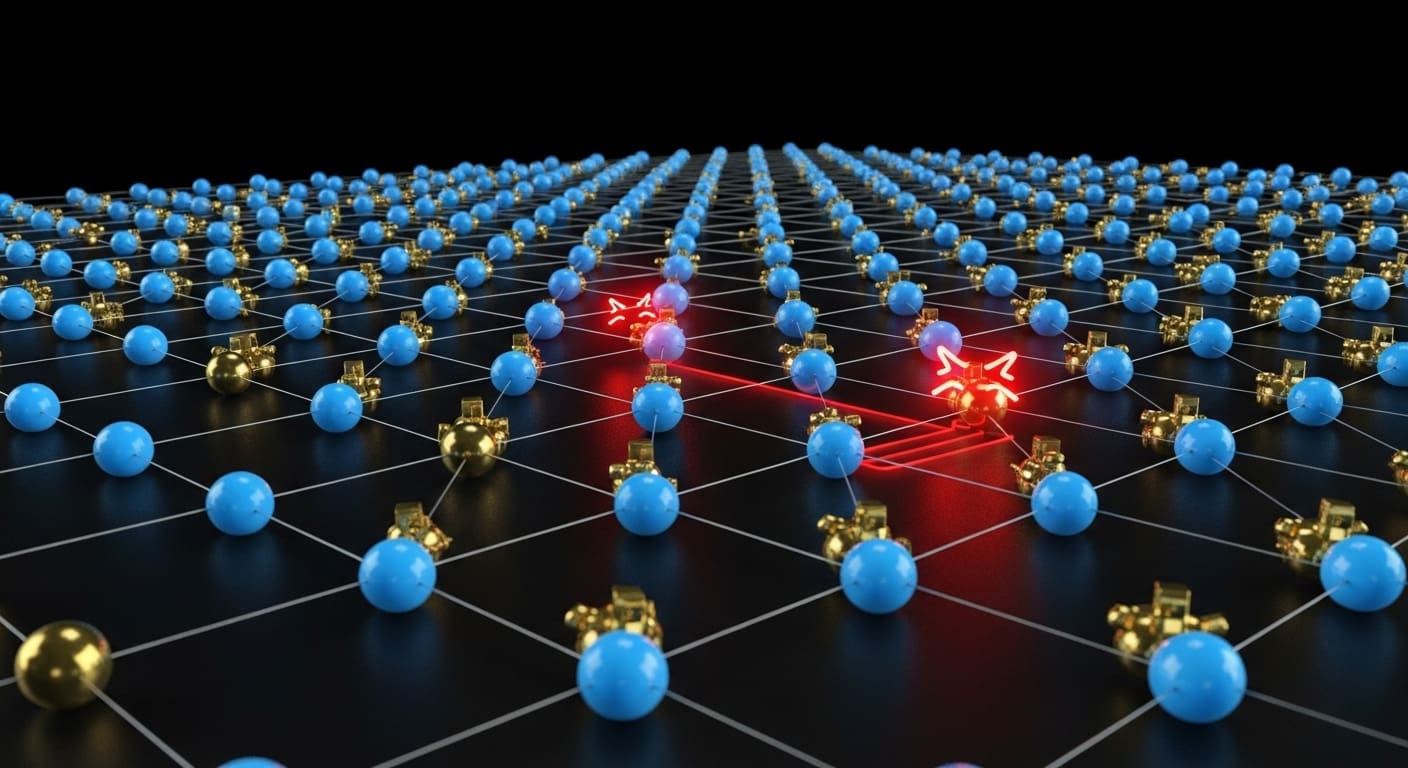
Riki Toshio and colleagues at Fujitsu Limited, in collaboration with The University of Osaka, have presented STAR-magic mutation, a protocol for implementing logical rotation gates on early fault-tolerant quantum computers. The protocol sharply improves upon existing methods by achieving a favourable error scaling and requiring minimal ancillary space, equivalent to a single surface code patch. It demonstrates a two-order-of-magnitude reduction in both execution time and error rate for small-angle rotation gates, and underpins a new quantum computing architecture, “STAR ver.~3”, capable of simulating complex systems, such as biologically-relevant molecules, with a few hundred thousand physical qubits even with realistic error rates.
Reduced error thresholds unlock larger scale quantum simulations
Quantum computation is inherently susceptible to errors arising from the delicate nature of quantum states and imperfections in physical hardware. Analogue rotation gates, which are fundamental to many quantum algorithms, are particularly vulnerable to these errors. Previously, error rates for these gates limited the scale of achievable quantum simulations, especially when the logical rotation angle was less than or equal to 10⁻⁵. The STAR-magic mutation protocol addresses this limitation, achieving a reduction in error rates by a factor of one hundred within this critical angle range. This improvement circumvents the substantial overhead traditionally associated with magic state distillation, a process used to enhance the fidelity of non-Clifford gates. Magic state distillation, while effective, demands significant qubit resources and introduces additional complexity. By minimising the need for extensive distillation, the STAR-magic mutation protocol enables more efficient computation on early fault-tolerant quantum computers, paving the way for larger and more complex simulations.
The protocol’s success stems from a judicious combination of two advanced state preparation techniques: transversal multi-rotation and magic state cultivation. Transversal multi-rotation distributes quantum operations across multiple physical qubits, effectively encoding logical information in a manner that is more resilient to individual qubit errors. This approach contrasts with traditional methods that apply rotations directly to single qubits, which are more susceptible to noise. Magic state cultivation, on the other hand, focuses on preparing highly entangled quantum states known as ‘magic states’. These states are essential for implementing non-Clifford gates, which are necessary for universal quantum computation. The protocol carefully manages the creation and utilisation of these magic states, minimising the accumulation of errors throughout the computation. Consequently, the “STAR ver.~3” architecture can now simulate biologically-relevant molecules with only a few hundred thousand physical qubits, even with a realistic physical error rate of 10⁻³. This represents a significant reduction in the resource requirements compared to previous approaches. Simulations reveal that this architecture can model biologically-relevant molecules using only a few hundred thousand physical qubits, despite a physical error rate of 10⁻³. However, these results currently assume ideal conditions and do not yet demonstrate sustained error correction over extended, complex computations, representing a key hurdle before practical applications become viable. Achieving sustained error correction requires robust quantum error correcting codes and sophisticated control mechanisms to detect and correct errors in real-time. A refined circuit compilation strategy utilises a Clifford+ +
+ gate set, differing from conventional approaches, and allows for more complex calculations, though this introduces architectural considerations.
Reduced gate set limitations versus gains in logical rotation efficiency
Minimising the resources needed to perform complex calculations is crucial for practical quantum computation. The number of qubits, the duration of the computation, and the fidelity of the gates all contribute to the overall cost. The STAR-magic mutation protocol offers a compelling reduction in error and execution time for important quantum operations, specifically logical rotation gates. However, its reliance on a specific gate set, Clifford++, presents a potential bottleneck. Universal quantum computation requires a complete set of gates, but certain gate sets are more amenable to implementation on specific hardware platforms. The Clifford++ gate set, while enabling efficient logical rotations, may not be optimal for all architectures. The paper acknowledges that alternative gate sets, such as those employing only Clifford+ or Clifford+ gates, may offer advantages in certain hardware implementations, raising a critical question of architectural trade-offs. For example, hardware designed for native Clifford gate operations might benefit from a gate set that prioritises these gates, even if it requires more complex decomposition of non-Clifford operations.
The protocol achieves a favourable error scaling of  , where
  represents the logical rotation angle and
  denotes the physical error rate. The parameter d relates to the distance of the surface code used for error correction; a larger d indicates a more robust code but also requires more qubits. This error scaling is particularly significant because it suggests that the error rate can be suppressed more effectively as the logical rotation angle increases. This is crucial for applications that require precise control over quantum states. This advancement enables more complex calculations with fewer physical qubits, despite relying on the Clifford++ gate set, potentially unlocking simulations of molecules and materials currently beyond classical capabilities, even with realistic error rates. Small-angle rotations, important for building complex quantum circuits like those used in materials science, are particularly impacted. Efficient implementation of logical rotation gates, precise adjustments to quantum information on emerging quantum computers, is achieved through this approach. It achieves favourable error scaling and requires minimal ancillary space, equivalent to just one surface code patch. The use of a single surface code patch for ancillary space is a significant advantage, as ancillary qubits represent an overhead in terms of resource consumption. Future research will likely focus on optimising the protocol for different hardware platforms and exploring the potential for further reducing the error rate and resource requirements.
The research demonstrated an efficient method for performing logical rotation gates on quantum computers, achieving an error scaling of and utilising only the space of a single surface code patch. This matters because it allows for more complex quantum calculations with fewer physical qubits, potentially accelerating simulations in fields like materials science and drug discovery. The protocol particularly improves the performance of small-angle rotations, essential building blocks for many quantum algorithms. Further work will concentrate on adapting this technique to various quantum computing hardware and minimising both error rates and qubit requirements.
👉 More information
🗞 STAR-Magic Mutation: Even More Efficient Analog Rotation Gates for Early Fault-Tolerant Quantum Computer
🧠 ArXiv: https://arxiv.org/abs/2603.22891