The pursuit of robust and controllable mechanical systems underpins many advances in quantum technologies, and researchers are continually seeking new methods for dynamic control at gigahertz frequencies. Jun Ji, Joseph G. Thomas (Virginia Tech), Zichen Xi, Liyang Jin (Virginia Tech), Dayrl P. Briggs (Oak Ridge National Laboratory), and Ivan I. Kravchenko demonstrate a significant step forward with the development of on-chip cavity electro-acoustic dynamics using lithium niobate phononic crystal resonators. This innovative platform mimics atomic energy levels by leveraging the unique frequency dispersion of phononic crystals, enabling electrical control of mechanical modes through piezoelectricity. The team achieves key phenomena such as Autler-Townes splitting, Stark shifts, and Rabi oscillations, culminating in non-reciprocal frequency conversions with substantial isolation, opening exciting possibilities for applications in sensing, signal processing, and the emerging field of quantum acoustics.
Nanoscale Sound Control and Non-Reciprocity
Integrated phononics, the manipulation of sound waves at the nanoscale, is a rapidly growing field with the potential to revolutionize technologies ranging from signal processing to quantum computing. Researchers are developing devices that precisely control sound waves, known as phonons, to create new functionalities, with a key focus on achieving non-reciprocity, crucial for isolating signals and improving system efficiency. This interdisciplinary field draws upon physics, materials science, and electrical engineering to build these innovative devices. Central to this research are phonons, the fundamental units of vibrational energy in solids, and phononic crystals, structures designed to control their propagation.
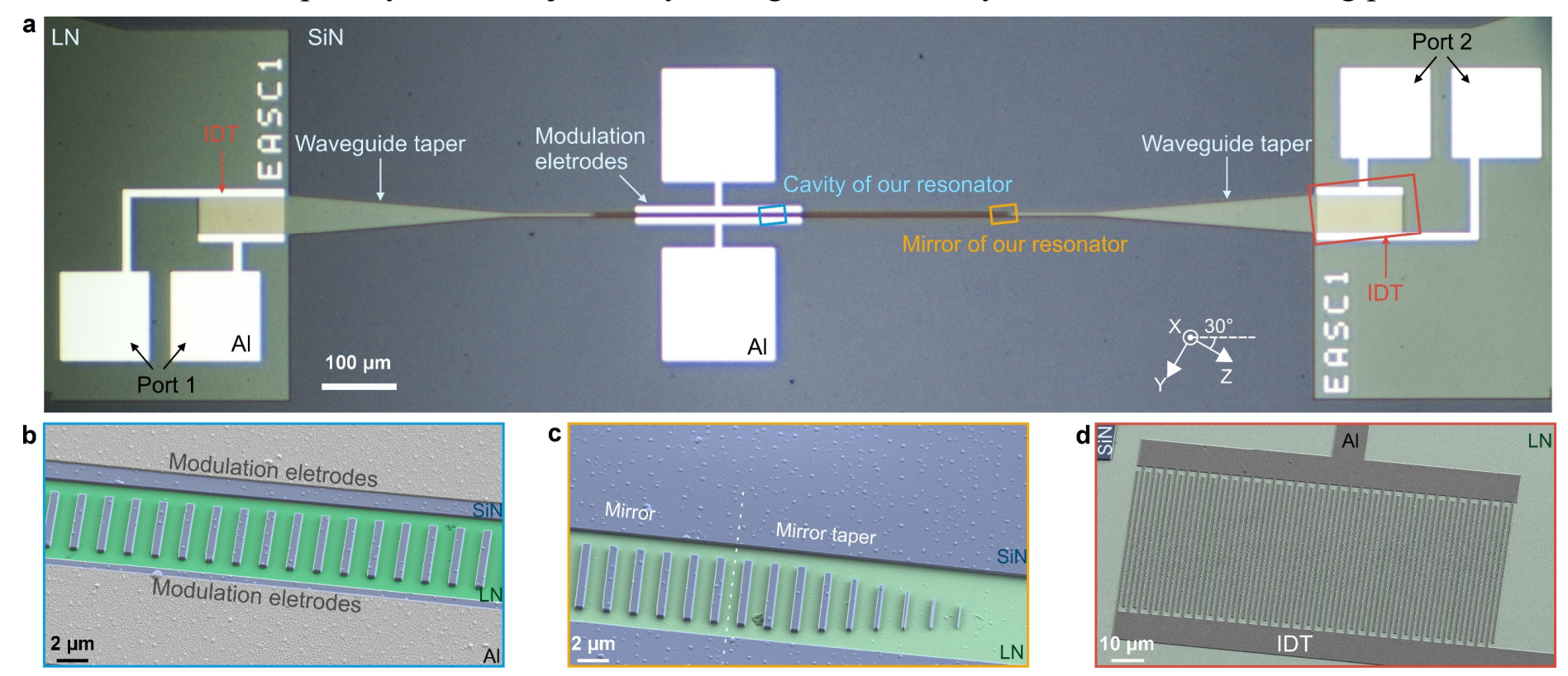
These crystals, analogous to photonic crystals that control light, can create bandgaps and guide sound waves with precision. Researchers are leveraging piezoelectric materials, like lithium niobate, which convert mechanical stress into electrical signals, to create and control these acoustic waves, connecting to acousto-optics and quantum acoustodynamics. These devices promise more efficient signal processing components, highly sensitive sensors, and isolators that prevent unwanted signals. Perhaps most excitingly, phonons are being explored as qubits for quantum computing or as a medium for coupling and controlling qubits. This innovative approach overcomes limitations of traditional methods by creating a system with unevenly spaced acoustic modes, mimicking the energy levels of atoms. The resonators consist of silicon nitride pillars forming a phononic crystal within an acoustic waveguide, enabling both high-quality vibrations and strong modulation, with surface acoustic waves excited and detected using interdigital transducers. The fabricated resonator supports multiple high-quality modes at distinct frequencies, a significant advantage over conventional designs.
Measurements confirm long lifetimes for these modes, aligning with observed quality factors, and researchers visualized the displacement profiles of these modes using a specialized optical vibrometer. To achieve precise control, modulation electrodes are positioned close to the waveguide, generating a strong electrical field to efficiently modulate the acoustic modes. This configuration allows selective interaction between acoustic modes, enabling phenomena analogous to atomic transitions. Experiments revealed Autler-Townes splitting, Stark shifts, and Rabi oscillations with a maximum cooperativity of 4. 18, demonstrating the ability to manipulate these mechanical modes with high precision. This work demonstrates on-chip electro-acoustic dynamics, enabling precise manipulation of high-frequency mechanical modes through electrical modulation. The team engineered the phononic crystal to create unevenly spaced modes, mimicking the energy levels of atoms and allowing for atomic-like transitions between them using applied electrical fields. Experiments revealed Autler-Townes splitting, Stark shifts, and Rabi oscillations between two phononic modes, achieving a maximum cooperativity of 4.
- Specifically, by applying electrical modulation, scientists observed Rabi oscillations with a specific temporal period, corresponding to a Rabi frequency, and increasing the modulation amplitude resulted in a higher Rabi frequency, demonstrating a linear relationship. These results align with predictions from analytical models and simulations, confirming the experimental setup. Extending the system to three modes, the team demonstrated programmable non-reciprocal frequency conversions with an isolation of up to 20 dB. This non-reciprocity, crucial for signal processing applications, is tunable by adjusting the timing of modulating pulses. The researchers achieved strong coupling between microwave-frequency mechanical modes, exceeding typical coupling strengths, and anticipate even stronger coupling regimes by increasing the resonator’s cavity length, opening avenues for exploring ultra-strong coupling phenomena. By carefully designing the structure of this device, the team created acoustic modes that behave analogously to atomic energy levels, allowing for precise manipulation of sound, and successfully achieved Autler-Townes splitting, Stark shifts, and Rabi oscillations, demonstrating a maximum cooperativity of 4. 18. Extending this work to three distinct acoustic modes, the researchers further demonstrated non-reciprocal frequency conversion with up to 20 dB of isolation, tunable through precise timing of electrical signals.
This achievement opens new avenues for applications in advanced sensing technologies, microwave signal processing, phononic computing, and quantum acoustics. The researchers characterized the performance of their device, measuring quality factors exceeding 10,000 for several acoustic modes and mapping the displacement profiles of these modes with high spatial resolution. While the current demonstration focuses on a limited number of modes, the team acknowledges that scaling to more complex systems presents a significant challenge and future work will likely focus on increasing the number of controllable modes and exploring the potential for integrating this technology into more complex acoustic circuits.
🗞 On-chip cavity electro-acoustics using lithium niobate phononic crystal resonators
🧠 ArXiv: https://arxiv.org/abs/2510.27496