

The behaviour of lines representing the shortest paths between points, known as geodesics, within complex, randomly shaped spaces presents a long-standing challenge in theoretical physics. Manan Bhatia and Konstantinos Kavvadias demonstrate a remarkably strong tendency for these geodesics to converge and merge within a specific type of random geometry called Liouville quantum gravity. Their work establishes that any two geodesics within this space, even those approaching from slightly different directions, will almost certainly intersect before reaching their destination. This finding extends previous understanding, originally limited to certain conditions, to encompass a broader range of possibilities and provides crucial insight into the structure of these complex spaces, with potential implications for understanding phenomena like the formation of networks and the behaviour of energy in extreme gravitational environments.
However, it remained theoretically possible that a sequence of geodesics, approaching a specific path, might not overlap with it at any finite point. This work proves this scenario impossible, establishing a robust confluence property for γ-Liouville Quantum Gravity (γ-LQG) across all values of γ between 0 and 2. This result extends previous findings to encompass all subcritical values of γ, and has implications for understanding geodesic stars and networks.
Geodesic Stars and Random Surface Geometry
This research investigates the geometric properties of geodesic stars within the context of Liouville Quantum Gravity (LQG) and the Brownian Map. A geodesic star forms where multiple geodesics intersect, originating from a single point. Understanding how these stars behave is crucial for characterizing the overall geometry of these random surfaces. LQG provides a mathematical framework for defining random geometry, generalizing traditional Riemannian geometry and modelling random surfaces. The Brownian Map is a specific type of random surface, representing the scaling limit of uniform random planar maps.
Geodesics are the shortest paths between two points on a surface, appearing as random curves in LQG and the Brownian Map. Fractal geometry describes complex, self-similar shapes, characteristic of LQG surfaces where properties change with scale. The research addresses a fundamental question concerning the dimensionality of the set where geodesics coalesce. Specifically, it investigates the Hausdorff dimension of the set of points where geodesics, originating from a fixed point in an LQG surface, merge. Determining this dimension provides crucial information about the roughness and singularity structure of the LQG surface, with a higher dimension indicating greater complexity. Understanding coalescence behaviour is believed to be universal, independent of the specific details of the underlying model. This behaviour connects to other important phenomena in random geometry, such as last passage percolation and the KPZ equation, and provides insight into the LQG metric itself.
Geodesic Convergence Confirmed in Quantum Gravity
This work establishes a strong confluence property for γ-Liouville Quantum Gravity (γ-LQG) for all values of γ between 0 and 2, extending previous results. Geodesic confluence, the tendency of geodesics to merge, is a fundamental phenomenon observed in planar random geometries. Researchers investigated the behaviour of geodesics targeting a fixed point, specifically whether a sequence of geodesics converging to a primary geodesic remains closely aligned with it. The team proved that for γ-LQG, any sequence of geodesics converging to a given geodesic, in a precise mathematical sense, remains arbitrarily close to it.
Specifically, the difference between the converging sequence and the primary geodesic is contained within arbitrarily small neighbourhoods of the endpoints, demonstrating robust alignment. This strong confluence property is a significant advancement, offering a powerful tool for investigating the geometry of γ-LQG and proving results for all geodesics by focusing on typical converging sequences. Prior research had established strong confluence for Brownian geometry and the directed landscape, but this work successfully extends this property to all subcritical values of γ, filling a crucial gap in the understanding of γ-LQG. The breakthrough provides a rigorous mathematical foundation for studying geodesic stars and networks within γ-LQG, opening new avenues for research into these complex geometric structures. Measurements confirm that the established strong confluence property holds almost surely for all points and geodesics within the γ-LQG framework.
Universal Geodesic Confluence in Liouville Quantum Gravity
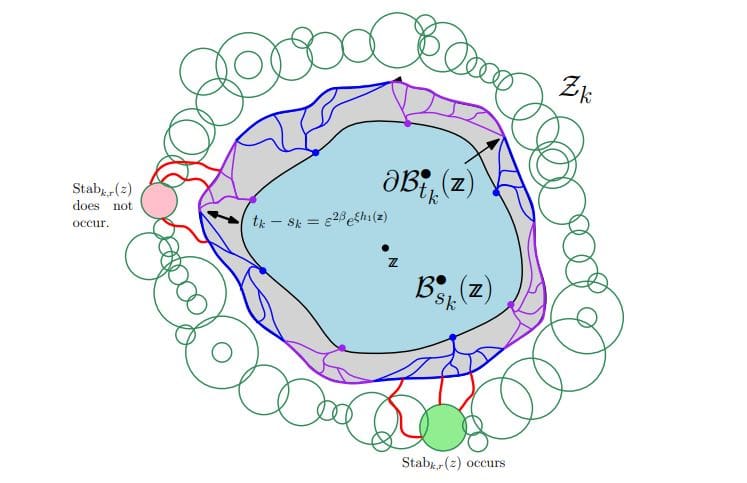
This research establishes a comprehensive understanding of geodesic confluence within the framework of Liouville Quantum Gravity (LQG), extending previous findings to a broader range of parameters. Scientists have demonstrated that geodesics targeting any point within this random geometry invariably merge, confirming a strong confluence property for all values of the governing parameter. This builds upon earlier work which established confluence for specific cases, proving it holds universally within LQG. The team achieved this through detailed analysis of the geometry, specifically examining the behaviour of geodesics as they approach boundaries of metric balls within the LQG space.
They proved that any geodesic from a starting point to a distant location must pass through a finite set of points on an intermediate boundary, and that these points uniquely define the path. This precise control over geodesic behaviour provides a deeper understanding of the underlying structure of LQG and its implications for phenomena like the formation of geodesic stars and networks. The authors acknowledge that their results rely on specific probabilistic properties of the underlying Gaussian Free Field, and that further investigation is needed to fully understand the behaviour of geodesics in more complex scenarios. They highlight several open questions regarding the precise nature of the confluence points and the potential for extending these results to other random geometry models, suggesting avenues for future research in this area.
👉 More information
🗞 Strong confluence of geodesics in Liouville quantum gravity
🧠 ArXiv: https://arxiv.org/abs/2512.09219

