

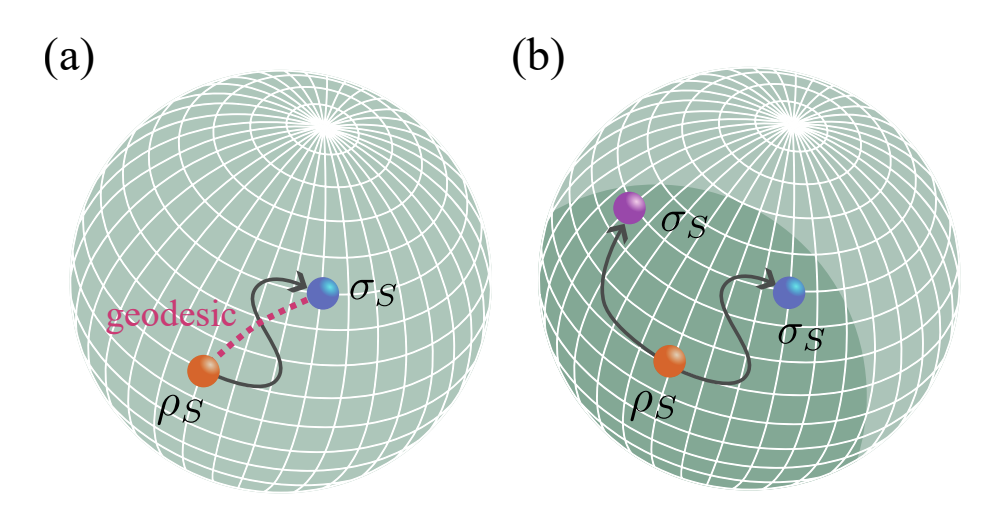
The fundamental limits of how quantum states evolve and how precisely we can measure them represent a long-standing challenge in physics, and new research offers a significant step forward in understanding these boundaries. Yoshihiko Hasegawa from The University of Tokyo, along with colleagues, demonstrates that achievable transformations of quantum states are constrained by a surprisingly simple relationship, determined only by the initial properties of the system and its environment. This work establishes universal limits on state changes and measurement precision, independent of the specific dynamics governing the system, effectively providing a new framework for understanding uncertainty in open quantum systems. The findings offer computable bounds for any quantum process, promising to refine our ability to design and analyse quantum technologies and deepen our understanding of fundamental quantum limits.
Eigenvalue Bounds Constrain Quantum Parameter Estimation
Researchers have discovered fundamental limits on how precisely parameters can be estimated in open quantum systems, those interacting with their environment. This work establishes that a bound exists between the initial state of a system and any state it can reach, a bound determined solely by the eigenvalues of the initial system and environment. Consequently, the research provides dynamics-independent lower bounds on the precision of measurements, echoing principles found in thermodynamic uncertainty relations, and also establishes limits on the variance of parameter estimators. These results offer computable bounds for understanding open quantum systems. The research addresses a fundamental challenge in quantum mechanics, namely the inherent limitations on measurement precision imposed by the dynamics of the system and its interaction with the environment. This work aims to provide a general and computable framework for understanding and optimising the precision of parameter estimation in open quantum systems, offering insights relevant to diverse applications ranging from quantum sensing to quantum control.
Quantum State Estimation and Evolution Speed
This research presents rigorous mathematical bounds on the precision of quantum state estimation and the speed at which quantum systems can evolve. It builds on concepts from quantum information theory and statistical estimation to derive limits on how accurately we can determine the parameters of a quantum state and how quickly that state can change. The results have implications for quantum technologies like quantum sensing, quantum communication, and quantum computation. The team derived a quantum speed limit based on the distance between initial and final states and the Fisher information, crucial for designing fast and efficient quantum algorithms. The work also explores quantum estimation theory, aiming to determine the best possible precision with which we can estimate the parameters of a quantum state, using concepts like the Fisher information and the Cramér-Rao bound. Key to this is the Rényi relative entropy, used to derive bounds on the variance of parameter estimators.
Quantum State Change Limited by Initial Conditions
Researchers have established new, fundamental limits on how quickly quantum states can change, offering insights into the dynamics of open quantum systems. This work demonstrates that the maximum rate of state transformation depends primarily on the initial properties of the system and its environment, rather than the specific details of how they evolve over time. This is a significant advancement because it provides computable bounds on state changes even when the complete evolution of the system is unknown. The team quantified the distance between the initial state of a quantum system and any state it might reach after interacting with its environment, demonstrating that this distance, measured using Rényi divergence, is bounded by a quantity determined solely by the eigenvalues of the initial system and environment.
Importantly, this research establishes dynamics-independent lower bounds on the precision of measurements, mirroring established uncertainty relations, and also bounds on the precision of parameter estimation. These findings represent a departure from previous quantum speed limits, which typically required detailed knowledge of the system’s evolution. By focusing on initial conditions, this work provides a more general and practical framework for understanding and predicting the behavior of open quantum systems, with potential applications in quantum computing, communication, and thermodynamics.
Dynamics-Independent Bounds Constrain Quantum State Change
This research establishes dynamics-independent bounds on how quantum states can change over time in open quantum systems, treating the system and its environment as evolving together. The key finding is an upper limit on the difference between an initial quantum state and any state reachable through this evolution, determined solely by the eigenvalues of the initial system and environment. This bound applies regardless of the specific dynamics involved, offering a general constraint on state transformations. Furthermore, the study demonstrates that these bounds have practical implications for measurements and parameter estimation. Researchers derived a lower bound on the precision of measurements, independent of both the dynamics and the measurement process itself, mirroring established uncertainty relations. Similarly, they obtained lower bounds on the accuracy of parameter estimation.
🗞 Dynamics-independent bounds on state transformations and precision in open quantum systems
🧠 ArXiv: https://arxiv.org/abs/2508.13884


