

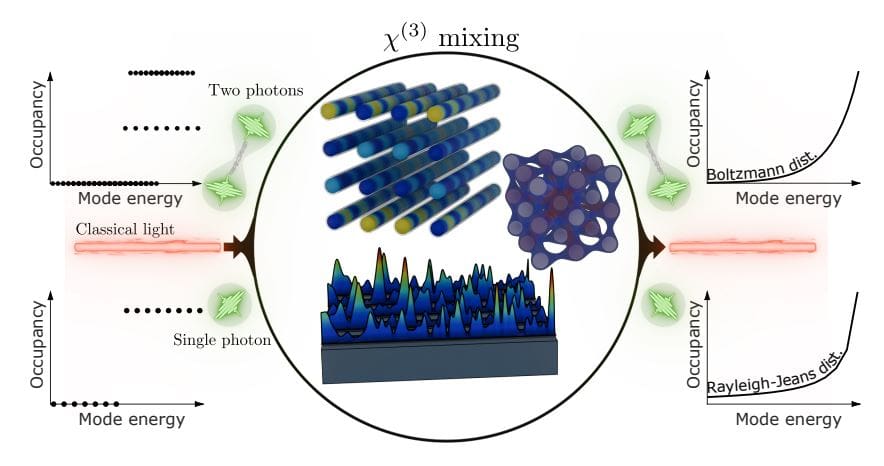
The behaviour of isolated quantum systems represents a fundamental challenge in modern physics, and recent work by Fouad Chahrour of the Max-Born-Institut and Humboldt-Universität zu Berlin, Şahin K. Ozdemir and Ramy El-Ganainy of Saint Louis University, along with Kurt Busch and colleagues, demonstrates a novel method for inducing interactions between photons using classical light. The team reveals that carefully designed nonlinear optical systems effectively thermalize fundamental light states, including single and two-photon states, leading to the emergence of statistical distributions characteristic of thermal equilibrium. This achievement provides a new pathway for investigating quantum dynamics through readily accessible classical optical experiments, and opens opportunities to explore complex phenomena such as phase transitions within these systems. By harnessing classical nonlinearities, the researchers establish a powerful platform for simulating and understanding previously inaccessible quantum behaviours.
Classical Fields Drive Quantum Thermalization of Light
Scientists demonstrate that nonlinear optical platforms can effectively induce interactions between photons, revealing the thermalization of fundamental light states, specifically single- and two-photon states. This thermalization manifests through the emergence of both Rayleigh-Jeans and Boltzmann statistical distributions, providing insights into how classical nonlinearities influence quantum dynamics. The research team achieved this by propagating beams alongside classical light within multimode nonlinear optical systems, allowing them to observe the evolution of quantum states driven by classical fields. The study centers on a system composed of coupled optical waveguides, where each guide supports transverse electric and magnetic modes, and evanescent coupling allows interactions between them.
Researchers modeled the system using a quantum Hamiltonian, incorporating propagation constants, coupling strengths, and nonlinear self- and cross-phase interactions. By treating one polarization mode as a classical field, they derived equations of motion governing the co-propagating classical and quantum components. Numerical solutions to these equations revealed that the classical field’s intensity profile becomes effectively chaotic due to nonlinear self-interactions, ultimately driving the thermalization of the quantum light. Crucially, the results show that the final thermal state depends on the photon statistics of the input quantum state; the steady-state distribution resulting from two-photon states differs from that of a single-photon input.
This highlights the central role of particle statistics in the thermalization process, even when mediated by classical nonlinear dynamics. The team demonstrated that the optical temperature of the system can be uniquely determined for any given internal energy and power, confirming predictions from nonlinear optical thermodynamics. Scientists engineered a system to investigate thermalization using interactions between classical and quantum light within nonlinear optical waveguides. This approach leverages Kerr nonlinearity to induce cross-phase modulation, effectively transferring energy between the classical and quantum fields.
Researchers designed the experiment to minimize the influence of the quantum field on the classical field, allowing the classical field’s chaotic dynamics to dominate the thermalization process. The team developed a detailed mathematical framework to model the interactions within coupled optical waveguides, accounting for propagation constants, coupling strengths between waveguides, and the nonlinear self- and cross-phase modulation effects. To simplify calculations and focus on the key thermalization mechanism, the team treated the classical light field as a deterministic background. This approximation allowed them to derive simplified evolution equations for both the classical and quantum components.
The study employed coupled optical waveguides, where evanescent coupling allows interactions between different polarizations of light, creating a network for energy exchange. Researchers solved the simplified equations numerically, simulating the propagation of light through the waveguide array. The results demonstrate that the classical field’s chaotic behaviour, resulting from its nonlinear self-interactions, effectively drives the thermalization of the quantum light. Crucially, the team observed that the final thermal state differs depending on whether the input quantum state consists of single photons or two-photon pairs, highlighting the role of particle statistics in the thermalization process.
This research demonstrates that complex interactions between light particles can be effectively simulated using nonlinear optical platforms. The team’s approach highlights the importance of particle statistics in this thermalization process, even when driven by classical nonlinear dynamics. Future research could explore the impact of neglected effects and investigate the potential for extending this approach to more complex scenarios, potentially offering insights into phase transitions and other complex phenomena within readily accessible optical settings. This work provides a new avenue for exploring light dynamics and understanding the fundamental principles governing the behaviour of photons.
👉 More information
🗞 Thermalization of quantum light induced by classical nonlinear wave dynamics
🧠 ArXiv: https://arxiv.org/abs/2511.15100

