

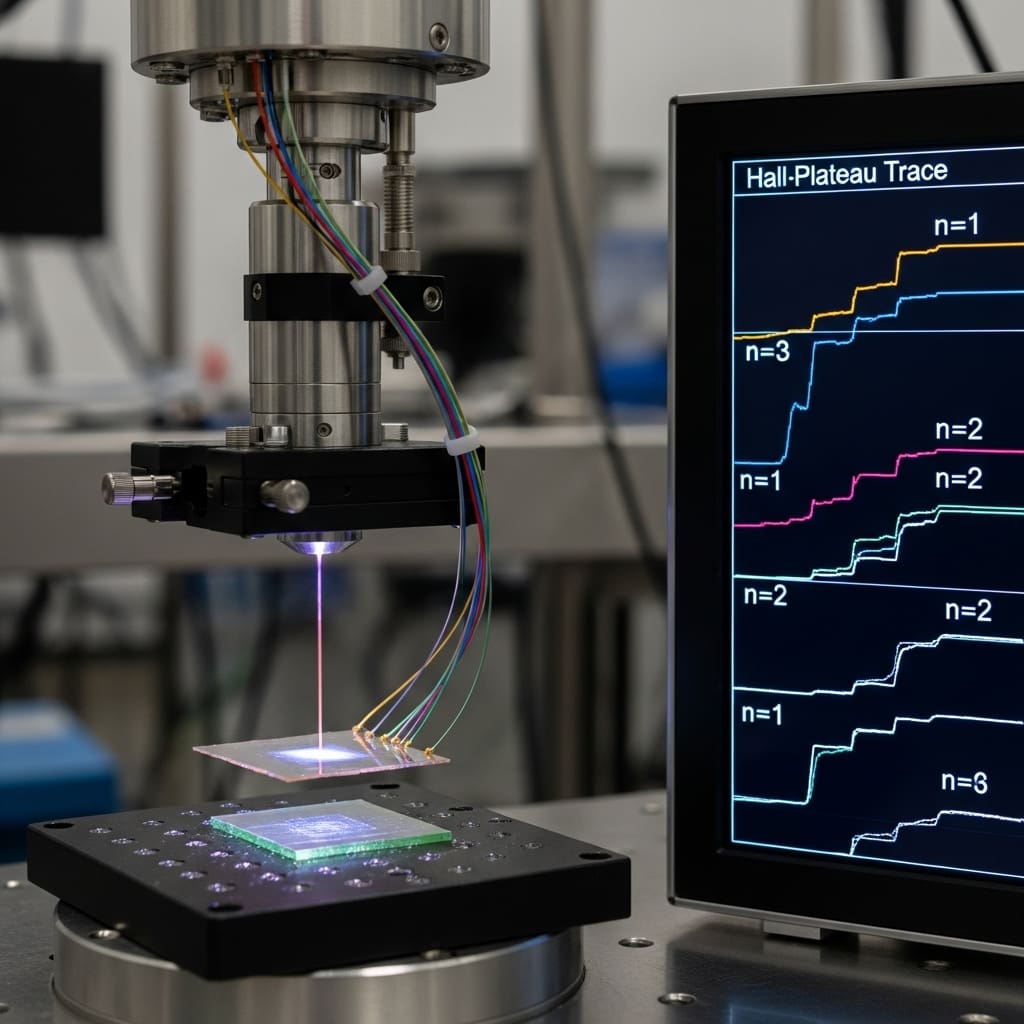
The pursuit of materials exhibiting the quantum anomalous Hall effect, where electrons flow without resistance along edges, receives a significant boost from new research into a unique form of carbon called plumbene. Zhe Li, Fangyang Zhan, and Haijun Cao, alongside their colleagues, demonstrate how carefully engineered light can unlock multiple pathways to this effect within plumbene’s complex electronic structure. Their work reveals a three-stage transformation, driven by circularly polarised light, that allows tuning of the quantum anomalous Hall effect to achieve remarkably high Chern numbers, a measure of the material’s topological properties. This control, achieved through manipulating the material’s band structure, not only expands the possibilities for creating robust, dissipationless electronic devices, but also highlights the potential of high-order topological insulators for advanced quantum technologies, and importantly, the team shows how growing plumbene on different substrates further enhances this tunability.
Topological Quantum Hall Effect in 2D Materials
Research into topological materials continues to advance, with a strong focus on two-dimensional materials like graphene and transition metal dichalcogenides. This work explores the potential of these materials to host unique quantum phenomena, specifically the quantum anomalous Hall effect, which promises dissipationless electronic currents without the need for external magnetic fields. A key strategy involves manipulating material properties to achieve high Chern numbers, a measure of the topological order and robustness of these states. Researchers are employing van der Waals heterostructures, created by stacking different 2D materials, to engineer desired topological properties.
Floquet engineering, a technique utilizing time-periodic driving with light, offers a powerful method for creating novel topological phases. Computational materials science plays a vital role, with calculations predicting and understanding the electronic structure and topological characteristics of these materials. Investigations demonstrate that the quantum anomalous Hall effect can be tuned by manipulating material composition, stacking order, strain, and external fields. Achieving high Chern numbers is a central goal, enhancing the robustness and functionality of the effect. Van der Waals heterostructures provide a versatile platform for engineering these properties and creating new functionalities.
Floquet engineering can induce topological phase transitions and create novel phases, while computational predictions guide the search for new topological materials. Specific materials under investigation include graphene, plumbene, and various transition metal dichalcogenides. The MnBi2Te4 family of materials, known for their magnetic properties, are also promising candidates. Researchers are combining these materials into van der Waals heterostructures to engineer specific topological characteristics. Optical spectroscopy probes the electronic structure and optical properties of these materials.
Future research focuses on developing materials with even higher Chern numbers to enhance device performance. New methods for controlling the quantum anomalous Hall effect, utilizing electric fields, magnetic fields, or light, are also being explored. The development of novel topological devices, including spintronic devices and quantum computers, is a key goal. Investigating the interplay between topology and superconductivity could lead to the discovery of new materials with exotic properties. This research represents a significant advancement, paving the way for revolutionary applications in spintronics, quantum computing, and energy-efficient electronics.
Plumbene Topological States Engineered Computationally
Researchers are pioneering a computational approach to engineer topological states in plumbene, a two-dimensional material with strong spin-orbit coupling. The goal is to create tunable dissipationless electronic devices. They employed calculations using the Vienna Ab-initio Simulation Package to determine the ground states of plumbene and its heterostructures. Rigorous optimization of structural configurations ensured accurate results. To investigate excited states under optical fields, the team constructed Hamiltonians using the Wannier90 package.
These ground-state Hamiltonians served as the basis for a custom-developed code implementing the Peierls substitution, which describes the interaction of electrons with periodic light fields. This allowed researchers to model the effects of circularly polarized light on the electronic structure of plumbene. The Green’s function method, implemented through the WanierTools package, analyzed the resulting topological characteristics, including edge states, Berry curvature distributions, and Chern numbers. The study reveals that free-standing plumbene exhibits a substantial gap, indicative of its strong spin-orbit coupling.
Calculations demonstrate that this material is topologically non-trivial, possessing corner states. Researchers predicted a tunable sequence of topological phases, including a multichannel anomalous Hall state with a Chern number of -3, and a +3 Chern number state achieved by growing plumbene on specific substrates. The ability to manipulate the Chern number through material design and external stimuli represents a significant step towards realizing advanced electronic devices.
Light Controls Plumbene’s Topological Electronic States
Scientists demonstrate a novel method for manipulating the electronic properties of plumbene using light. This work reveals a pathway to engineer high Chern numbers within anomalous Hall states, offering potential for advanced electronic devices. The team investigated how circularly polarized light alters the band structure of plumbene, predicting a three-stage topological transition dependent on light intensity. Initially, free-standing plumbene exhibits a significant gap between electronic bands. Under very low light intensity, the bands remain largely unchanged.
As light intensity increases, a distinct change occurs, disrupting the overlap and establishing a valley-based quantum anomalous Hall state with a Chern number of -8. This represents the first stage of the topological transition. Further increasing the light intensity reduces the Chern number to -6. Finally, at higher light intensities, the bands close and reopen, resulting in a multichannel quantum anomalous Hall state with a compensated Chern number of -3. Detailed analysis of the spin-resolved band structure reveals that the transition involves a unique band closure accompanied by a reversal of the Berry curvature. The team validated these findings through calculations of the anomalous Hall conductance and distributions of Wannier charge centers, confirming the observed Chern numbers for each topological phase. These results demonstrate a pathway to tune high Chern numbers in high-order topological insulators, potentially enabling the development of next-generation dissipationless electronic devices.
Light Drives Plumbene’s Topological Phase Transitions
This work demonstrates a pathway to control the topological properties of plumbene using light irradiation, a technique known as Floquet engineering. Researchers predicted a three-stage topological phase transition in plumbene under right-handed circularly polarized light, revealing anomalous Hall states characterized by high Chern numbers of -8, -6, and -3. Notably, this study identifies conditions under which a multichannel quantum anomalous Hall state is induced within the pure material, a phenomenon not previously observed in similar materials. Moderate tensile strain is crucial for achieving the necessary band gaps for these states. Furthermore, the choice of substrate significantly influences the topological characteristics.
👉 More information
🗞 Light-engineered Multichannel Quantum Anomalous Hall Effect in High-order Topological Plumbene
🧠 ArXiv: https://arxiv.org/abs/2511.18520