LiDAR technology promises robust sensing and covert observation, particularly in challenging low-light environments, but conventional systems rely on predictable beam scanning patterns. Junyeop Kim, Dongjin Lee, and Woncheol Shin, along with their colleagues at Pohang University of Science and Technology and the Electronics and Telecommunications Research Institute, now present a fundamentally new approach to beam steering that overcomes this limitation. Their research introduces a method where the direction of the LiDAR beam becomes inherently unpredictable, significantly enhancing operational stealth, and they demonstrate this using the unique properties of photon pairs and dispersive materials. The team successfully detects multiple targets simultaneously, achieving up to a 1000-fold improvement in signal-to-noise ratio compared to traditional LiDAR systems, establishing a new standard for secure sensing and opening possibilities for advanced applications in areas like secure communications.
offers noise resilience and stealth observation capabilities in low-light conditions. While Quantum LiDAR can enable stealth observation, operational stealth is enhanced by inherently unpredictable beam steering. Here, scientists introduce a novel stealth beam steering method that is fundamentally immune to prediction. In a photon pair, the probe photon undergoes diffraction in an unpredictable direction at a grating due to wavelength randomness. The arrival time of the heralding photon, delayed by propagation through a dispersive medium, enables.
Coincidence Counting Validates Noisy Environment Performance
This supplementary material provides detailed experimental validation and theoretical justification for the performance of a Quantum Enhanced LiDAR (QEP-LiDAR) system. It demonstrates that, despite not achieving the theoretical quantum advantage in timing resolution, the system offers a significant advantage in noisy environments due to the ability of coincidence counting to filter out background noise and enhance signal detection. The calibration process accurately maps detected photon arrival times to their corresponding wavelengths, crucial because the fiber spool used in the experiment introduces dispersion, distorting spectral information. Scientists measure the arrival time histograms of both the probe and heralding photons, identifying singularities that represent specific wavelengths and aligning them to calibrate the time-to-wavelength mapping.
Accurate calibration is essential for precise ranging and imaging within the QEP-LiDAR system. Researchers quantify the information gain about the target’s transmission parameter using Fisher information, a theoretical measure of estimation precision. They derive equations for the Fisher information for both the QEP-LiDAR system and a classical LiDAR system, calculating an enhancement factor to compare performance. Experiments reveal that the Fisher information for the QEP-LiDAR system is significantly higher than for the classical system, especially at high noise levels. The coincidence term, originating from correlated photon pairs, dominates the Fisher information in noisy conditions, achieving a 100-fold improvement in information gain.
This demonstrates that the QEP-LiDAR system provides a significant advantage in noisy environments by filtering noise and enhancing signal detection. Although the system doesn’t achieve the theoretical quantum advantage in timing resolution, it offers a practical advantage in real-world conditions. This research demonstrates a practical quantum advantage in LiDAR, not through improved timing resolution, but through enhanced noise filtering and signal detection. Coincidence counting is crucial for achieving this advantage, making the QEP-LiDAR system significantly more robust to noise than classical LiDAR systems.
Unpredictable Quantum LiDAR Achieves Stealth Detection
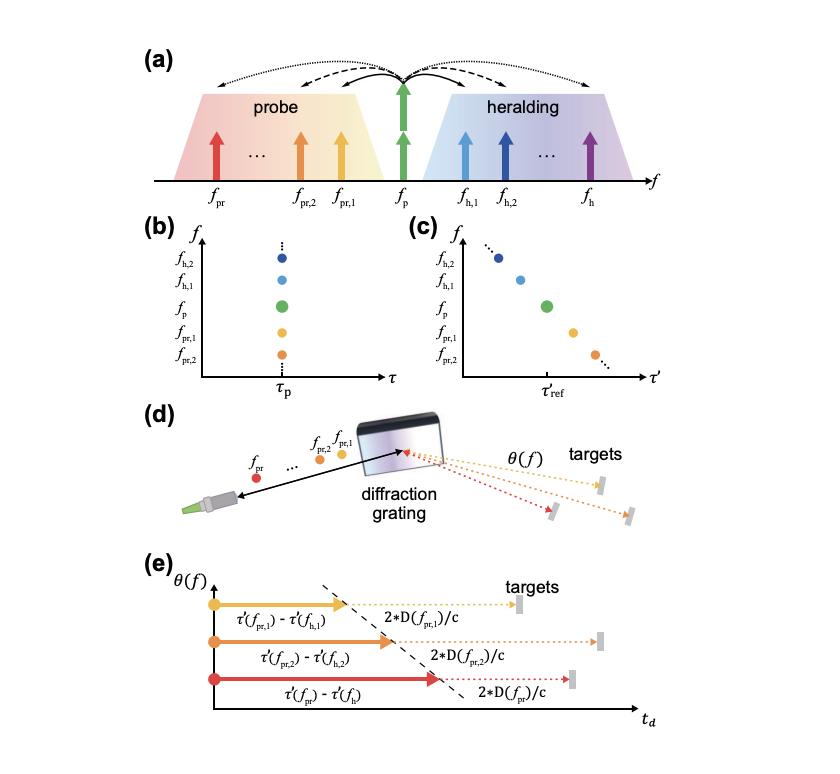
Scientists have developed a new light detection and ranging (LiDAR) system that achieves unprecedented stealth capabilities and signal clarity. This quantum-enhanced LiDAR, termed QEP-LiDAR, utilizes correlated pairs of photons to dramatically improve detection performance, particularly in challenging, noisy environments. The core innovation lies in a method of beam steering that is inherently unpredictable, making the system exceptionally difficult to detect or intercept. The system generates photon pairs through spontaneous four-wave mixing, where two pump photons create a probe photon and a heralding photon.
Crucially, the frequency of the probe photon remains undefined until the heralding photon’s wavelength is measured, ensuring the observation direction remains unknown until detection. By analyzing the arrival time of the heralding photon, scientists accurately determine the probe photon’s frequency, calculate its direction using a diffraction grating, and measure the distance to the target. This allows for parallel target detection and ranging, identifying objects at varying distances and directions simultaneously. Experiments demonstrate a remarkable 1000-fold enhancement in signal-to-noise ratio (SNR) compared to classical LiDAR systems.
This improvement stems from the strong correlation between the photon pairs, which effectively filters out noise and enhances the clarity of the detected signal. The team defines noise resilience as the ratio of false to true probe photon detections, and their calculations reveal a substantial improvement in SNR through this quantum approach. The results show that QEP-LiDAR significantly outperforms classical LiDAR in noisy conditions, paving the way for advancements in secure communications, stealth technologies, and beyond. This breakthrough establishes a new paradigm for sensing, offering a substantial leap forward in both performance and security.
Quantum LiDAR Achieves High Resolution Ranging
This research successfully demonstrates target detection and ranging using a novel quantum LiDAR method, which achieves inherently unpredictable beam steering by exploiting the random frequencies of photon pairs. By precisely resolving the arrival times of heralding photons, the system determines the frequency and propagation direction of probe photons, enabling a significant enhancement in signal-to-noise ratio compared to classical LiDAR systems under identical conditions. The experiment validated the noise resilience of this quantum approach and achieved a resolution of 2. 2cm with an angular resolution of 0.144° under the current experimental setup. A key achievement lies in the implementation of a parallel observation system within a quantum LiDAR framework, utilizing spatially separated probe-photon modes to improve the signal-to-noise ratio. This parallel approach not only enhances noise resilience but also significantly increases measurement speed compared to traditional raster-scanning methods, reducing the average number of photons required per measurement direction while maintaining performance. The authors acknowledge that further studies are necessary to fully explore the potential of this technology, but the combination of inherent unpredictability, high signal-to-noise ratio, and rapid data acquisition demonstrated here offers substantial promise for advancements in quantum LiDAR, random number generation, quantum communication, and quantum networking applications.
🗞 Inherently unpredictable beam steering for quantum LiDAR
🧠 ArXiv: https://arxiv.org/abs/2511.09089