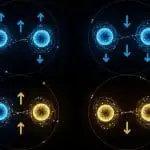
In a groundbreaking development, scientists have harnessed the potential of digital-analog learning algorithms on Rydberg atom arrays, creating a new approach to machine learning that combines digital and analog computing strengths. This hybrid method is more practical and scalable than traditional quantum learning methods, allowing for shorter circuit depths and greater robustness to realistic error models.
Researchers have created a powerful tool for tackling complex machine-learning tasks, such as handwritten digit classification and unsupervised quantum phase boundary learning by leveraging digital computers’ precise calculations and analog computers’ real-time simulation capabilities. The implications are significant, with potential applications in fields like image recognition, natural language processing, and materials science.
As researchers continue to explore the possibilities of digital-analog learning on Rydberg atom arrays, we can expect significant advances in machine learning and quantum simulation.
What is Digital-Analog Learning on Rydberg Atom Arrays?
Digital-analog learning algorithms are a new approach to machine learning that combines the benefits of digital and analog computing. In the context of Rydberg atom arrays, this means using both single-qubit operations in the digital setting and global driving according to the Rydberg Hamiltonian in the analog setting. This hybrid approach can potentially be more practical and scalable than traditional quantum learning methods.
The idea behind digital-analog learning is to leverage the strengths of both digital and analog computing. Digital computers are great at performing precise calculations, but they can be slow and prone to errors when dealing with complex systems. Analog computers, on the other hand, can simulate complex systems in real-time, but they can be difficult to control and may introduce errors. By combining these two approaches, researchers hope to create a more robust and efficient way of learning from data.
In the case of Rydberg atom arrays, digital-analog learning algorithms are being explored as a potential solution for near-term quantum algorithms. These arrays have already been shown to simulate complex many-body quantum phenomena, including quantum phase transitions and topological phases of matter. By leveraging these capabilities, researchers hope to develop more efficient and robust quantum algorithms that can be used soon.
What are Rydberg Atom Arrays
What are Rydberg Atom Arrays?
Rydberg atom arrays are programmable quantum simulators that use an array of atoms trapped by optical tweezers. These arrays have already been scaled up to several hundred qubits, enabling recent experiments demonstrating intriguing emergent many-body quantum phenomena. The rapid progress towards larger-scale Rydberg quantum processors motivates researchers to explore their applications for near-term quantum algorithms.
In a simplified picture, the Rydberg system can be thought of as a system of atoms trapped in a desired arrangement individually in their ground state (denoted 0) that is globally driven for some finite time t under the Rydberg many-body Hamiltonian. This capability alone is enough to realize many exotic physical properties of Rydberg arrays, such as quantum phase transitions and topological phases of matter.
Beyond global driving, another high-fidelity control that can be added to a Rydberg atom array system is single-qubit rotations. These gates operate in a space of hyperfine states rather than the Rydberg two-level system, which we will describe in more detail later. The ability to perform these operations with high fidelity is crucial for realizing many-body quantum phenomena and simulating complex physical models.
What are the Benefits of Digital-Analog Learning on Rydberg Atom Arrays?
The benefits of digital-analog learning on Rydberg atom arrays include improved variational quantum learning experiments in the near term. This approach is more robust to realistic error models than traditional digital learning schemes, requiring shorter circuit depths.
In a comprehensive numerical study, researchers have demonstrated that digital-analog learning is feasible in the near term and more efficient than traditional digital learning methods. The results suggest that this approach opens a promising path toward improved variational quantum learning experiments in the near term.
The benefits of digital-analog learning on Rydberg atom arrays are twofold. First, it allows for the development of more efficient and robust quantum algorithms, which can be used in the near term. Second, it provides a new approach to machine learning that combines the strengths of digital and analog computing.
How Does Digital-Analog Learning Work on Rydberg Atom Arrays
How Does Digital-Analog Learning Work on Rydberg Atom Arrays?
Digital-analog learning on Rydberg atom arrays combines single-qubit operations in the digital setting with global driving according to the Rydberg Hamiltonian in the analog setting. This hybrid approach allows for the development of more efficient and robust quantum algorithms.
In the digital setting, single-qubit operations are performed using a space of hyperfine states rather than the Rydberg two-level system. These gates operate with high fidelity, crucial for realizing many-body quantum phenomena and simulating complex physical models.
In the analog setting, global driving, according to the Rydberg Hamiltonian, allows for the simulation of complex many-body quantum phenomena, including quantum phase transitions and topological phases of matter. By combining these two approaches, researchers can develop more efficient and robust quantum algorithms that can be used soon.
What are the Implications of Digital-Analog Learning on Rydberg Atom Arrays?
The implications of digital-analog learning on Rydberg atom arrays are significant. First, it provides a new approach to machine learning that combines the strengths of digital and analog computing. Second, it allows for the development of more efficient and robust quantum algorithms, which can be used in the near term.
In high-energy physics, digital-analog learning on Rydberg atom arrays may provide a new way to simulate complex physical models. By leveraging these arrays’ capabilities, researchers may be able to develop more accurate and efficient simulations of complex systems, which could have significant implications for our understanding of the universe.
Overall, the implications of digital-analog learning on Rydberg atom arrays are far-reaching and have the potential to revolutionize quantum computing.
Publication Date: 2024-11-12
Authors: Jonathan Z. Lu, Lucy Jiao, Kristina Wolinski, Milan Kornjača, et al.
Source: Quantum Science and Technology
DOI: https://doi.org/10.1088/2058-9565/ad9177