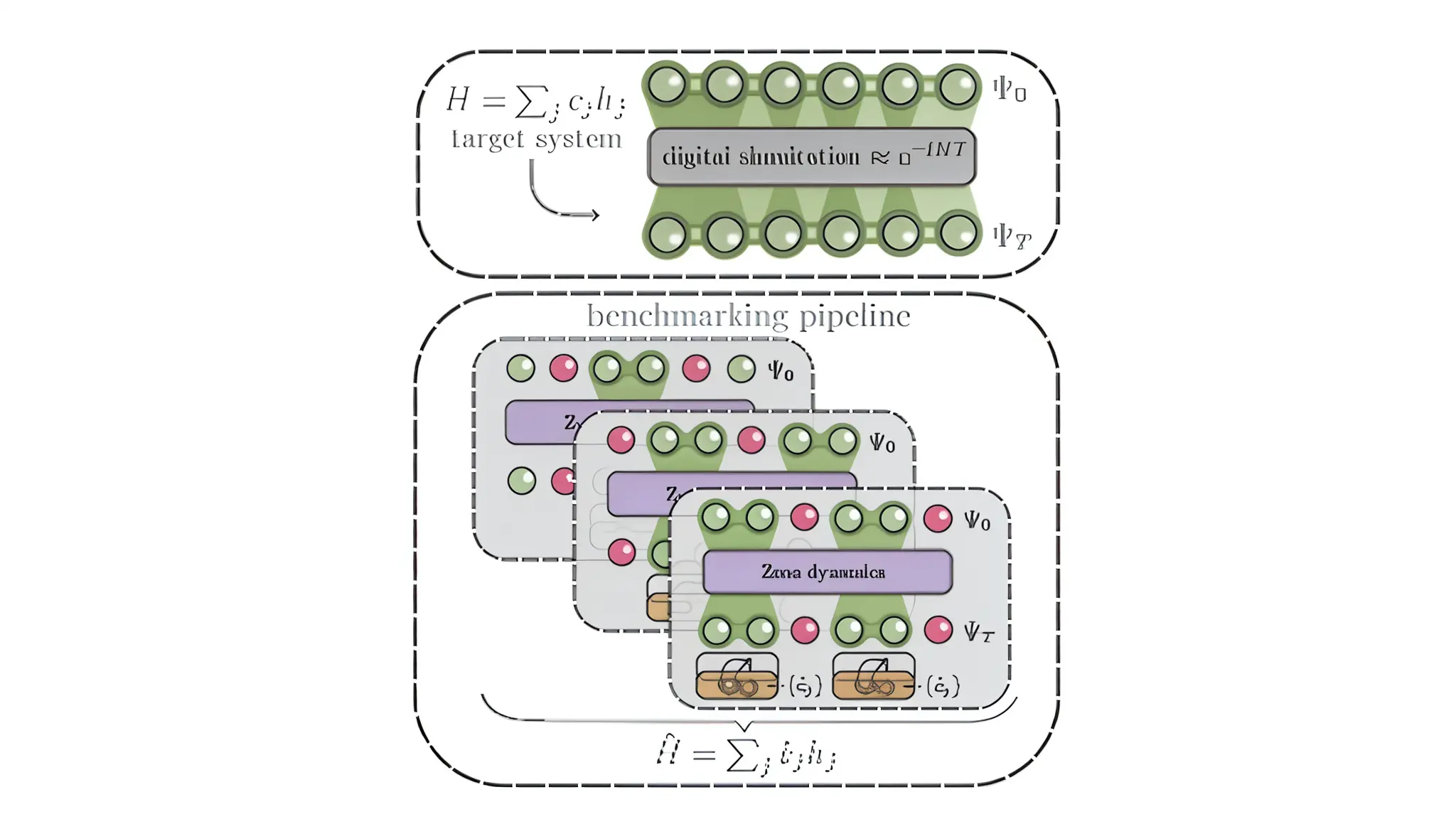
Determining the underlying rules governing a quantum system’s behaviour requires precise knowledge of its Hamiltonian, a task that becomes increasingly difficult as systems grow more complex. Giacomo Franceschetto, Egle Pagliaro, Luciano Pereira, and colleagues at ICFO, Institut de Ciencies Fotoniques and ICREA now present a new method for reconstructing this crucial information, offering a significant advance in the field of Hamiltonian learning. Their approach leverages the quantum Zeno effect, a phenomenon where frequent measurements slow down a system’s evolution, to simplify the dynamics and enable efficient learning of the Hamiltonian’s parameters. This technique avoids the need for complicated initial state preparations and relies on readily achievable experimental operations, allowing the team to successfully learn the coefficients of a 109-qubit Hamiltonian, demonstrating a substantial step towards scalable quantum system characterisation and benchmarking.
Hamiltonian Learning via Reshaped Quantum Tomography
Scientists have developed a new method for determining the governing dynamics of quantum systems, particularly those with many interacting components. This research addresses the challenge of accurately characterizing complex systems, essential for validating quantum simulators and advancing quantum computation. The team engineered a protocol that combines local Hamiltonian reconstruction with a reshaping technique to improve the efficiency and accuracy of the process, especially for larger systems. This approach provides a detailed understanding of the system’s behaviour and offers a path towards more reliable quantum technologies.
The method relies on accurately reconstructing local Hamiltonians and then combining them to form a global description of the system. A reshaping technique reduces the complexity of the quantum process tomography required, enabling analysis of larger systems. Detailed error analysis and scaling arguments demonstrate the method’s potential for practical implementation. This work represents a significant advancement in the field, providing a comprehensive and transparent approach to Hamiltonian learning. The detailed explanations, thorough error analysis, and focus on hardware implementation make this research particularly valuable for scientists working with real quantum devices.
Dynamic Decoupling for Hamiltonian Learning
Scientists have developed a novel Hamiltonian learning protocol to determine the governing dynamics of quantum systems, particularly those with a large number of interacting components. The study addresses the challenge of accurately characterizing complex systems, essential for validating quantum simulators and advancing quantum computation. The team engineered a method that leverages the quantum Zeno effect, employing frequent ‘virtual Z gates’ to reshape the system’s dynamics and isolate local interactions. This technique dynamically decouples the system into non-interacting patches, simplifying the learning process and mitigating the effects of decoherence.
The core of the approach involves applying these frequent unitary kicks to selected qubits, effectively suppressing unwanted Hamiltonian interactions and focusing analysis on specific local areas. This reshaping tool allows researchers to independently characterize each isolated patch using quantum process tomography, a technique for reconstructing quantum processes from experimental data. By focusing on these smaller, decoupled regions, the team significantly reduces the complexity of the overall Hamiltonian reconstruction task. The method avoids demanding operations and complex state preparations, making it particularly suitable for implementation on noisy intermediate-scale quantum devices.
Researchers successfully demonstrated the feasibility of this protocol through both numerical simulations and experimental implementation on superconducting hardware. The study achieved accurate learning of the coefficients for a 109-qubit Hamiltonian, showcasing the scalability and effectiveness of the technique. This achievement represents a significant step forward in the field of Hamiltonian learning, providing a practical and efficient method for characterizing complex quantum systems and validating their performance.
Hamiltonian Learning via Quantum Zeno Effect
Scientists achieved a breakthrough in Hamiltonian learning, successfully reconstructing the coefficients of a 109-qubit Hamiltonian using a novel protocol combining the quantum Zeno effect and quantum process tomography. This work addresses a critical challenge in benchmarking and characterizing quantum hardware as devices increase in size and complexity. The team developed a method that reshapes the system’s dynamics to isolate local patches of qubits, enabling parallel and accurate reconstruction of the Hamiltonian. The core of the achievement lies in leveraging the quantum Zeno effect via frequent unitary kicks, dynamically confining the evolution to local patches.
Theoretical analysis demonstrates a quantifiable relationship between accuracy and experimental control, providing a clear understanding of the limitations and potential of the method. Following the reshaping of dynamics, the team employed quantum process tomography to characterize the resulting local evolutions. By partitioning the system into spatially disjoint subsystems, QPT could be performed independently and in parallel, significantly enhancing efficiency. The protocol was successfully implemented on superconducting hardware, demonstrating its feasibility and paving the way for more efficient and accurate characterization of complex quantum systems. This advancement is crucial for validating the performance of quantum computers and simulators, ultimately accelerating progress in the field of quantum information science.
Hamiltonian Learning via the Quantum Zeno Effect
This research presents a new protocol for efficiently learning the Hamiltonian of a quantum system, a crucial step in understanding and validating its behaviour. The team successfully demonstrated a scalable approach that leverages the Zeno effect to reshape the system’s dynamics, allowing for the accurate determination of Hamiltonian coefficients using process tomography. Unlike existing methods, this protocol avoids complex state preparations and relies on experimentally accessible, coherence-preserving operations. The researchers validated their approach through numerical simulations of large systems, up to 128 qubits, and, importantly, through an experimental implementation on superconducting hardware, successfully learning the coefficients of a 109-qubit Hamiltonian.
Results indicate consistent reconstruction quality across varying system sizes, with an average relative error around 10%. While acknowledging that their reshaping strategy differs from those used in other protocols, the team highlights the simplicity and minimal requirements of their method as key strengths. Future research directions include extending the protocol to two-dimensional quantum systems and adapting it to investigate open quantum systems, potentially offering insights into decoherence mechanisms and improved quantum control strategies.
🗞 Hamiltonian learning via quantum Zeno effect
🧠 ArXiv: https://arxiv.org/abs/2509.15713