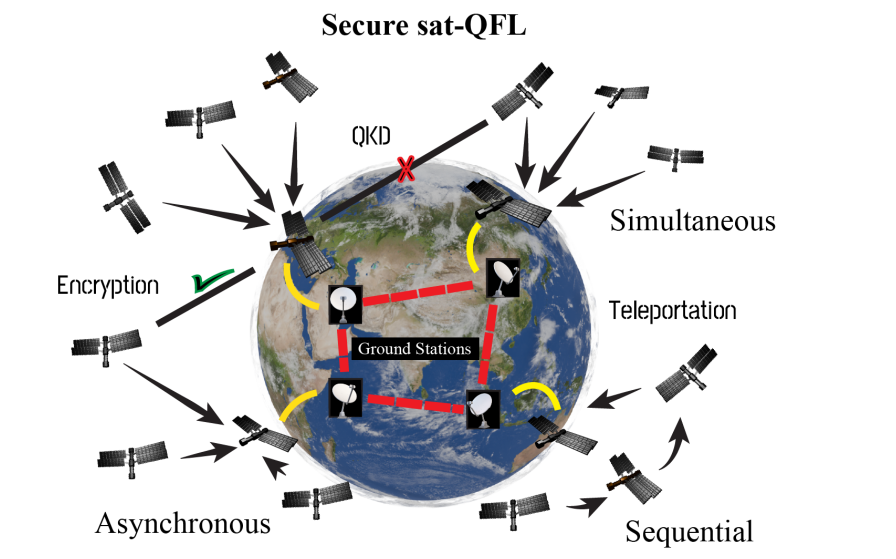
The increasing deployment of low Earth orbit satellite constellations presents significant challenges for collaborative machine learning, as traditional methods struggle with intermittent connections and strict latency requirements. Dev Gurung and Shiva Raj Pokhrel, from Deakin University, address this problem with sat-QFL, a novel quantum federated learning framework designed specifically for these dynamic networks. This system intelligently partitions satellites into roles based on connectivity, optimising training schedules to align with visibility windows and minimise communication bottlenecks. Crucially, sat-QFL incorporates quantum key distribution to ensure the confidentiality and integrity of exchanged models, offering a quantum-resilient approach to secure collaborative learning in space, and demonstrates robust performance under realistic conditions.
Satellites operate in defined roles, with some maintaining constant ground connections and others relying solely on links between satellites, and the system schedules training sessions to align with when satellites are visible. To ensure secure and reliable machine learning, sat-QFL integrates quantum key distribution, establishing secure key exchange, with authenticated encryption for model exchange; researchers also investigated quantum teleportation as a means of transferring quantum information.
Federated Learning for Satellite Constellations
Research focuses on applying federated learning to networks of low Earth orbit satellites and integrated space, air, and ground communication systems. Key areas of investigation include improving efficiency by reducing communication overhead and accelerating convergence, enhancing security and privacy through techniques like secure aggregation and decentralized key generation, and overcoming the challenges of intermittent connections, limited bandwidth, and high latency inherent in satellite links. Scientists are also exploring the use of high-altitude platforms and edge computing to assist in the learning process. Quantum computing and communication play a significant role, with studies examining quantum key distribution using satellites for secure key exchange and the feasibility of quantum teleportation.
Researchers utilise datasets like Statlog, derived from Landsat satellite imagery, and EuroSat, designed for land use classification, to benchmark and evaluate their algorithms. Specific techniques under investigation include secure aggregation, decentralized key generation, split learning, asynchronous federated learning, and one-shot federated learning, all aimed at improving performance and efficiency. Zero trust architecture is being applied to satellite communication networks, and quantum neural networks are being explored for machine learning tasks. Parallel training methods are being developed to accelerate the training of these quantum networks.
Frequent contributors to this field include M. Elmahallawy and T. Luo, who have published extensively on federated learning in satellite constellations, and S. R. Pokhrel, researching quantum federated learning and secure satellite communication.
Zhai and colleagues developed FedLEO, a decentralized framework for low Earth orbit networks, while N. Razmi, B. Matthiesen, A. Dekorsy, and P. Popovski have contributed to ground-assisted federated learning in these constellations. Low Earth orbit satellites are the primary focus of this research, alongside integrated space, air, and ground networks and the use of high-altitude platforms and mobile edge computing. This body of work represents a comprehensive survey of current research aiming to leverage the benefits of both federated learning and quantum technologies to create more secure, efficient, and resilient communication and computation systems in space and on Earth.
Satellite Quantum Federated Learning For Constellations
Scientists have developed sat-QFL, a new quantum federated learning framework specifically designed for low Earth orbit satellite constellations. This framework addresses the unique challenges of intermittent connectivity and strict latency requirements by categorising satellites into primary and secondary roles, optimising communication and training schedules. The team demonstrates robust model aggregation even with varying satellite participation, effectively mitigating communication bottlenecks while maintaining modest security overhead. The sat-QFL framework integrates quantum key distribution with authenticated encryption to establish secure key exchange and protect model parameters during transmission, enhancing confidentiality and integrity.
Researchers also assessed quantum teleportation as a potential method for transferring quantum information, further bolstering security protocols. Experiments reveal that the asynchronous approach employed by sat-QFL effectively mitigates delays, optimising resource utilisation within the low Earth orbit environment. A comprehensive comparison with existing federated learning approaches demonstrates the advantages of sat-QFL, which incorporates quantum security measures and a topology-aware design. This research delivers a practical and robust system for quantum federated learning in low Earth orbit settings, paving the way for secure and efficient collaborative learning in space.
Satellite Quantum Federated Learning Achieved
This work presents sat-QFL, a new quantum federated learning framework specifically designed for low Earth orbit satellite constellations. Researchers addressed the unique challenges posed by intermittent connectivity, fluctuating participation, and strict latency requirements inherent in these systems. The team developed a hierarchical approach, partitioning satellites into primary and secondary roles to optimise communication and training schedules. The implementation integrates quantum key distribution with authenticated encryption to ensure the confidentiality and integrity of model exchanges, while also assessing the feasibility of quantum teleportation for transferring quantum information.
Results demonstrate that sat-QFL sustains robust model aggregation even with fluctuating satellite participation and achieves this with modest security overhead. Performance evaluations, conducted using realistic constellation traces and workloads, show trade-offs between communication time and overall performance, confirming the practicality of the framework for addressing critical issues in satellite communications. This research establishes a foundation for secure and efficient collaborative machine learning in the rapidly evolving domain of satellite-based applications.
🗞 sat-QFL: Secure Quantum Federated Learning for Low Orbit Satellites
🧠 ArXiv: https://arxiv.org/abs/2509.16504