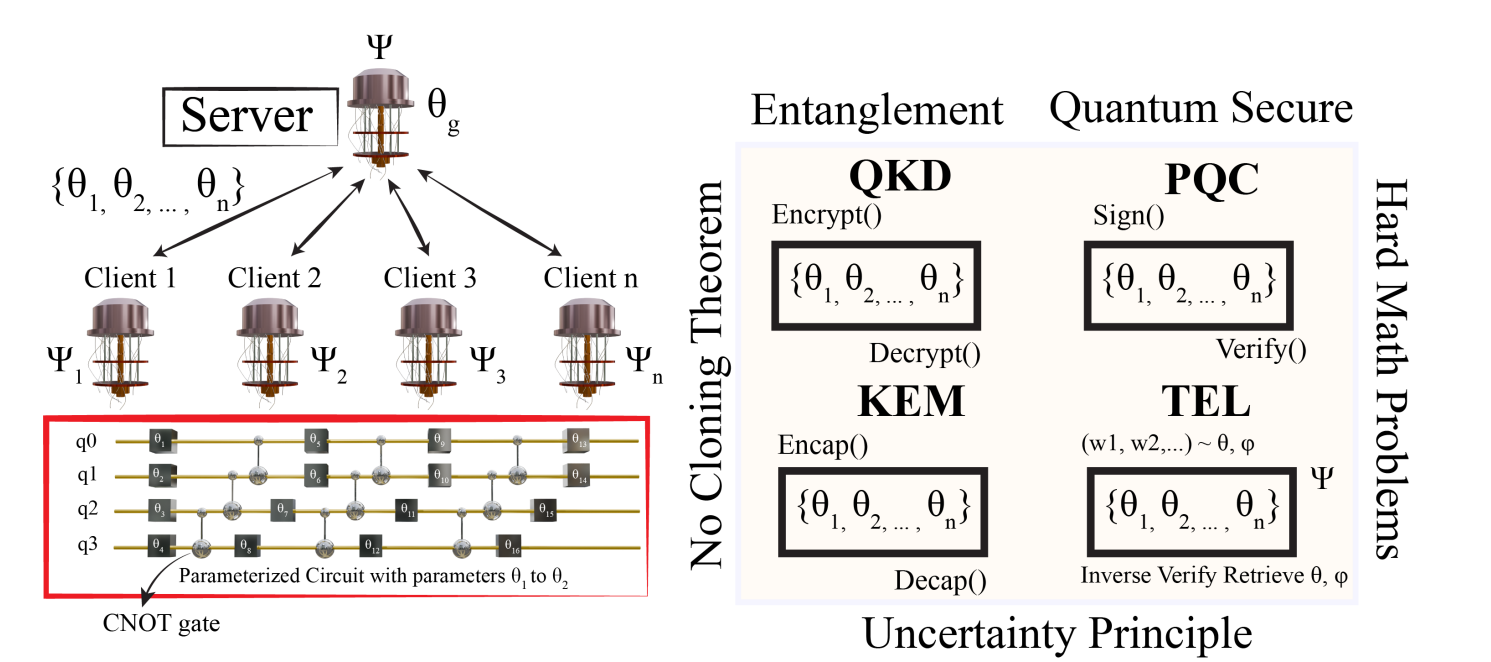
The increasing vulnerability of current encryption methods to quantum computers presents a significant challenge to the security of distributed machine learning, known as federated learning. Dev Gurung and Shiva Raj Pokhrel, from Deakin University, address this critical issue by introducing QuantumShield, a novel framework that fortifies federated learning against attacks from quantum-enabled adversaries. This research establishes a resilient security architecture, integrating advanced quantum and post-quantum protocols such as Quantum Key Distribution and Key Encapsulation Mechanisms, to create a secure and scalable ecosystem. By rigorously evaluating these mechanisms, the team demonstrates a pathway towards next-generation federated learning systems that maintain data confidentiality and integrity even in the face of increasingly powerful computing technologies.
Post-Quantum Signature and KEM Size Comparison
This analysis compares several post-quantum cryptographic algorithms, focusing on signature schemes and key encapsulation mechanisms (KEMs), and evaluates their size characteristics. The study considers key size, signature/ciphertext size, and claimed security levels, providing specific measurements to enable direct comparison. Algorithms are assessed based on compactness, with smaller sizes generally preferred. For signature schemes, MAYO-1 stands out with the smallest public key, secret key, and signature sizes. Falcon-512 offers a relatively small signature size among larger schemes.
In contrast, cross-rsdp-256-fast exhibits the largest public key, secret key, and signature sizes. Hash-based signatures, like SPHINCS+, generally have larger signature sizes but provide strong security guarantees, while lattice-based signatures offer a trade-off between key and signature size. Regarding KEMs, Kyber512 is the most compact, with small public key, ciphertext, and shared secret sizes. Classic-McEliece-8192128 has the largest public key, ciphertext, and shared secret. Classic McEliece is known for its large public key but relatively small ciphertext, while Kyber offers a good balance between size and performance. FrodoKEM exhibits relatively large key and ciphertext sizes.
Quantum Federated Learning with Multi-Layered Cryptography
Scientists engineered a novel quantum-secure federated learning (QFL) framework to protect distributed learning systems from potential attacks by quantum computers. Recognizing the vulnerability of current cryptographic methods, the team developed a resilient architecture integrating advanced quantum and post-quantum protocols. The study pioneered a multi-layered cryptographic approach, addressing vulnerabilities in aggregation, communication, and potential client compromises.
Researchers focused on preventing unauthorized access to local client models and mitigating the impact of malicious actors attempting to manipulate gradients or insert backdoors. The team investigated defenses against gradient manipulation, training rule manipulation, label flipping, and direct insertion of malicious code, ensuring the integrity of the learning process. Scientists implemented protocols to prevent the central server from influencing local client models and to detect and neutralize poisoned models. The framework incorporates techniques to analyze global models for data inference attacks, protecting the privacy of individual client datasets. This work extends beyond communication security, addressing threats during training, such as backdoor attacks and model poisoning, through careful manipulation of gradients and objective functions.
Quantum Teleportation Secures Federated Learning Systems
This work presents a groundbreaking quantum-secure federated learning (QFL) framework designed to protect distributed learning systems from attacks by quantum computers. Recognizing the vulnerability of current cryptographic methods, the team developed a resilient security architecture capable of withstanding threats from quantum-enabled adversaries. A key achievement involves utilizing quantum teleportation to securely share model parameters between devices and a server.
Experiments demonstrate that individual device parameters can be encoded as angles in a quantum state and reliably transmitted via entangled qubits. Measurements confirm that the server can accurately reconstruct these parameters after applying conditional gates and inverse transformations, enabling secure parameter aggregation. Using schemes like Kyber, devices encrypt their model parameters and securely transmit them to the server, which then decapsulates the ciphertext to recover the parameters, ensuring confidentiality and integrity.
Tests demonstrate that this approach allows for secure parameter aggregation and distribution, protecting the learning process from unauthorized access. The team also investigated the use of various Post-Quantum Cryptography (PQC) schemes, such as Dilithium and Falcon1024, for digital signatures. Experiments show that each device can sign its model parameters with its private key, and the server can verify the signatures using the corresponding public key, ensuring authenticity and preventing malicious modifications. The laws of quantum physics, such as the no-cloning theorem and Heisenberg’s uncertainty principle, prevent eavesdropping and ensure the confidentiality of the shared secret key, providing a robust foundation for secure communication and parameter sharing.
Quantum Federated Learning Against Future Threats
This work presents a novel quantum-secure federated learning framework designed to protect distributed learning systems from attacks enabled by quantum computers. Experimental results across different datasets indicate that the proposed framework maintains performance comparable to classical federated learning while significantly enhancing security against emerging quantum threats. The team’s findings establish a strong foundation for developing next-generation federated learning systems capable of resisting attacks from quantum computers, a growing concern as quantum computing technology advances. While the framework demonstrates promising results, the authors acknowledge that further research is needed to address potential vulnerabilities, such as photon attacks, and to explore the benefits of quantum networks and entangled distribution for multi-party key distribution. Future work also includes investigating the application of homomorphic encryption for aggregated computation, contingent upon advancements in the design of fault-tolerant quantum computers.
🗞 QuantumShield: Multilayer Fortification for Quantum Federated Learning
🧠 ArXiv: https://arxiv.org/abs/2510.22945