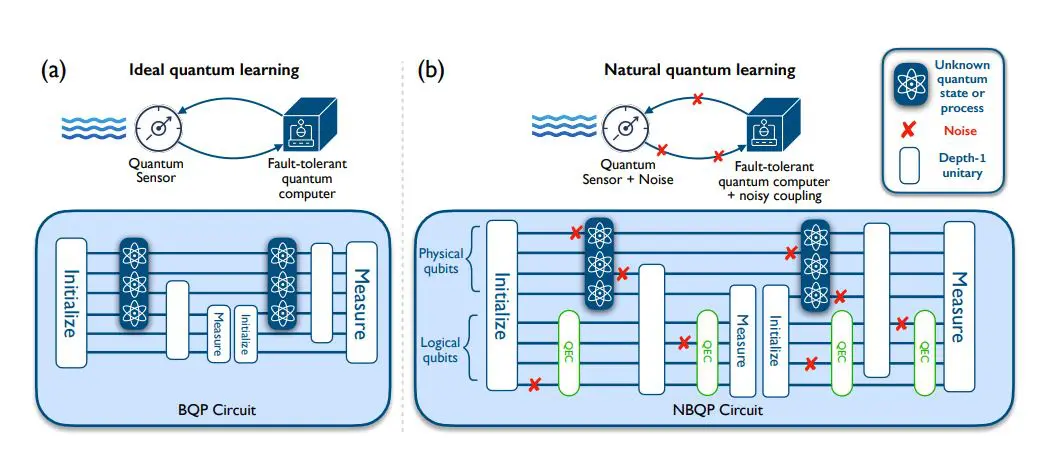
The challenge of extracting useful information from noisy quantum systems currently limits the potential of quantum technologies, and researchers are now investigating how this noise impacts the very foundations of quantum learning. Jordan Cotler from Harvard University, Weiyuan Gong from Harvard University, and Ishaan Kannan from Caltech, alongside their colleagues, develop a comprehensive framework to understand how noise affects the ability of quantum devices to learn from experiments. Their work demonstrates that common sources of noise can eliminate the significant learning advantages expected from ideal quantum systems, effectively blurring the line between current, limited “noisy intermediate-scale quantum” (NISQ) devices and the powerful, fault-tolerant quantum computers of the future. Importantly, the team identifies specific scenarios, inspired by theoretical physics, where noise-resistant structures can restore learning advantages, and they establish fundamental limits on how effectively we can characterise quantum systems in the presence of noise, paving the way for designing more robust quantum algorithms and experiments.
Beyond these theoretical separations, the team studies concrete noisy learning tasks, specifically purity testing, where established exponential speedups can be lost when realistic noise is introduced. However, they also identify a setting motivated by the AdS/CFT correspondence, in which inherent noise-resilience restores a quantum learning advantage in a noisy regime, suggesting potential avenues for robust quantum computation. The researchers then analyse noisy Pauli shadow tomography, deriving lower bounds that characterize the relationship between the size of the problem, the quantum memory required, and the level of noise, providing insights into the limitations and possibilities of this quantum technique.
Quantum Search Algorithms and Oracle Limitations
This research builds upon a foundation of prior work in quantum algorithms and complexity, including Simon’s demonstration of exponential speedup in quantum computation and Grover’s quadratic speedup for search algorithms. Investigations into the impact of noisy oracles on search complexity, and the impossibility of quantum speedup with faulty oracles, inform the current study. Recent work further explores quantum search with noisy oracles, while a unified framework for quantum algorithms has also been proposed. The team also draws upon advances in quantum error correction and codes, including holographic codes and entanglement renormalization techniques.
This research also benefits from prior work in quantum metrology and sensing, including explorations of quantum lithography and Heisenberg-limited parameter estimation. Investigations into optimal quantum estimation of loss in bosonic channels, and Mach-Zehnder interferometry at the Heisenberg limit, provide valuable context. Advances in quantum metrology subject to spatially correlated Markovian noise, and ultimate precision limits for noisy frequency estimation, also inform the study. Prior work in quantum learning and machine learning, including quantum principal component analysis and learning of stabilizer states, contributes to the research. Work on entanglement-enabled learning and multi-copy quantum learning tasks provides further context. Finally, the research draws upon foundational work in quantum information, including Maldacena’s AdS/CFT correspondence.
Noise Limits and Restores Quantum Advantage
This research establishes a framework for understanding learning from experiments performed on devices susceptible to noise, particularly those accessing complex systems through imperfect connections. The team demonstrates that noise can eliminate the exponential advantages typically expected from ideal quantum learners, while still maintaining a significant, superpolynomial difference in capability between current, noisy intermediate-scale quantum (NISQ) devices and fully fault-tolerant quantum computers. Investigations into specific learning tasks, such as purity testing, reveal that even established exponential speedups can be lost under realistic noise conditions. However, the research also identifies scenarios where inherent noise-resilience within the experimental system can restore a learning advantage, highlighting the importance of considering the physical properties of the system alongside algorithmic techniques. Detailed analysis of Pauli shadow tomography, a method for characterizing quantum states, establishes fundamental limits on sample complexity in noisy environments and informs the design of algorithms that approach these limits.
These findings collectively demonstrate that achieving meaningful quantum advantages requires a nuanced understanding of how noise interacts with both the experimental setup and the learning algorithms employed, and that advantages are more delicate and problem-dependent than previously assumed. The authors acknowledge that their lower bounds on sample complexity are specific to the noise models considered and that further research is needed to explore the impact of different noise characteristics. Future work should focus on developing learning strategies that explicitly leverage noise-robust physical properties and on designing experiments that minimize the detrimental effects of noise, ultimately informing both the development of near-term quantum technologies and the long-term potential of quantum computers as scientific instruments.