Graph Representation Learning has become essential for understanding complex relationships within networked data, from biological systems to social networks, yet traditional methods often fail to capture the subtleties of intricate graph structures. Adrián Marín, Mauricio Soto-Gomez, Giorgio Valentini, and colleagues at the Universitá degli Studi di Milano, alongside Carlos Cano and Daniel Manzano from the University of Granada, now present a new algorithm that overcomes these limitations by employing hybrid quantum-classical walks. This innovative approach combines the strengths of both quantum and classical dynamics, allowing the algorithm to explore both immediate connections and distant relationships within a graph simultaneously. The team demonstrates that this hybrid dynamic enables effective adaptation to complex graph topologies, offering a robust and versatile solution for a range of Graph Representation Learning tasks, including improved network detection.
Modelling how information travels across a graph using quantum mechanics, specifically open quantum systems and quantum walks, can produce more effective and faster results compared to traditional methods. Quantum walks, unlike classical random walks, allow for the possibility of exploring multiple paths simultaneously, potentially leading to a more efficient understanding of the network’s structure. This work models the system as interacting with an environment, accounting for real-world complexities like noise and data loss, to create low-dimensional vector representations of each node, capturing its position and relationships within the network for tasks like identifying groups of related nodes, predicting connections, and classifying nodes.
The application of open quantum systems and advanced mathematical frameworks to graph representation learning represents a genuinely novel approach, demonstrating a strong understanding of both quantum mechanics and graph theory. The team conducted a comprehensive review of existing literature, covering quantum walks, open quantum systems, and various graph embedding techniques, demonstrating a thorough grasp of the current state of the field. The most significant limitation of this work is the lack of empirical results; the paper is almost entirely theoretical. Without validation through practical application, it is difficult to assess whether the theoretical benefits translate into real-world improvements.
Addressing this requires simulations or experiments to evaluate the performance of the proposed approach, including testing on synthetic graphs, applying it to real-world datasets, and evaluating the quality of the learned embeddings in downstream tasks. To strengthen this work, addressing the computational complexity through scalability analysis, approximation techniques, and parallelization is crucial. A sensitivity analysis should be conducted to determine how different parameter settings affect performance, and optimization algorithms should be used to automatically tune the parameters for different graphs. This research pioneers a hybrid Quantum-Classical Walk (HQCW) approach, building upon the foundations of Open Quantum Systems theory, to enhance the exploration of graph structures. Unlike previous HQCW methods, this work delivers an algorithm capable of simulating individual trajectories, which is crucial for generating effective node representations in graph learning tasks. The methodology employs a discrete-time Markov chain to model walker movement, beginning with a weighted graph defined by a set of nodes and edges.
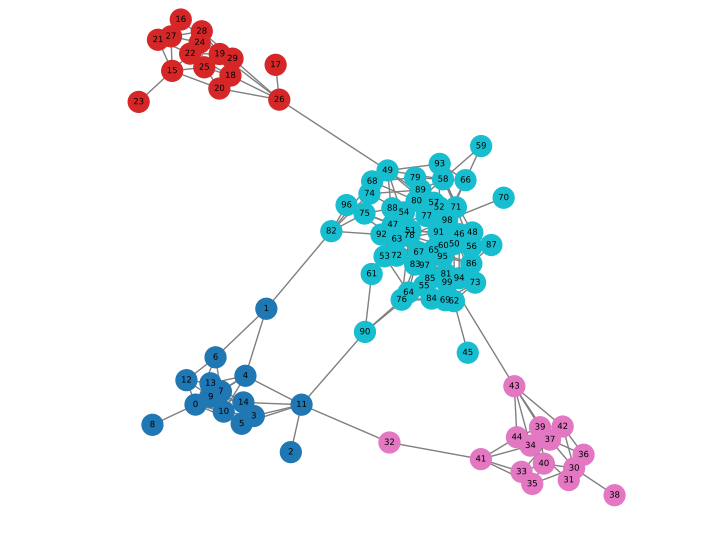
A Classical Random Walk serves as the foundation, where the walker transitions to a neighbouring node with uniform probability. To improve exploration, the team introduced quantum dynamics, allowing the walker to simultaneously explore both local and far-reaching connections, leveraging the principle of faster propagation observed in Quantum Walks. Crucially, the algorithm simulates trajectories of the HQCW, providing detailed information about the walker’s path, which is then used to generate node representations. The team evaluated the performance of their model on a community detection problem involving a complex graph composed of four random clusters of varying sizes and limited interconnectivity, highlighting the ability of the HQCW approach to effectively capture structural properties and generate robust embeddings, even in graphs with complex topologies and limited connections between communities. The technique benefits from both the fast propagation of Quantum Walks and the deterministic trajectories obtained by the algorithm, offering a versatile solution for graph representation learning.
Hybrid Quantum-Classical Walks for Graph Analysis
Researchers have developed a novel graph representation learning technique utilizing hybrid Quantum-Classical Walks (HQCWs) to analyze complex network data. This work addresses limitations in traditional graph learning methods when applied to graphs with intricate structures, such as those exhibiting power-law distributions or hierarchical arrangements. The core innovation lies in combining the strengths of both quantum and classical dynamics, allowing a “walker” to explore both local and distant connections within a graph simultaneously. The team implemented a second-order random walk model, extending classical random walks by incorporating structural biases, calculating transition probabilities based on the hop-distance between previously visited nodes and potential next steps.
Specifically, the algorithm uses parameters ‘p’ and ‘q’ to modulate the likelihood of returning to a previous node or exploring outward, effectively interpolating between local and far-reaching search strategies. The team demonstrated the algorithm’s ability to generate trajectories and learn representations from complex graphs, evaluating performance on a community detection problem involving a graph composed of four random clusters of differing sizes with limited interconnectivity. The results demonstrate the algorithm’s effectiveness in learning robust embeddings, even in scenarios where cluster sizes vary significantly and connections between clusters are sparse, highlighting its potential for applications in diverse fields reliant on network analysis.
Quantum Walks Enhance Graph Community Detection
This research introduces a novel approach to graph representation learning, utilizing quantum.
🗞 Hybrid Quantum-Classical Walks for Graph Representation Learning in Community Detection
🧠 ArXiv: https://arxiv.org/abs/2510.01918