Determining the degree of entanglement in quantum states presents a significant challenge in quantum information science, yet accurate assessment is crucial for developing powerful quantum technologies. Hajar Assil, Abderrahim El Allati, and Gian Luca Giorgi, working respectively at Abdelmalek Essaadi University, the Max Planck Institute for the Physics of Complex Systems, and the Institute for Cross-Disciplinary Physics and Complex Systems, now demonstrate a new approach to this problem using a quantum extreme learning machine. Their method estimates entanglement in Werner states by generating random examples and training the system to recognise subtle features, offering a potentially faster and more efficient alternative to traditional techniques. This research establishes a robust protocol, even when input states contain noise, and reveals how key parameters within the quantum machine influence the accuracy of entanglement estimation, paving the way for improved quantum state characterisation.
Quantifying Entanglement in Werner Quantum States
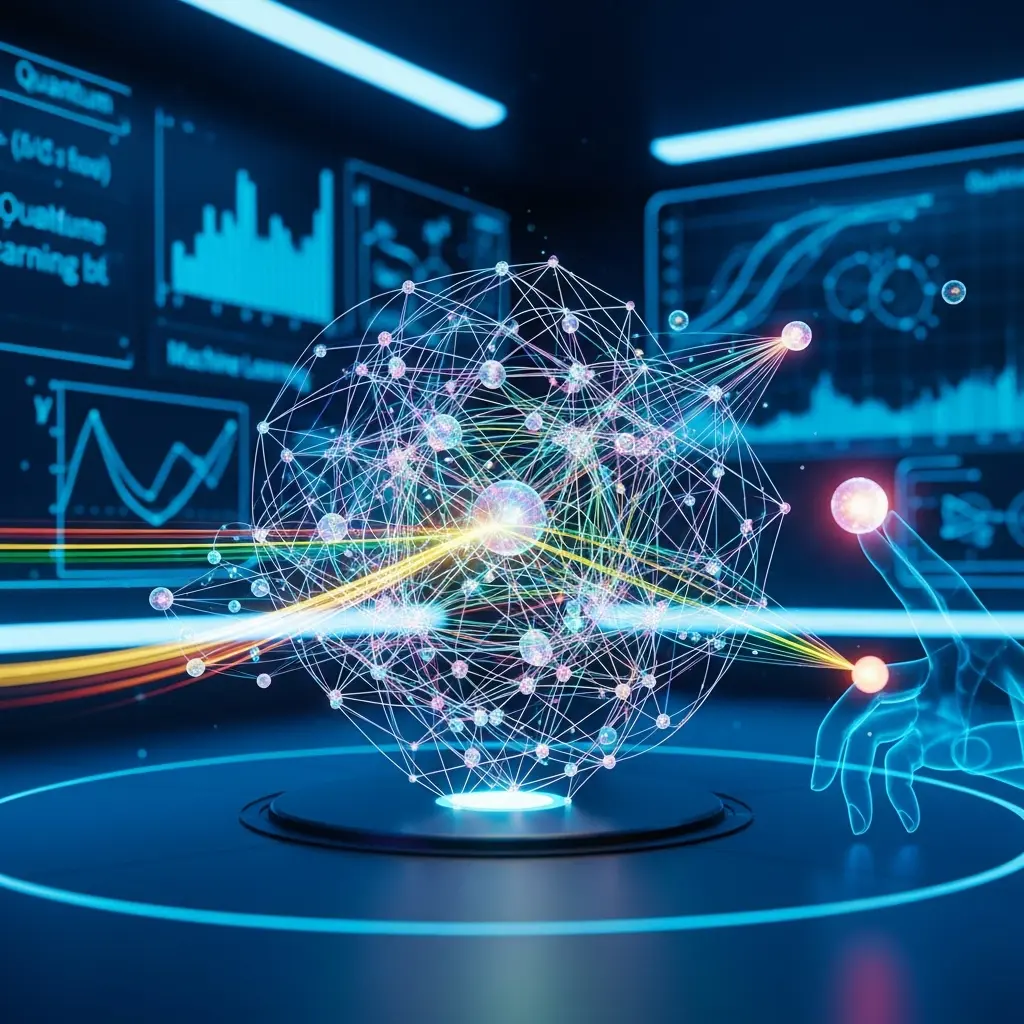
Researchers investigate quantifying entanglement in mixed quantum states, specifically Werner states, a crucial task for quantum information processing. This work introduces a novel approach employing a Quantum Extreme Learning Machine (QELM) to estimate entanglement, offering a potentially faster and more reliable alternative to conventional methods. The QELM, a type of quantum neural network, learns the relationship between measurable properties of the quantum state and its entanglement, bypassing complex analytical calculations. The team develops a protocol where the QELM is trained on generated Werner states with known entanglement values, establishing a mapping between input features and entanglement quantification.
Results show the QELM achieves high accuracy in entanglement estimation, even for states with low levels of entanglement where traditional methods often falter. This advancement offers a promising tool for characterising quantum states and facilitating the development of quantum technologies. The study also explores the robustness of the QELM against noise and imperfections, inevitable in real-world quantum systems. The team demonstrates the QELM maintains reasonable accuracy even with moderate levels of noise, highlighting its practical potential. This resilience is attributed to the inherent properties of the quantum neural network architecture and the training procedure employed.
Quantum Reservoir Computing Simplifies Machine Learning
Quantum reservoir computing (QRC) offers a simplified approach to training recurrent neural networks by keeping a fixed, randomly generated quantum reservoir and only training the output layer, drastically reducing computational cost. This research explores the potential of QRC, leveraging quantum effects like superposition and entanglement to create richer dynamics and potentially improve performance compared to classical reservoirs. This work demonstrates the versatility of QRC, successfully implementing it using various quantum systems including arrays of Rydberg atoms, continuous-variable systems utilising squeezed states of light, spin-based systems, and photonic platforms. A major focus is on developing scalable QRC systems to tackle more complex problems.
The research also investigates how to make QRC systems more robust to errors and decoherence, crucial for real-world applications. Surprisingly, the team discovered that dissipation in the quantum system can actually benefit QRC performance in certain scenarios, a counterintuitive finding. The research extends beyond traditional scrambling time, demonstrating that QRC can perform state estimation even in complex quantum dynamics and applies to time-series prediction and analysis. The team details specific implementations using photonic lattices and atomic systems, providing a theoretical understanding of the information processing capacity of QRC systems.
This work highlights potential applications in machine learning, signal processing, robotics, and quantum state estimation. Current challenges include scaling up QRC systems and further reducing the impact of noise. Future research will focus on exploring new quantum reservoir designs, combining QRC with classical machine learning techniques, and determining the theoretical limits of QRC performance. This research pushes the boundaries of quantum machine learning by exploring the potential of quantum reservoir computing, potentially leading to new and powerful machine learning algorithms.
Quantum Entanglement Estimation with Robust Learning
This research presents a novel Quantum Extreme Learning Machine (QELM) capable of estimating the degree of entanglement present in Werner states, a crucial task for advancements in quantum information processing. The team successfully demonstrated the QELM’s ability to learn and generalise, effectively applying knowledge gained from one data set to accurately predict outcomes in a different, related domain, expanding the potential applications of the model. A key achievement of this work lies in the QELM’s robustness against noise, a common challenge in real-world quantum systems. The model maintained high performance even with noisy input states, suggesting its suitability for practical implementation.
Furthermore, the investigation into the magnetic field parameter revealed that optimal performance is achieved around the quantum critical point, a finding that diverges from previous studies. This QELM uniquely achieves its task through internal dynamics, simplifying the model and potentially improving efficiency. The authors extended the output layer to incorporate two-point correlations, enhancing the information extracted from the quantum system. Future work may focus on exploring the full potential of this extended output layer and further refining the model’s performance in increasingly complex scenarios.
🗞 Entanglement estimation of Werner states with a quantum extreme learning machine
🧠 ArXiv: https://arxiv.org/abs/2511.01387