

The relentless flood of data from modern particle colliders demands increasingly sophisticated and rapid data selection techniques, and researchers are now exploring the potential of quantum machine learning to meet this challenge. Benedikt Maier from Imperial College London, along with Michael Spannowsky and Simon Williams from Durham University, investigate a novel approach using continuous-variable photonic quantum extreme learning machines. Their work demonstrates how encoding data in light and processing it with a fixed optical setup allows for exceptionally fast training of machine learning models, requiring only a single calculation to adapt to new data. This method achieves competitive performance on crucial particle identification tasks, such as distinguishing top-jets from background noise and identifying Higgs bosons, surpassing conventional machine learning algorithms with a fraction of the computational effort and offering the potential for real-time data analysis at future collider experiments.
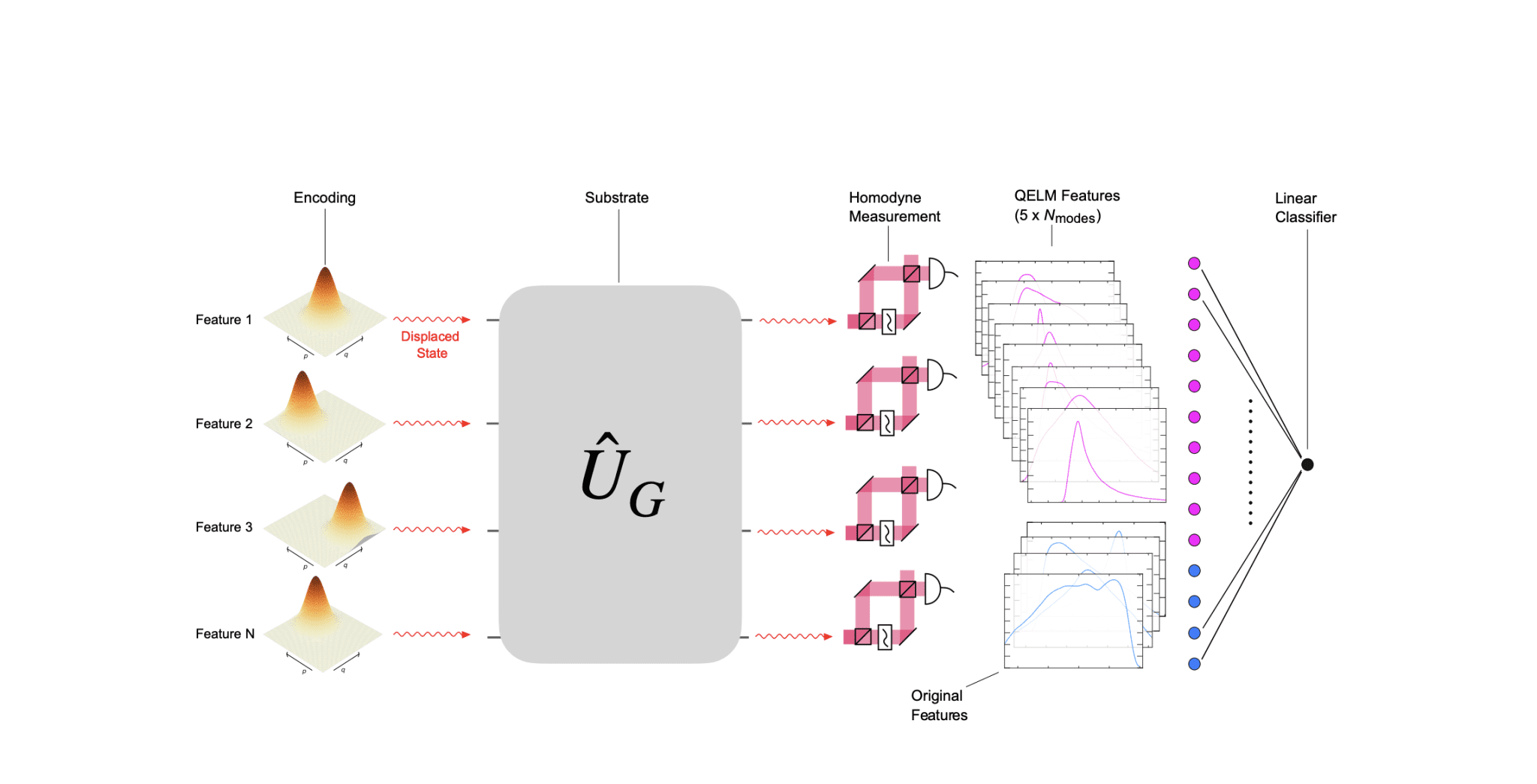
Learning machines function as fast, low-overhead front-ends for collider data processing. Data encodes in photonic modes through quadrature displacements and propagates through a fixed-time Gaussian quantum substrate. The final readout occurs through Gaussian-compatible measurements, producing a high-dimensional random feature map. Only a linear classifier trains, using a single linear solve, so retraining remains fast, and the optical path and detector response set the analytical and inference latency.
Quantum Machine Learning with Continuous Variables
This research explores the intersection of quantum machine learning, continuous variable quantum computing, and high-energy physics. A significant body of work focuses on leveraging quantum algorithms and hardware for machine learning tasks, including quantum neural networks and quantum kernels. Continuous variable quantum computing, which uses properties like the amplitude and phase of light, receives considerable attention due to its potential for near-term implementation with photonic systems. This approach connects directly to applications in high-energy physics, such as particle identification, event reconstruction, and data analysis.
The research also emphasizes photonic quantum computing and investigates practical hardware implementation with components like single-photon detectors and FPGAs. This collection of studies categorizes foundational quantum machine learning techniques, continuous variable quantum computing methods, quantum reservoir computing and extreme learning machines, high-energy physics applications, and hardware implementation details. Research focuses on feature Hilbert spaces, continuous-variable quantum neural networks, homodyne statistics, and quantum key distribution, while also demonstrating the use of machine learning for particle identification and data analysis. The inclusion of hardware details and FPGA implementation suggests a desire to move beyond theoretical proposals and demonstrate practical applications.
Photonic Machine Learning Outperforms Neural Networks
Scientists have achieved a breakthrough in collider data processing by developing a continuous-variable photonic extreme learning machine (QELM). This work demonstrates a novel approach to fast, low-overhead front-end processing, encoding data in photonic modes via quadrature displacements and propagating it through a fixed-time Gaussian substrate. The resulting high-dimensional random feature map enables rapid classification with only a linear classifier requiring a single linear solve for training. Experiments reveal that the photonic QELM outperforms a multi-layer perceptron (MLP) with two hidden units across all training sizes tested, and matches or exceeds the performance of an MLP with ten hidden units at larger sample sizes, while training only the linear readout layer.
These results demonstrate the ability of Gaussian photonic extreme learning machines to provide compact and expressive random features at fixed latency, a critical advantage for real-time data analysis. The team measured performance on two representative classification tasks, top-jet tagging and Higgs-boson identification, using standard public datasets and identical train, validation, and test splits. The photonic QELM’s architecture leverages deterministic timing and rapid retraining capabilities, offering significant advantages over traditional methods. Measurements confirm that the system operates with low optical power and at room temperature, making it a credible building block for online data selection and even first-stage trigger integration at future collider experiments. This breakthrough delivers a pathway towards ultra-fast, reconfigurable front-end processing for pattern recognition at the detector edge, potentially revolutionizing data analysis in high-energy physics.
Photonic Quantum Extreme Learning Machine Achieves Superior Performance
This research demonstrates a novel approach to data processing for high-energy physics, employing continuous-variable photonic extreme learning machines, or QELMs. The team successfully encoded data into the quadrature variables of light, propagating it through a fixed-time Gaussian substrate, and then reading it out using Gaussian-compatible measurements. This process generates a high-dimensional random feature map that, when combined with a linear classifier, allows for rapid data analysis and retraining, bypassing the need for computationally intensive back-propagation algorithms. The results show that this photonic QELM outperforms conventional machine learning models with limited hidden units on tasks such as top-jet tagging and Higgs-boson identification, achieving comparable or superior performance to larger models while training only the final linear layer.
This indicates the potential for compact and expressive random feature generation at a fixed latency, offering a significant advantage for real-time data selection at future collider experiments. The authors acknowledge that the current implementation relies on idealised Gaussian substrates and that further work is needed to account for realistic noise and imperfections in photonic devices. Future research directions include exploring more complex quantum substrates and investigating the scalability of this approach for even more demanding data processing tasks.
👉 More information
🗞 Continuous-variable photonic quantum extreme learning machines for fast collider-data selection
🧠 ArXiv: https://arxiv.org/abs/2510.13994


