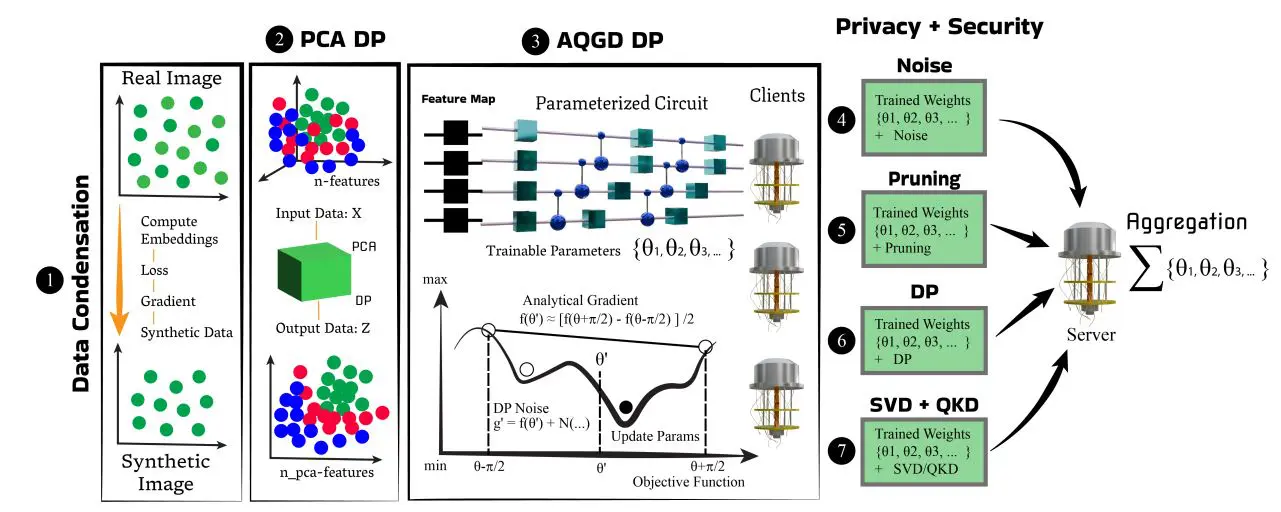
Federated Learning offers a powerful new approach to distributed machine learning, harnessing the collective processing power of numerous devices while collaboratively building a single model, but ensuring privacy remains a significant hurdle. Dev Gurung and Shiva Raj Pokhrel, from Deakin University, address this challenge with a novel privacy-preserving framework for Quantum Federated Learning. Their design integrates techniques such as Singular Value Decomposition, Quantum Key Distribution, and Analytic Gradient Descent to protect data and models throughout the entire training process, from initial preparation to final model updates. This work demonstrates a robust solution that safeguards confidentiality without sacrificing the efficiency needed for practical application, representing a substantial step towards secure and scalable distributed machine learning.
The work focuses on combining techniques like Dataset Condensation and Quantum Computing to improve both the efficiency and security of collaborative model training, allowing multiple parties to learn from data without directly sharing it. The goal is to enable collaborative machine learning while upholding the privacy of individual data contributors. Dataset Condensation reduces the size of a training dataset while preserving its essential information, speeding up training and reducing communication costs. Quantum Computing offers the potential for faster computations and enhanced security through the principles of quantum mechanics. Research demonstrates that dataset condensation significantly reduces communication costs and training time in FL by creating a small, condensed dataset that performs as effectively as the original, larger one.
Balancing privacy protection with model accuracy remains a challenge, but quantum computing is being explored as a way to improve the efficiency of tasks like secure aggregation and cryptographic operations. Secure aggregation protocols allow the central server to compute the aggregate of model updates without seeing individual updates, crucial for preserving privacy. The research also addresses vulnerabilities to poisoning attacks and explores methods for detecting and mitigating these threats. Several challenges remain in PPFL, including balancing privacy and accuracy, managing communication costs, and addressing system heterogeneity.
Security threats, such as data leakage and model
Security threats, such as data leakage and model inversion attacks, also need to be addressed. Future research focuses on developing more efficient privacy-preserving techniques, reducing communication costs, improving scalability, and exploring the potential of quantum computing. The ultimate goal is to create robust and reliable FL systems for real-world applications. In summary, PPFL is a promising approach to collaborative machine learning that protects data privacy. Combining techniques like dataset condensation, differential privacy, and quantum computing can improve the efficiency and security of these systems. The team initially employed SVD to reduce dimensionality and extract essential features from the data, obscuring individual data points.
Subsequently, QKD was implemented to establish secure communication channels between devices and the central server, ensuring encrypted transmission of model updates. This process leverages the principles of quantum mechanics to guarantee secure key exchange, preventing eavesdropping and unauthorized access. To further protect data privacy, the researchers implemented a differential privacy mechanism, adding carefully calibrated noise to model updates before transmission.
This noise masks the contribution of individual data instances, preventing attackers from inferring sensitive information. The level of noise is controlled by privacy parameters, allowing a trade-off between privacy and model accuracy. This work demonstrates robust protection of both data and model parameters during the learning process. The framework achieves (ε, δ)-differential privacy by adding Gaussian noise to gradients, with the amount of noise determined by the sensitivity of the gradient and the privacy parameters ε and δ. To further enhance privacy and efficiency, the team implemented a weight pruning technique, setting parameters with small absolute values to zero, reducing model complexity and communication overhead.
Experiments show that pruning, combined with averaging initial weights, improves performance in federated learning scenarios. The researchers also explored SVD for parameter compression, reshaping weight vectors into matrices and retaining only the top singular values to reduce data volume. This compressed data is then encrypted using keys established through QKD, ensuring secure communication of model updates. Measurements confirm that the SVD and QKD combination significantly reduces the encryption bottleneck while maintaining data security. The team successfully reconstructed weight matrices from compressed data, achieving accurate model updates. Furthermore, the research introduces a condensation technique to reduce training data size while preserving model performance, offering a pathway to reduce computational and communication costs. Through theoretical analysis and experimentation using both the MNIST and genomic datasets, they demonstrate that this framework effectively protects privacy without significantly compromising training efficiency. The team conducted extensive ablation studies and comparative analyses, revealing comparable performance to standard federated learning approaches, and in some instances, even improvements in accuracy. Notably, the use of data condensation techniques, reducing dataset size from 20,000 to 400 samples, substantially reduced communication overhead without significant performance loss. Future work will focus on developing advanced quantum privacy protocols and exploring more sophisticated privacy-preserving frameworks to further enhance the security and scalability of quantum federated learning.
👉 More information🗞Scaling Trust in Quantum Federated Learning:
🗞 Scaling Trust in Quantum Federated Learning: A Multi-Protocol Privacy Design
🧠 ArXiv: https://arxiv.org/abs/2512.03358