Ground-state estimation represents a fundamental challenge in quantum simulation, yet current near-term approaches often struggle with complex energy landscapes. Kyunghyun Baek, Seungjin Lee, and Joonsuk Huh, alongside their colleagues, present a new method, the quantum amplitude-amplification eigensolver (QAAE), which moves beyond traditional energy minimization techniques. This innovative approach coherently guides a trial state towards the ground state using quantum amplitude amplification, avoiding the need to calculate energy gradients and instead relying on a state-learning process to refine the solution. Demonstrating both theoretical convergence and practical performance on IBMQ processors and through numerical benchmarks on various systems, including complex Ising models, the team establishes QAAE as a promising, hardware-compatible pathway towards accurate and stable ground-state estimation for near-term quantum simulations.
Hybrid Algorithm Finds Hamiltonian Ground States
This research details a growing area of hybrid quantum-classical algorithms designed to solve complex quantum mechanical problems, specifically finding the ground state, the lowest energy state, of a Hamiltonian. The work addresses limitations of existing variational quantum algorithms (VQAs) and proposes methods to improve their performance. Determining ground states is crucial in fields like quantum chemistry, materials science, and condensed matter physics, but classical methods struggle with many-body quantum systems due to the exponential increase in computational cost as system size grows. VQAs offer a potential solution by leveraging quantum computers to prepare trial wavefunctions and estimate energy, while classical optimizers adjust the wavefunction parameters to minimize that energy.
VQAs face significant challenges, including the ‘barren plateau’ phenomenon, where the gradient of the cost function vanishes with the number of qubits, making optimization extremely difficult. Highly expressive quantum circuits, while desirable, can also be harder to train. Classical optimizers can also get stuck in local minima, and current quantum computers are noisy, introducing errors into energy estimates. To address these issues, the researchers explored techniques including utilizing ancillary qubits to improve the optimization landscape, improved classical optimization methods, and more efficient quantum circuit designs.
Optimizing how quantum observables are measured to reduce noise and employing error mitigation techniques were also key areas of focus, alongside leveraging symmetries within the Hamiltonian to reduce computational cost and expanding the search space within a relevant quantum subspace. The research involved studies on various quantum systems, including the Transverse-Field Ising Model and the Hubbard Model, as well as the Hydrogen Molecule (H2) and Lithium Hydride (LiH) as benchmark problems. The key takeaway is that hybrid algorithms offer a promising path towards solving complex quantum mechanical problems on near-term quantum computers. Addressing barren plateaus and mitigating noise are essential for scaling VQAs to larger systems, and continued research is needed to develop more efficient and robust VQA methods.
Quantum Amplitude Amplification for Ground State Estimation
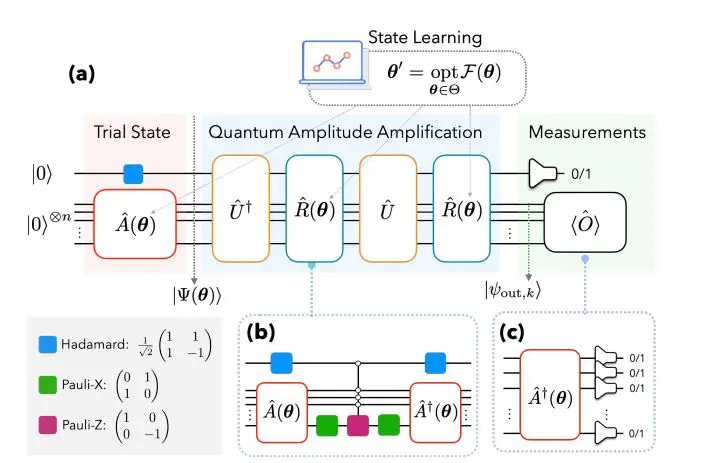
Scientists have developed the quantum amplitude-amplification eigensolver (QAAE), a novel approach to ground-state estimation that moves beyond traditional variational methods. Unlike techniques that rely on minimizing energy, QAAE coherently drives a trial state towards the ground state using quantum amplitude amplification. The method begins by preparing a trial state using a quantum circuit and then applies a process incorporating a normalized Hamiltonian, central to the amplification step. A key innovation lies in the use of a reflection operation, implemented using the quantum circuit itself, which, combined with the Hamiltonian-based process, forms the core of the amplification transformation.
This transformation is applied to the trial state, and a measurement on an ancillary qubit yields an amplified state closer to the true ground state. The team then enters a ‘learn’ phase, reconfiguring the trial state by using the amplified state as the basis for a new quantum circuit. This amplify-learn loop is repeated iteratively, with each cycle increasing the overlap between the trial state and the ground state. The process was validated through experiments on IBMQ processors, and numerical benchmarks demonstrate that QAAE surpasses gradient-based methods in both accuracy and stability, particularly when integrated with chemistry-inspired and hardware-efficient quantum circuits.
Quantum Amplitude Amplification Finds Ground States
Scientists have developed the quantum amplitude-amplification eigensolver (QAAE), a new method for estimating ground states in quantum simulations that moves beyond traditional variational approaches. This work introduces a technique that coherently drives a trial state towards the ground state, utilizing quantum amplitude amplification rather than relying on minimizing energy landscapes. The process involves alternating a reflection about a learned trial state with controlled evolution under a normalized Hamiltonian, demonstrably increasing the overlap with the ground state. Experiments conducted on an IBMQ processor successfully verified the amplification mechanism.
Further numerical benchmarks were performed on systems including H2, LiH, and a 10-qubit system, demonstrating that QAAE integrates effectively with both chemistry-inspired and hardware-efficient quantum circuits. Notably, the 10-qubit benchmark achieved higher accuracy and reliability compared to the variational quantum eigensolver (VQE) when using comparable resources. This breakthrough delivers a method that avoids the pitfalls of energy-landscape exploration and gradient pathologies, offering a robust alternative for ground-state estimation.
Guaranteed Ground State Improvement via Amplification
The team developed the quantum amplitude-amplification eigensolver (QAAE), a new method for estimating the ground state of quantum systems. Unlike conventional variational approaches that search for the lowest energy state by navigating complex energy landscapes, QAAE coherently amplifies the ground-state component of a trial state and then re-encodes the result into the chosen quantum circuit. This process, which alternates between amplification and learning, demonstrably increases the overlap with the ground state in each round, offering a guaranteed improvement under standard conditions. Validation of QAAE involved experiments on IBMQ hardware. This method offers a promising route towards solving complex quantum mechanical problems on near-term quantum computers.
🗞 Quantum Amplitude-Amplification Eigensolver: A State-Learning-Assisted Approach beyond Energy-Gradient-Based Heuristics
🧠 ArXiv: https://arxiv.org/abs/2511.12062