Quantum machine learning rapidly gains momentum as a potential pathway to more powerful computation, and a team led by A. De Lorenzis, M. P. Casado, and N. Lo Gullo investigates a specific approach called Quantum Extreme Learning Machines. These machines simplify the training process by focusing on the final layer, and the researchers combine techniques for reducing complexity with quantum dynamics to create a novel learning architecture. Their work reveals a surprising and critical transition point during the machine’s operation, where accuracy jumps sharply before levelling off at a performance level comparable to the most complex quantum systems. Importantly, this transition happens quickly enough for information to spread to nearby components, and the team demonstrates that the machine’s effectiveness does not depend on its size, suggesting that these quantum learning machines may be more readily simulated using conventional computers than previously thought.
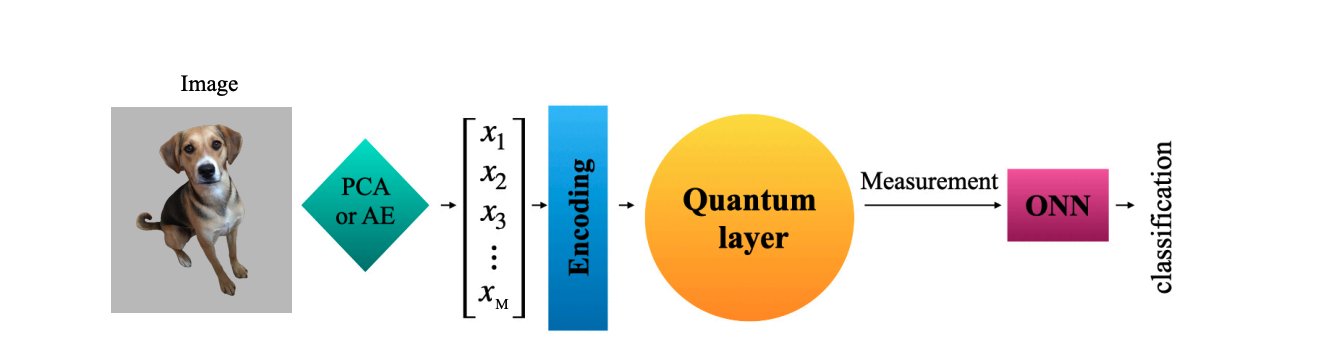
The proposed architecture combines dimensionality reduction, utilising either Principal Component Analysis or Autoencoders, with quantum state encoding. Evolution under an XX Hamiltonian then follows, before measurement provides features for a single-layer classifier. By analysing the performance of QELMs, researchers aim to establish their potential within the field of quantum computation and machine learning.
Quantum Reservoir Computing with Entanglement
Quantum Reservoir Computing (QRC) stands out as a promising approach to quantum machine learning, leveraging the complex dynamics of quantum systems for computational tasks. QRC utilizes a quantum system, often referred to as a ‘reservoir’, to map input data into a high-dimensional feature space, enabling effective classification and regression. Entanglement, a key quantum property, plays a crucial role in enhancing the computational power of QRC. Researchers are actively exploring various hardware implementations of QRC, including systems based on Rydberg atoms and spin-based systems. Autoencoders and neural networks are frequently employed to reduce the dimensionality of input data before it is processed by the quantum reservoir, simplifying the data while preserving essential features.
Benchmarking QRC systems against classical machine learning algorithms using datasets like MNIST, Fashion-MNIST, and CIFAR is essential for evaluating their performance. Higher-order QRC and projected quantum kernel methods represent specific algorithms designed to improve the performance of these quantum systems. The team discovered that QELMs, which utilize a unique combination of dimensionality reduction, quantum evolution, and measurement, can effectively learn and classify complex datasets. Experiments reveal a distinct transition in performance, where the accuracy rapidly increases and then plateaus, reaching levels comparable to those achieved with highly complex, random quantum systems. The research demonstrates that QELMs achieve saturation accuracy matching that of random unitary transformations, which optimally scramble information.
Remarkably, the critical time required for this transition, around a value of 1, remains consistent regardless of the system size, meaning the number of qubits does not affect the speed of learning. This independence suggests that QELMs can be efficiently simulated using classical computers for a wide range of tasks, despite their quantum mechanical underpinnings. Further investigation revealed a connection between the QELM’s performance and the spreading of information within the quantum system. The team found that while quantum evolution initially scrambles information locally, a global mapping between input and output is preserved, enhancing the ability to distinguish between different inputs.
This is particularly noteworthy because the specific Hamiltonian used, the XX model, is highly specific, translationally invariant, and even integrable, yet still achieves performance comparable to random quantum systems. The saturation accuracy achieved by QELMs consistently aligns with the performance of systems driven by random unitary transformations, confirming that information spreading is a key factor in successful classification. These findings open new avenues for developing efficient and scalable quantum machine learning algorithms with potential applications in image recognition, data analysis, and beyond.
🗞 Behind the scenes of the Quantum Extreme Learning Machines
🧠 ArXiv: https://arxiv.org/abs/2509.06873