Bloch oscillations (BOs), the oscillations of electrons under constant external forces in a lattice, were first studied a century ago but only observed in the 1990s due to defects in real-life crystals. Researchers have now successfully simulated BOs in a one-dimensional superconducting circuit with nine qubits and achieved coherent control of BOs by applying a well-controlled driving force. This could have significant implications for quantum computing, potentially leading to new methods of quantum information processing. The research also paves the way for further studies on BOs and super-Bloch oscillations (SBOs).
What are Bloch Oscillations and How Can They Be Controlled?
Bloch oscillations (BOs) are oscillations of electrons under external constant forces in a lattice, revealing the wavelike behavior of electrons. These oscillations lead to the localization of the wave packet, a phenomenon known as Wannier-Stark localization (WSL), which results in the inhibition of conductivity. This concept was first studied about a century ago by Bloch and Zener, and by Wannier in the 1960s. However, due to defects and dissipations in real-life crystals, the observation of BOs was not achieved until the experiments on semiconductor superlattices in the 1990s. Since then, BOs have also been observed in Bose-Einstein condensates, optical waveguide arrays, and superconducting circuits.
The amplitude of the BO, viewed as a quantification of the WSL, can be tuned to be much larger by applying periodic driving on top of the constant force, giving rise to the so-called super-Bloch oscillations (SBOs). This effect can be used as a control knob for the turning on or off of transportation. It has triggered many ongoing research works on the subject of BOs and SBOs in both theory and experiment.
Superconducting circuits offer a promising platform for quantum simulations in condensed-matter physics due to their excellent scalability, editable Hamiltonian, and precise controllability. Unsymmetrical BOs and WSLs have been demonstrated in superconducting circuits, however, the coherent control of BOs remains a subject of ongoing studies.
How Can Superconducting Circuits Be Used to Control Bloch Oscillations?
In a recent study, researchers realized symmetrical BOs and the coherent control of BOs by applying a driving force. They observed the competition between BO and SBOs by changing the phase and amplitude of the driving. The BOs were simulated experimentally by using an array of nine superconducting qubits. With precise onsite control of the qubit frequencies in the time domain, a constant force and a driving force were realized to manipulate the wave packet of the photon.
The researchers observed the delocalization of the wave packet with resonant driving due to assisted tunneling between the Wannier-Stark levels. Additionally, they observed more localization with a detuned driving with a specific amplitude and phase, which exhibits quantum interference between the wave of BOs and the driving wave.
What is the System Hamiltonian and Simulation Design?
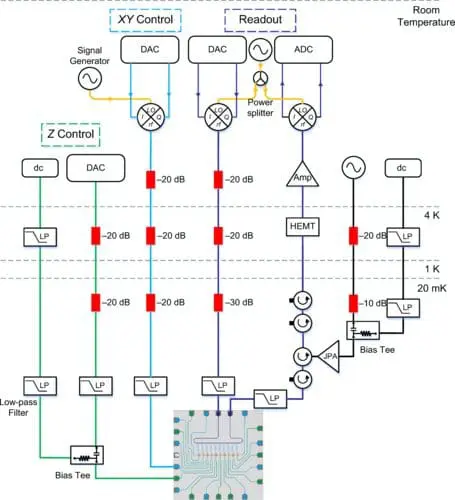
The experiment was performed on a superconducting chip in a dilution refrigerator with a base temperature of about 15 mK. The chip contains ten transmon qubits, each with its own readout cavity and XY and Z control lines. All the readout cavities are coupled to a readout line for multiplexed readout. To maintain the parity symmetry with respect to a central qubit, only nine of them were utilized for the coherent control experiment of BOs.
In order to observe SBOs, an experimental configuration was required. To realize it, the frequencies of the nine qubits were linearly detuned by a gradient of F, and each qubit was modulated to make its frequency oscillate in time with the same frequency FD, but with different amplitudes. The amplitudes increase linearly with respect to the distance from the central qubit.
What Does This Mean for the Future of Quantum Computing?
The successful simulation of BOs in a one-dimensional superconducting circuit with nine qubits and the realization of the coherent control of BOs by applying a well-controlled driving force with a frequency close to BOs is a significant step forward in the field of quantum computing. This study demonstrates the visualized wave behavior of electrons and proves a way to modulate electron transport in a perfect lattice.
The ability to control the amplitude of BOs and to turn on or off the transportation of electrons could have significant implications for the development of quantum computing technologies. The precise control of qubit frequencies in the time domain to manipulate the wave packet of the photon could lead to new methods of quantum information processing.
The research also opens up new avenues for further studies on the subject of BOs and SBOs, both in theory and experiment. The use of superconducting circuits as a platform for quantum simulations in condensed-matter physics could lead to new discoveries and advancements in the field.
Publication details: “Coherent Control of Bloch Oscillations in a Superconducting Circuit”
Publication Date: 2024-04-03
Authors: Pengtao Song, Zhongcheng Xiang, Yu-Xiang Zhang, Zhan Wang, et al.
Source: PRX Quantum 5, 020302
DOI: https://doi.org/10.1103/PRXQuantum.5.020302