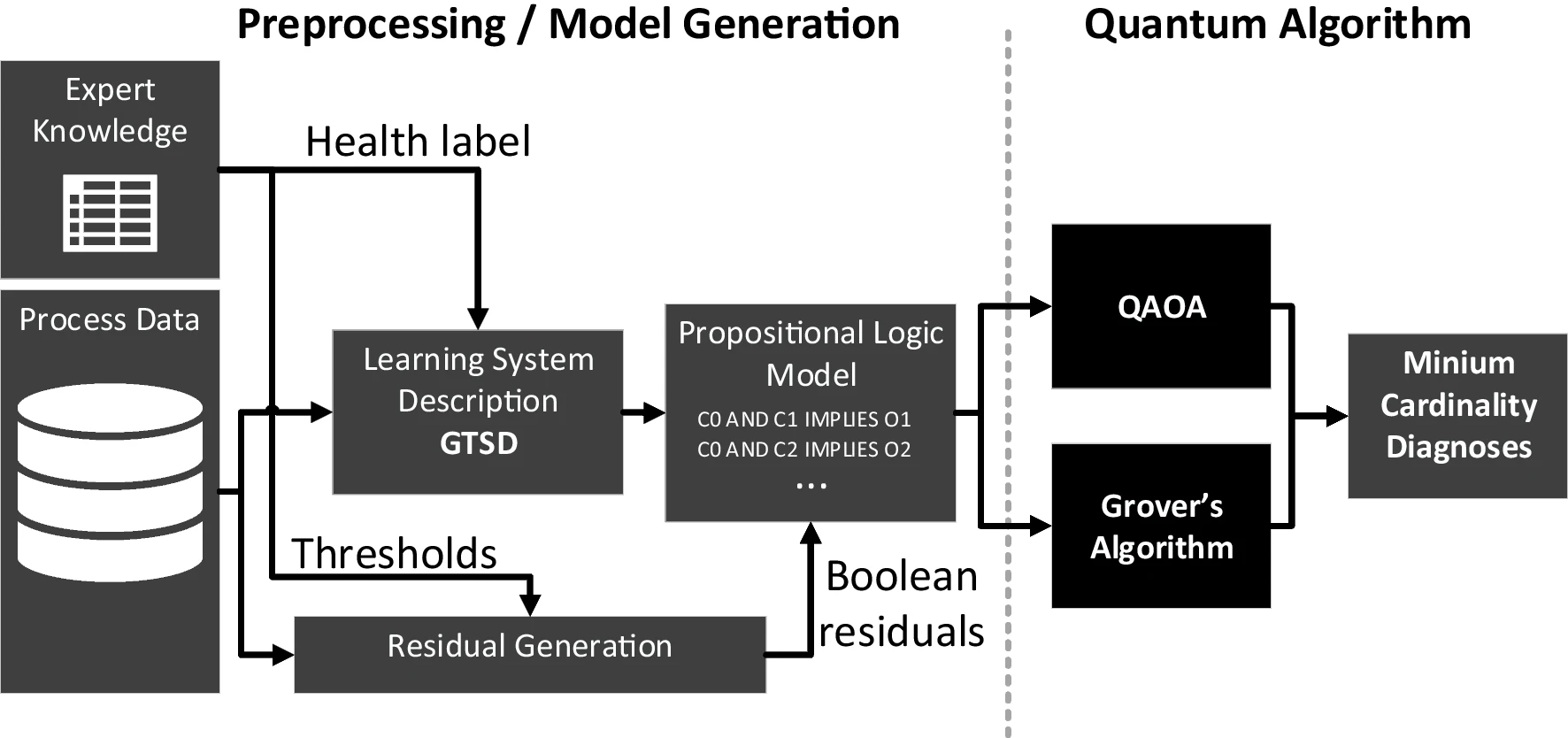
Industrial cyber-physical systems face a daunting challenge in fault diagnosis, with traditional manual and expert-driven methods often proving expensive, slow, and error-prone. However, researchers are now exploring the potential of quantum computers to solve this problem, leveraging their ability to process vast amounts of data exponentially faster than classical computers.
Studies have shown that quantum computers can significantly outperform classical PCs regarding runtime, making them a promising solution for industrial fault diagnosis. Researchers have proposed novel approaches using Grover’s algorithm and the Quantum Approximate Optimization Algorithm (QAOA) to diagnose faults efficiently and accurately. These approaches have been evaluated on an IBM Falcon processor, demonstrating impressive results.
Moreover, an integrated approach combining machine learning techniques with quantum computing has been proposed. This approach can learn a diagnosis model from process data and use it for diagnosis. This approach has shown significant promise in runtime and accuracy, outperforming traditional methods.
As researchers continue to explore quantum computers’ potential in industrial fault diagnosis, several future directions emerge, including scalability, hybrid approaches, and real-world applications. By addressing these challenges and opportunities, researchers can unlock quantum computers’ full potential in solving industrial fault diagnosis problems, leading to significant improvements in efficiency, safety, and productivity.
Can Quantum Computers Revolutionize Industrial Fault Diagnosis?
The world of industrial cyberphysical systems, which includes injection molding machines, mixers, bottling plants, and tank systems, is a complex one. These systems are characterized by high interconnectivity, modularity, throughput, and the number of system parameters. Reliable fault diagnosis is crucial for plant personnel to troubleshoot issues and minimize repair costs and downtime. However, fault diagnosis is a challenging task that often demands exponential runtime.
Researchers have turned to quantum computation as an efficient solution for industrial fault diagnosis problems to mitigate this issue. Quantum computers can process vast amounts of data exponentially faster than classical computers, making them an attractive option for solving complex problems like fault diagnosis. The use of quantum computers for fault diagnosis has become a significant area of applied research.
The first challenge in using quantum computers for fault diagnosis is efficiently solving the diagnosis problem itself. Many diagnostic procedures are based on reduction to the NP-complete satisfiability problem, which requires exponential runtime. To overcome this hurdle, researchers have proposed novel approaches that exploit quantum computing to solve diagnosis problems. These methods include employing Grovers algorithm and the Quantum Approximate Optimization Algorithm (QAOA).
What Are the Key Challenges in Using Quantum Computers for Fault Diagnosis
What Are the Key Challenges in Using Quantum Computers for Fault Diagnosis?
One of the primary challenges in using quantum computers for fault diagnosis is obtaining available models from heterogeneous cyberphysical systems. In practice, many companies still rely on manual and expert-driven diagnosis and repair procedures, which are often expensive, slow, and error-prone. This approach can lead to significant downtime and repair costs.
Another challenge is that most publications using quantum computers for fault diagnosis have employed quantum annealers, a specific type of quantum computer designed for solving optimization problems. However, this article proposes two novel approaches to conducting fault diagnosis on universal quantum computers (QCs). These methods aim to leverage the power of QCs to solve complex diagnosis problems more efficiently.
How Do Quantum Computers Compare to Classical PCs in Solving Fault Diagnosis Problems?
This study analyzes the scaling between quantum computers and classical PCs. The results show that quantum computers can process vast amounts of data exponentially faster than classical PCs, making them an attractive option for solving complex problems like fault diagnosis. However, the actual performance of quantum computers depends on various factors, including the quality of the quantum hardware and the specific algorithm used.
To demonstrate quantum computers’ potential in solving fault diagnosis problems, researchers have evaluated their diagnostic capabilities and runtime on an IBM Falcon processor using three publicly available benchmarks from the process industry. The results show that quantum computers can indeed solve complex diagnosis problems more efficiently than classical PCs.
What Are the Key Benefits of Using Quantum Computers for Fault Diagnosis?
Using quantum computers for fault diagnosis offers several key benefits, including improved diagnostic capabilities and reduced runtime. By leveraging the power of QCs, researchers can develop novel approaches to conduct fault diagnosis on heterogeneous cyberphysical systems more efficiently. This can lead to significant cost savings and reduced downtime in industrial settings.
Moreover, using quantum computers for fault diagnosis can also enable the development of more accurate models of complex systems. By analyzing vast amounts of data exponentially faster than classical PCs, researchers can identify patterns and relationships that would be difficult or impossible to detect using traditional methods.
What Are the Key Approaches Proposed in This Article
What Are the Key Approaches Proposed in This Article?
This article proposes two novel approaches to conduct fault diagnosis on universal quantum computers (QCs). The first method employs Grovers algorithm, which is a quantum algorithm designed for solving search problems. The second approach uses the Quantum Approximate Optimization Algorithm (QAOA), a hybrid quantum-classical algorithm designed to solve optimization problems.
Both methods aim to leverage the power of QCs to solve complex diagnosis problems more efficiently than classical PCs. By employing these novel approaches, researchers can develop more accurate models of complex systems and improve diagnostic capabilities in industrial settings.
What Are the Key Findings of This Study?
The key findings of this study include:
- Quantum computers can process vast amounts of data exponentially faster than classical PCs, making them an attractive option for solving complex problems like fault diagnosis.
- The use of quantum computers for fault diagnosis offers several key benefits, including improved diagnostic capabilities and reduced runtime.
- Novel approaches that exploit quantum computing to solve diagnosis problems have been proposed, including employing Grovers algorithm and the Quantum Approximate Optimization Algorithm (QAOA).
- This study analyzes the scaling between quantum computers and classical PCs, showing that quantum computers can indeed solve complex diagnosis problems more efficiently than classical PCs.
Overall, this article demonstrates the potential of quantum computers to solve complex diagnosis problems more efficiently than classical PCs. By leveraging the power of QCs, researchers can develop novel approaches to fault diagnosis on heterogeneous cyberphysical systems and improve diagnostic capabilities in industrial settings.
Publication Date: 2024-10-08
Authors: Alexander Diedrich, Stefan Windmann and Oliver Niggemann
Source: Quantum Machine Intelligence
DOI: https://doi.org/10.1007/s42484-024-00184-x