

The quest to control spin properties in semiconductor materials drives advances in quantum technologies, and recent research focuses on vertically coupled quantum dots as promising building blocks for these applications. Marius Cizauskas, A. Kors, and J. P. Reithmaier, alongside colleagues from Technische Universität Dortmund and A. M. Fox and M. Benyoucef, investigate how increasing the number of vertically stacked quantum dots impacts the behaviour of charge carriers’ spin. Their work demonstrates a clear layer-dependent effect on spin coherence, revealing a transition from electron to hole dominance with the addition of a second layer, and a change in strain environment affecting heavy-hole and light-hole mixing in four-layer structures. Crucially, the team observes hole spin mode locking in samples with four or more layers, allowing precise measurement of hole coherence times, and establishes potential design rules for optimising spin coherence in quantum dots operating at crucial telecom wavelengths for future information technologies.
Quantum Dot Excitons and Infrared Emission
Research into semiconductor quantum dots focuses on understanding their fundamental optical and spin properties, with potential applications in quantum computing, communication, and advanced optoelectronics. Scientists are investigating quantum dots composed of materials like indium arsenide and gallium arsenide, exploring how their structure influences their behavior, particularly the creation and recombination of excitons, which emit light at specific wavelengths, often targeting the infrared region around 1. 3 micrometers. This research also delves into the spin of electrons and holes within these quantum dots, examining how long this spin can be maintained, a crucial factor for quantum information processing.
Investigations cover various material combinations and how external factors like electric and magnetic fields, temperature, and strain affect quantum dot properties. Researchers are particularly interested in understanding exciton creation and recombination dynamics, how excitons interact with each other, and the role of confinement in determining energy levels. They are also exploring the behavior of coupled quantum dots, where interactions between neighboring dots influence their properties. Advanced spectroscopic techniques, including time-resolved measurements, are used to characterize emission wavelengths and efficiencies, while theoretical modeling helps predict and interpret experimental results. This comprehensive approach aims to control the optical and spin properties of quantum dots, paving the way for innovative technologies.
Spin Dynamics in Stacked Quantum Dots
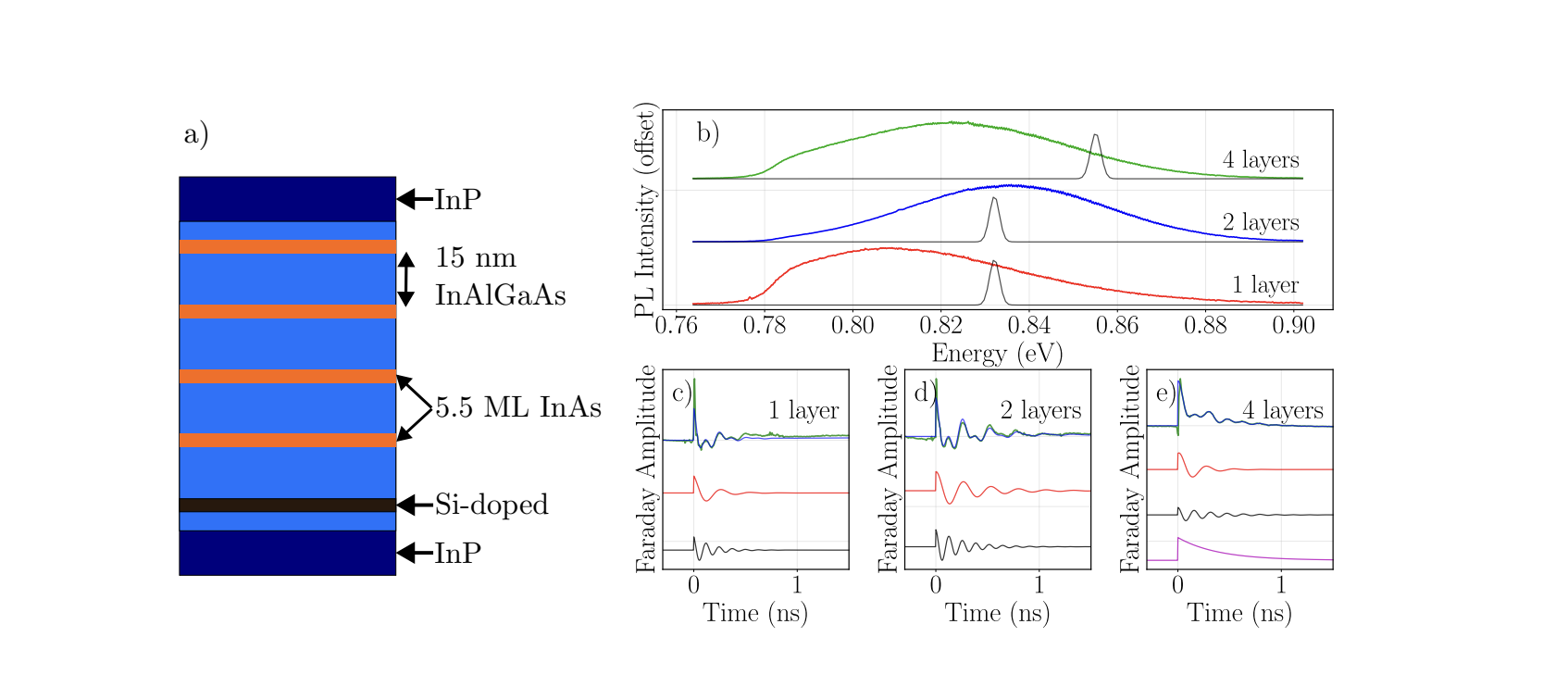
Scientists are investigating the spin properties of charge carriers within vertically stacked indium arsenide/indium aluminum gallium arsenide quantum dots, designed to emit light at telecom C-band wavelengths, crucial for optical communication. These structures are grown using molecular beam epitaxy, and researchers fabricate samples with varying numbers of quantum dot layers, one, two, and four, each containing a silicon-doped layer to introduce electrons. The core of this work involves time-resolved pump-probe Faraday ellipticity measurements, a technique used to systematically quantify spin-coherence parameters across these different layer configurations. Experiments are conducted at extremely low temperatures, ranging from 6 to 60 Kelvin, using a liquid helium cryostat and a powerful superconducting magnet generating fields up to 4 Tesla.
Optical excitation is achieved using a mode-locked titanium-sapphire laser, coupled with an optical parametric oscillator to generate tunable pulses in the telecom wavelength range. By analyzing the resulting signal, scientists can measure the spin polarization within the quantum dots and track how it evolves over time. Researchers discovered that adding a second quantum dot layer flips the charge from electrons to holes, while the four-layer sample exhibits unique behavior and supports hole spin mode locking, enabling precise measurement of hole coherence times, approximately 13 nanoseconds.
Electron-Hole Flip in Vertically Coupled Quantum Dots
Scientists are investigating the spin properties of charge carriers within vertically stacked indium arsenide/indium aluminum gallium arsenide quantum dots, designed to emit light at telecom C-band wavelengths. Using time-resolved pump-probe Faraday ellipticity measurements, the team systematically studies configurations with one, two, and four layers of quantum dots to quantify how vertical coupling affects key spin-coherence parameters. Results demonstrate that adding a second quantum dot layer alters the charge carriers from electrons to holes, consistent with electron tunneling and subsequent hole charging within the lower-energy dots. Experiments reveal that samples containing four or more layers develop an additional decaying signal component, absent in single- and two-layer samples, attributed to changes in the strain environment caused by multiple layers, which reduces the mixing of heavy-hole and light-hole states.
Furthermore, the team observed hole spin mode locking in samples with four or more layers, enabling quantitative extraction of the hole coherence time. Measurements confirm hole coherence times ranging from 2. 26 to 2. 73 nanoseconds across varying layer counts, while longitudinal relaxation times decrease with increasing layers, from 1. 03 seconds for single-layer samples to 0.
31 seconds for four-layer samples. Analysis of spin dephasing times shows that hyperfine interactions dominate at low magnetic fields, while inhomogeneities within the quantum dot ensemble become the limiting factor at higher fields. The team’s findings provide potential design guidelines for engineering spin coherence in telecom-band quantum dots for information applications.
Vertical Coupling Impacts Spin Coherence
This research systematically investigates the spin properties of electrons and holes within vertically coupled quantum dots, structures designed to emit light at telecom C-band wavelengths, crucial for optical communication. By fabricating and examining single-, two-, and four-layer dot configurations, scientists have quantified how vertical coupling impacts spin coherence, a key characteristic for information processing applications. The team discovered that adding a second layer of dots alters the charge carriers from electrons to holes, demonstrating electron tunneling between layers. Furthermore, samples with four or more layers exhibit a unique decaying signal component, attributed to changes in strain within the material that affect the mixing of heavy and light holes.
Importantly, the researchers observed spin mode locking in four-layer samples, allowing for precise measurement of hole coherence times, and successfully extracted both longitudinal relaxation and transverse dephasing times, as well as g-factors, for both electrons and holes across all configurations. Hole spin dephasing times remained relatively stable regardless of the number of layers, while longitudinal relaxation times decreased with increasing layers. The team acknowledges that observed spin dephasing times are lower than theoretical limits imposed by hyperfine interactions, suggesting that strain-induced effects and nuclear quadrupolar interactions contribute to reduced coherence. Future work may focus on reducing strain through alternative growth techniques, potentially achieving spin dephasing times closer to the hyperfine limit and enhancing the performance of these quantum dots in information technologies.
🗞 Layer-Dependent Spin Properties of Charge Carriers in Vertically Coupled Telecom Quantum Dots
🧠 ArXiv: https://arxiv.org/abs/2509.15051


