Research demonstrates a new key distribution protocol, Onion Routing Relay (ORR), enhances security within quantum key distribution networks by integrating post-quantum cryptography and onion routing. ORR improves confidentiality, integrity, and authenticity, offering competitive performance against existing methods, though an authentication extension impacts quality of service.
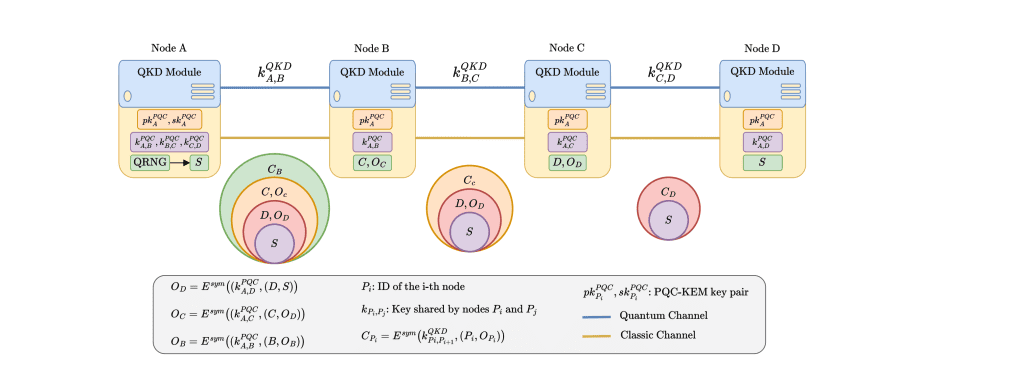
The vulnerability of current encryption standards to increasingly powerful computational resources drives research into quantum key distribution (QKD) networks as a potential solution for secure communication. These networks establish a shared, secret key between parties using the principles of quantum mechanics, enabling provably secure encryption. However, practical implementation requires addressing challenges related to network scalability and the security of intermediate nodes. Researchers at atlanTTic – research center, Universidade de Vigo – Pedro Otero-García, David Pérez-Castro, Manuel Fernández-Veiga, and Ana Fernández-Vilas – detail a novel approach to this problem in their paper, “Network-wide Quantum Key Distribution with Onion Routing Relay”. Their work evaluates a protocol integrating onion routing – a technique for anonymising data transmission – with post-quantum cryptography to enhance the confidentiality, integrity and authenticity of key distribution within a quantum key distribution network.
Evaluating Performance Trade-offs in Quantum Key Distribution Networks
The anticipated development of large-scale quantum computers presents a substantial risk to currently deployed public-key cryptographic systems. This necessitates a transition to quantum-resistant, or post-quantum, cryptographic solutions and a re-evaluation of key distribution methodologies. This research assesses the performance characteristics of several key distribution schemes within Quantum Key Distribution Networks (QKDNs), examining methods to address limitations in conventional architectures and establish secure communication channels. Simulations were conducted utilising an 11-node network, integrating Quantum Key Distribution (QKD) with Post-Quantum Cryptography (PQC) to enhance resilience against future computational threats and ensure long-term confidentiality.
Four distinct approaches were evaluated: Direct QKD, a Trusted Node (TN) scheme, Onion Routing (OR), and enhanced Onion Routing with Authentication (OR-Auth). QKD leverages the principles of quantum mechanics to distribute cryptographic keys with guaranteed security, based on the laws of physics. PQC refers to cryptographic algorithms that are believed to be secure against attacks from both classical and quantum computers.
Direct QKD demonstrated the lowest latency and highest throughput, establishing key exchange directly between communicating nodes. However, this approach fundamentally relies on a fully trusted node – a single entity assumed to be immune to compromise – creating a critical single point of failure and a potential target for attack. The TN scheme offers moderate performance but inherits the same security limitations as direct QKD, depending on a central authority and potentially becoming a network bottleneck.
Onion Routing introduces a significant increase in latency due to the layered encryption of data packets. Each node in the path decrypts a layer of encryption to reveal the next destination, obscuring the origin and destination of the message. This reduces reliance on fully trusted nodes, distributing trust across multiple participants. While susceptible to compromise if an attacker controls nodes along the communication path, results indicate that basic Onion Routing incurs higher encryption overhead but provides substantial security improvements without drastically impacting key distribution time, offering a viable trade-off between security and performance.
The implementation of authentication at each layer, as seen in OR-Auth, demonstrably enhances security by mitigating attacks targeting intermediate nodes and verifying data integrity. This prevents malicious nodes from altering or intercepting data. However, this increased security comes at a cost; the computational overhead of authentication processes results in higher latency and lower throughput, potentially impacting real-time applications. The study confirms a clear trade-off between security and performance within QKDNs. Network designers must carefully consider their specific requirements and prioritise accordingly, balancing the need for robust security with the demands of application performance. Further research should focus on optimising authentication protocols and exploring hybrid approaches that combine the strengths of different key distribution schemes.
👉 More information
🗞 Network-wide Quantum Key Distribution with Onion Routing Relay (Conference Version)
🧠 DOI: https://doi.org/10.48550/arXiv.2505.13158