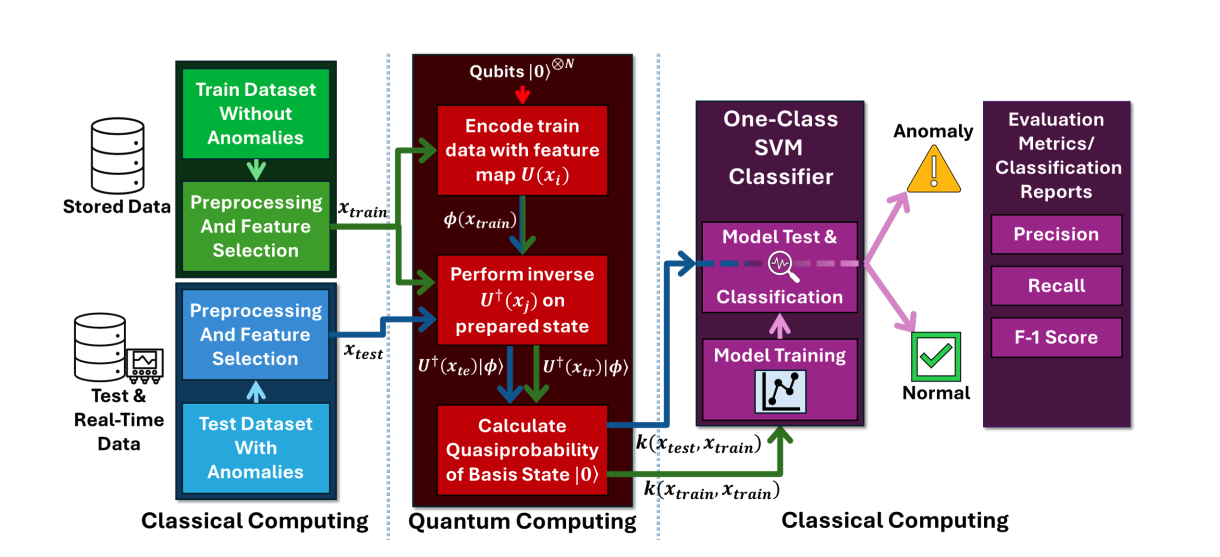
Hybrid Support Vector Machines (QSVMs) demonstrate enhanced anomaly detection capabilities within Industrial Control Systems, achieving 13.3% higher F1 scores than classical kernel methods. Simulations utilising IBMQ hardware reveal minimal error (0.98%) and a 1.57% reduction in classification metric degradation, alongside a 91.023% improvement in kernel alignment.
The increasing sophistication of cyber threats targeting industrial control systems (ICS) necessitates advanced anomaly detection techniques to safeguard critical infrastructure. These systems, responsible for monitoring and controlling physical processes, generate substantial data streams, making the identification of malicious or erroneous inputs a complex undertaking. Researchers are now exploring the potential of quantum machine learning to enhance this process, specifically through the application of quantum-enhanced Support Vector Machines (SVMs). A study by Cultice, Hassan Onim, Giani, and Thapliyal details the performance of these Quantum SVMs (QSVMs) on datasets representative of cyber-physical systems, demonstrating improved accuracy and kernel alignment compared to conventional methods. Their work, entitled “Quantum-Hybrid Support Vector Machines for Anomaly Detection in Industrial Control Systems”, investigates the practical implications of QSVMs, including the impact of noise inherent in current quantum hardware, and suggests a pathway towards more robust cybersecurity for vital infrastructure.
SVMs, or Support Vector Machines, are supervised learning models used for classification and regression. Kernel methods within SVMs map data into higher-dimensional spaces to facilitate more effective separation of data points. F1 score is a measure of a test’s accuracy.
Quantum support vector machines (QSVMs) demonstrably improve anomaly
Quantum support vector machines (QSVMs) demonstrably improve anomaly detection within critical infrastructure, offering a potential enhancement to cybersecurity for vital systems. Researchers actively investigate the application of QSVMs to bolster anomaly detection within cyber-physical systems (CPS), specifically industrial control systems and water treatment facilities, recognising the increasing need for robust security measures. Cyber-physical systems integrate computation, networking and physical processes, and are therefore vulnerable to attacks that could disrupt essential services. Results consistently demonstrate QSVMs outperform classical kernel methods, achieving a 13.3% improvement in F1 scores across tested datasets, suggesting a heightened capacity for accurately identifying anomalous behaviour crucial for maintaining security and operational integrity. The F1 score is a measure of a test’s accuracy, considering both precision and recall.
This study rigorously assesses the impact of quantum hardware limitations on QSVM performance, acknowledging the challenges inherent in emerging technologies. Simulations, based on data from real IBMQ hardware, reveal a manageable error rate of only 0.98% within the QSVM kernels, indicating a degree of robustness against practical limitations. While this error does result in a modest average reduction of 1.57% in classification metrics, the overall performance remains significantly above that of classical counterparts, highlighting the resilience of the approach and validating its potential for real-world deployment. Kernel methods are a class of algorithms that use kernel functions to map data into higher-dimensional spaces, enabling the identification of complex patterns.
A key finding centres on kernel-target alignment, where
A key finding centres on kernel-target alignment, where QSVMs exhibit a substantial 91.023% improvement compared to classical methods, demonstrating a superior ability to map data into a feature space where anomalous patterns are more readily discernible. This enhanced alignment suggests a more effective separation of normal and anomalous data, leading to fewer false positives and false negatives, and ultimately improving the reliability of the anomaly detection system. The feature space is a multi-dimensional space where data points are represented as vectors, allowing algorithms to identify relationships and patterns.
Future work should focus on scaling these QSVM models to handle larger and more complex datasets. Researchers are also investigating the potential for combining QSVMs with other machine learning algorithms to further enhance their performance, and exploring the use of transfer learning to leverage knowledge from related tasks. Transfer learning allows algorithms to apply knowledge gained from solving one problem to a different but related problem. Further research includes the development of more robust and efficient quantum algorithms for training QSVMs, and the exploration of hybrid quantum-classical algorithms to overcome the limitations of current quantum hardware. Hybrid algorithms combine the strengths of both quantum and classical computing, potentially offering a pathway to practical quantum advantage.
🗞 Quantum-Hybrid Support Vector Machines for Anomaly Detection in Industrial Control Systems
🧠 DOI: https://doi.org/10.48550/arXiv.2506.17824