

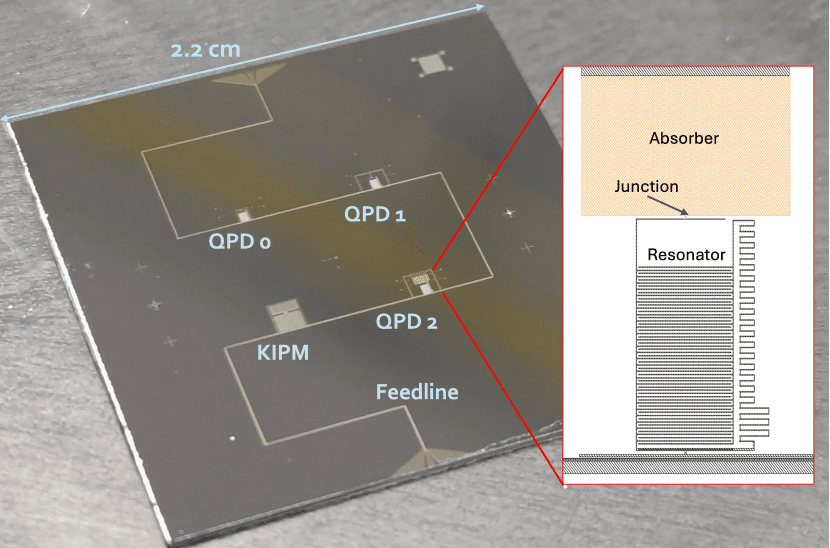
The search for dark matter and elusive neutrinos demands detectors capable of registering incredibly faint energy deposits, pushing the boundaries of current technology. Brandon J. Sandoval from the California Institute of Technology, Andrew D. Beyer and Pierre M. Echternach from NASA’s Jet Propulsion Laboratory, along with colleagues including Sunil R. Golwala and Lanqing Yuan, now demonstrate a significant step forward with a Quantum Parity Detector (QPD). This device, sensitive to phonons, the quantum units of vibration, achieves a quiescent quasiparticle density consistent with theoretical predictions, indicating its potential for sub-electronvolt energy detection. Crucially, the team also details a novel argon ion-milling process for fabricating the complex Josephson junctions within the detector, paving the way for more sensitive and reliable rare-event experiments.
8 ±0. 8μm−3, consistent with theoretical predictions. This research also details an improved argon ion-mill process for fabricating multi-step Josephson junctions, a technique that expands limited existing knowledge and proves useful in avoiding unwanted parasitic junctions. These detectors aim to identify low-energy particles, making them ideal for searching for dark matter and other elusive phenomena. QPDs function by detecting phonons, which are quantized vibrations within a material, generated by particle interactions. The detectors are designed to achieve a very low energy threshold, enabling the detection of weakly interacting particles that are difficult to observe with conventional methods. Significant effort is dedicated to shielding the detectors from external noise and interference, and they are operated at extremely low temperatures to minimize thermal noise and maximize sensitivity. The use of KIDs allows for the potential scalability of the detectors to large arrays by multiplexing many sensors onto a single readout line. The research demonstrates the feasibility of using qubits as sensitive detectors of low-energy particles and shows promising energy resolution, crucial for distinguishing between different types of particles.
A major focus is understanding and mitigating quasiparticle fluctuations, which can limit the detector’s sensitivity. The team identified and characterized various noise sources, including cosmic rays and thermal fluctuations, and highlighted the importance of understanding variations in detector performance across multi-pixel arrays. Addressing challenges like quasiparticle poisoning and achieving accurate calibration are critical for maximizing the signal-to-noise ratio and achieving the desired sub-MeV energy threshold. This scalability, combined with the potential for large arrays, makes QPDs well-suited for searching for dark matter particles and other rare events. This research pushes the boundaries of particle detection by leveraging the unique properties of superconducting qubits, offering substantial benefits for the search for elusive particles.
Quiescent Phonon Density Confirmed in QPD Sensors
Scientists have achieved a significant breakthrough in the development of phonon-mediated detectors, demonstrating a pathway towards sub-eV threshold sensitivity for rare-event experiments searching for dark matter and neutrinos. Experiments reveal a quiescent quasiparticle density of 1. 8 ±0. This process proves useful in avoiding secondary parasitic junctions, a common challenge in superconducting device fabrication. When a particle interacts with the detector, it generates phonons that create quasiparticles, which tunnel through the Josephson junction onto the island.
This tunneling process modifies the energy levels of the qubit, shifting its charge parity, which can be detected via changes in the resonator’s signal. The team fabricated QPDs with varying absorber sizes to investigate the relationship between absorber volume and detector responsivity. Measurements confirm the successful fabrication of these devices and establish a foundation for future investigations into their performance characteristics and potential for detecting extremely faint signals from dark matter or neutrinos. The team demonstrated that this detector is capable of registering quasiparticle tunneling, a key indicator of energy deposition, and confirmed that its baseline quasiparticle density aligns with theoretical expectations. A significant achievement was the refinement of an argon ion-mill process for fabricating the complex Josephson junctions essential to the detector’s operation, addressing a gap in existing fabrication techniques. The investigation also quantified the impact of readout power on quasiparticle generation, revealing a density at least 100times greater than predicted by qubit-derived models.
This finding suggests that direct coupling to feedlines at higher power levels may limit the performance of these superconducting sensors, offering valuable insight for future designs. While the initial results are promising, the authors acknowledge that further work is needed to optimize the fabrication process and fully characterize the detector’s performance. They also highlight the need for continued investigation into the sources of quasiparticle generation to improve sensitivity and reduce background noise.
👉 More information
🗞 Assessing the operating characteristics of an ion-milled phonon-mediated quantum parity detector
🧠 ArXiv: https://arxiv.org/abs/2509.18637


