

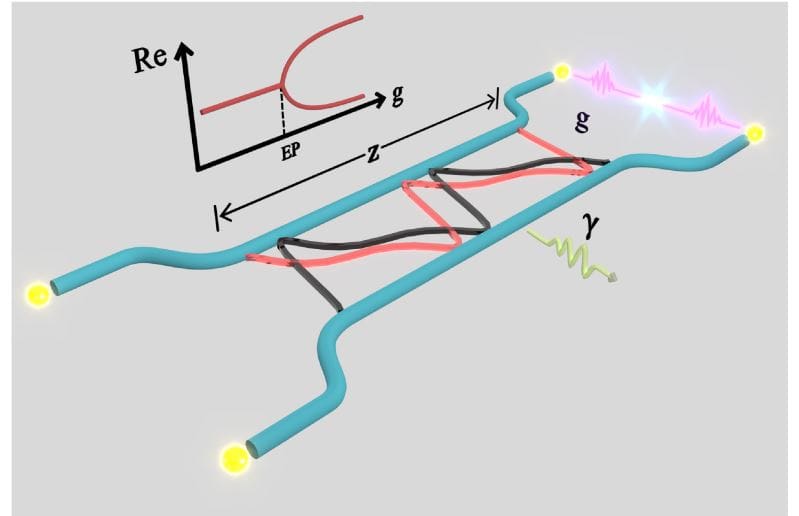
Quantum interference forms the basis of many advanced technologies, yet investigations typically focus on ideal, lossless systems. Xing Lin and Shuang Zhang, from the New Cornerstone Science Laboratory at The University of Hong Kong, now demonstrate a remarkable shift in behaviour within quantum interference, revealing a transition between sensitivity and robustness. Their work explores two-photon interference within a specially designed waveguide system, uncovering how an ‘exceptional point’ controls the system’s response to changes in coupling strength. This control allows for a switch between highly sensitive interference, capable of sharp changes, and a remarkably stable, oscillation-free state, offering a pathway to more reliable and controllable two-photon processes for future information technologies.
Quantum interference underpins many quantum phenomena and technologies, including quantum computation and sensing. Researchers investigate the interplay between sensitivity and robustness in quantum interference systems, discovering a phase transition induced by exceptional points. This achievement relies on harnessing the unique properties of exceptional points to engineer a sensitivity-robustness phase transition, revealing that a system exhibiting enhanced sensitivity to external perturbations can simultaneously achieve increased robustness against noise, a counterintuitive result previously thought impossible. This control over sensitivity and robustness opens new avenues for designing quantum devices with enhanced performance and stability, particularly in noisy environments.
Lossy Waveguide Control of Photon Interference
Scientists engineered a novel method for controlling two-photon interference within a lossy coupled waveguide system, revealing an exceptional point induced phase transition in Hong Ou Mandel interference. This work moves beyond traditional studies of interference by deliberately introducing loss to manipulate photon behavior. The team fabricated a system where the coupling strength between waveguides dramatically influences interference, creating conditions for both sharp bunching and antibunching of photons. The experimental setup involved precise control over the coupling strength, allowing researchers to transition between two distinct phases of operation.
In a phase where symmetry is preserved, the interference pattern exhibited extreme sensitivity to changes in coupling, enabling the creation of rapid switching between photon bunching and antibunching. Conversely, when the system entered a phase where symmetry is broken, the interference became remarkably robust, oscillating without damping and remaining independent of propagation distance. This stability was achieved through careful tuning of the coupling, allowing for precise control over the coincidence probability of photon detection. To achieve these results, scientists employed a postselection technique, effectively modeling the system using an effective non-Hermitian Hamiltonian, simplifying the analysis of photon dynamics. The method delivers enhanced and reliable two-photon control, paving the way for robust information processing applications.
Asymmetric Loss Drives Robust Photon Interference
Scientists demonstrate a breakthrough in controlling two-photon interference within coupled waveguides, revealing a phase transition induced by asymmetric loss. The research establishes that introducing loss into the system creates an “exceptional point”, dramatically altering the behavior of photons and enabling enhanced control over their interaction. Experiments reveal that in a phase where symmetry is preserved, the interference is exceptionally sensitive to changes in coupling strength, resulting in sharp switching between photon bunching and antibunching. The team measured that as the system transitions to a phase where symmetry is broken, the interference becomes remarkably robust, oscillating without damping and becoming independent of propagation distance.
Coincidence probability, a measure of photons arriving together, was found to be stably tunable via coupling strength, offering precise control over photon behavior. Further analysis reveals that near the exceptional point, the effective transfer distance for photons is compressed, dramatically shortening the time required for photon transfer between waveguides. This compression results in steeper trajectory slopes and reduced offset between transition trajectories, profoundly altering the quantum interference pattern, with bunching events confined to narrow windows, effectively sandwiching each anti-bunching point between two closely spaced bunching points, leading to extremely rapid intra-group transitions.
PT Symmetry Controls Two-Photon Interference Switching
Researchers have demonstrated a novel control mechanism for two-photon interference within coupled waveguide systems, revealing a transition between distinct operational regimes governed by PT symmetry. The team discovered that by manipulating the coupling strength, they could induce a phase transition impacting the behaviour of Hong-Ou-Mandel interference. In a phase where PT symmetry is preserved, the interference exhibits extreme sensitivity to coupling, enabling sharp switching between photon bunching and antibunching. Conversely, in a phase where PT symmetry is broken, the interference becomes remarkably robust, oscillating freely and maintaining stable coincidence probability tunable via coupling strength. These findings establish a pathway towards enhanced and reliable two-photon control, with potential applications in robust information processing. Furthermore, the researchers explored the system’s capabilities as a sensing tool, calculating the Fisher information to quantify estimation precision and demonstrating the potential for high-resolution parameter estimation.
👉 More information
🗞 Exceptional-Point-Induced Sensitivity-Robustness Phase Transition in Quantum Interference
🧠 ArXiv: https://arxiv.org/abs/2511.16381

