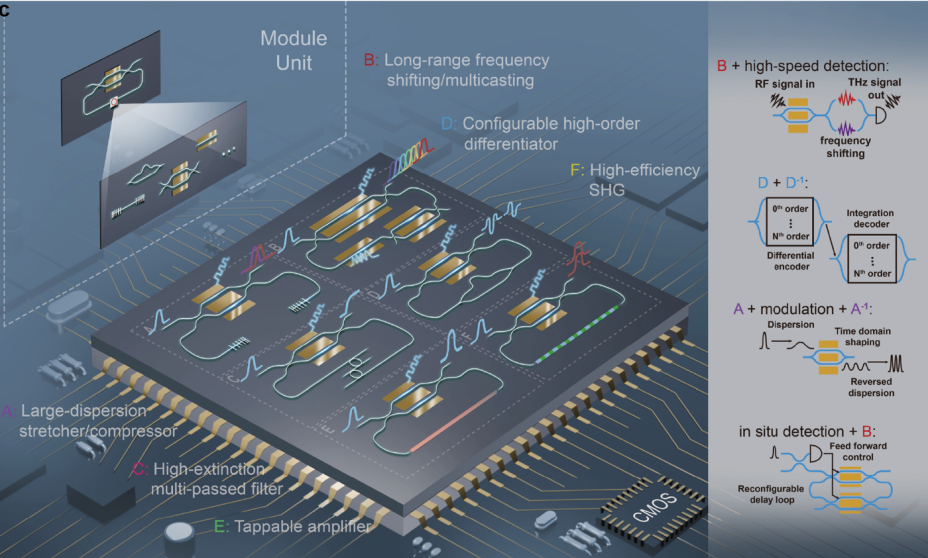
Researchers are developing new ways to manipulate light on microchips, and a team led by Xudong Li, Yaowen Hu, and Tong Ge, alongside Andrea Cordaro, Yunxiang Song, and Xinrui Zhu from Harvard University, has achieved a significant breakthrough in spectral-temporal optical processing. They demonstrate a compact and versatile system that overcomes limitations of existing on-chip technologies, which typically struggle with both size and bandwidth. The team’s innovative approach uses a recursive electro-optic circuit, effectively creating a loop where light signals can be processed repeatedly within a small space, and achieves unprecedented control over optical signals. This allows for complex operations such as frequency shifting, delay manipulation, and even differentiation of optical packets in time, paving the way for future integrated systems with vastly improved reconfigurability and spectral-temporal versatility.
Thin-Film Lithium Niobate for Integrated Photonics
Thin-film lithium niobate (TFLN) is emerging as a powerful platform for integrated photonics, offering significant advantages over traditional silicon-based systems. This material excels in applications requiring high-speed modulation and complex signal processing due to its strong electro-optic effect, broad operational bandwidth, and ability to achieve high quality factors in resonant structures. Advanced fabrication techniques enable the creation of high-quality TFLN films suitable for building compact photonic circuits. The versatility of TFLN photonics extends to a wide range of applications.
In high-speed optical communications, TFLN enables the creation of modulators that overcome bandwidth limitations, generates optical frequency combs for precise frequency measurements and high-speed data transmission, and facilitates wavelength division multiplexing for increased data capacity. Beyond communications, TFLN supports advanced signal processing functions, including all-optical computing, optical filtering, and precise pulse shaping. Furthermore, TFLN is proving valuable in sensing applications, enabling the creation of compact spectrometers and sensors for detecting various physical parameters. The potential of TFLN extends to quantum technologies, with applications in single photon sources and detectors, secure quantum key distribution, and the development of quantum computers. It also finds use in microwave photonics, enabling advanced microwave signal processing and high-speed analog-to-digital conversion. This research positions TFLN as a disruptive technology with the potential to revolutionize fields requiring high-speed, broad bandwidth, and complex signal processing, paving the way for more compact, efficient, and powerful optical systems.
Recursive Photonics Enables Ultrahigh Bandwidth Processing
Researchers have achieved a breakthrough in integrated photonics by developing a recursive optical signal processing framework using thin-film lithium niobate. This innovative system overcomes limitations in both footprint and bandwidth, establishing a powerful and scalable platform for multifunctional photonic processing and paving the way for next-generation integrated systems with ultrahigh reconfigurability and spectral-temporal versatility. The core of this advancement lies in a dynamically reconfigurable optical resonator, controlled by a fast electro-optic switch that directs optical signals either through a processing element or recirculates them within the loop. Experiments demonstrate remarkable spectral shearing of optical pulses, achieving a frequency shift of up to 420GHz using only a 3GHz sinusoidal microwave signal.
This was accomplished by embedding a phase modulator within the recursive loop, effectively manipulating the spectral characteristics of the light. Furthermore, the team successfully created a recursive delay line utilizing chirped Bragg gratings, achieving large group delays of 28ps/nm over a 30nm optical bandwidth, significantly enhancing signal processing capabilities. The research extends to temporal differentiation, with the integration of an asymmetric Mach-Zehnder interferometer enabling reconfigurable differentiation of optical packets up to an unprecedented fifth order. Characterization of the dynamically coupled resonator revealed strong suppression of resonant peaks when the switch is configured in coupled and circulating states, demonstrating precise control over the resonator’s operation. These results demonstrate a significant advancement in integrated photonics, offering a compact and versatile platform for a wide range of applications, including high-speed communications, advanced sensing, and optical computing.
Reconfigurable Lithium Niobate Optical Packet Processing
Researchers have developed a new method for on-chip optical signal processing using a reconfigurable recursive circuit fabricated from thin-film lithium niobate. This approach overcomes limitations of conventional methods, such as large physical size and narrow bandwidth, by trapping and recirculating optical packets within a loop. By precisely controlling fast electro-optic switches, the team demonstrated the ability to manipulate these packets, achieving functionalities including frequency shifting, large optical delays, and high-order signal differentiation, all within a remarkably small footprint. The demonstrated system successfully shifted optical packet frequencies by up to 420GHz, introduced delays of 28 picoseconds per nanometer, and performed reconfigurable differentiation up to the fifth order, representing a significant advancement in performance compared to existing technologies.
Current limitations stem from optical losses within the loop, allowing for approximately 14 roundtrips of the optical packet; however, the researchers estimate that improvements in device quality and loop length could easily increase this to 500 roundtrips, and the addition of gain could further reduce losses. Future work will focus on extending this recursive approach to other functionalities, potentially enabling the creation of narrow filters with both high extinction and narrow bandwidth. The team also suggests that combining this technology with fast electrical feedback circuits could open doors for applications in measurement-based quantum computation.
🗞 Spectral-temporal processing using integrated recursive electro-optic circuit
🧠 ArXiv: https://arxiv.org/abs/2509.25102