

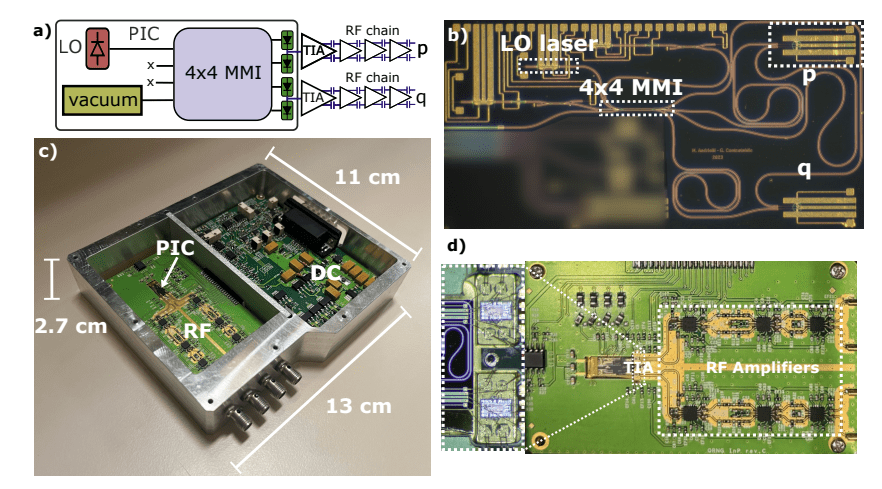
Truly random numbers underpin many technologies, from accurate scientific modelling to secure communication, and generating them reliably presents a significant challenge. Peter Seigo Kincaid, Lorenzo De Marinis, and Francesco Testa, all from the TeCIP Institute at Scuola Superiore Sant’Anna, alongside colleagues including Nicola Andriolli from the University of Pisa, now report a breakthrough in this field, demonstrating the first source-device-independent monolithically integrated random number generator. This compact device achieves an impressive generation rate exceeding 35 Gbit/s, utilising a novel photonic integrated circuit and vacuum state entropy source, and crucially, presents only standard electrical interfaces. The resulting simplicity, compactness, and speed position this generator as a promising component for advanced applications such as quantum key distribution, offering a robust and practical solution for high-performance random number generation.
Photonic Chip Achieves Source-Device Independence
Scientists have created a new photonic integrated circuit that generates truly random numbers independently of the specific quantum source or detection equipment used. This source-device-independent quantum random number generator (QRNG) represents a significant step forward in security and reliability. The system utilizes a heterodyne measurement scheme, mixing quantum signals with a strong local oscillator to enhance signal strength and enable high-speed operation. By integrating the entire process onto a single indium phosphide chip, the team achieved a compact and practical design suitable for diverse applications.
The system generates random numbers at a high rate, demonstrating its potential for real-time applications requiring secure data. The randomness originates from the fundamental quantum fluctuations of light. The integrated circuit combines the entropy source, heterodyne mixer, and detection circuitry onto a single chip, leveraging the advantages of indium phosphide for high-speed optical components. After the quantum signal is detected, the data undergoes processing to extract the random numbers, employing a technique based on the leftover hash lemma. This post-processing step ensures maximum randomness by accounting for any imperfections and bolstering security.
Rigorous testing using the NIST statistical test suite confirms the high quality and randomness of the generated numbers. This innovative QRNG surpasses existing approaches by eliminating reliance on assumptions about the quantum source or detection apparatus, enhancing security and robustness. Compared to classical random number generators, which are deterministic, this system leverages the fundamental laws of physics to produce true randomness. The compact design and electrical interface allow for easy integration into various systems, making it ideal for applications like quantum key distribution, cryptography, scientific simulations, and gaming. This research demonstrates a significant advancement in QRNG technology, paving the way for secure and reliable random number generation in a wide range of applications.
Vacuum State Entropy for Fast Random Numbers
Researchers have developed the first monolithically integrated, source-device-independent quantum random number generator, achieving a generation rate of 35 gigabits per second. The device harnesses the inherent randomness of vacuum states, utilizing an indium phosphide photonic integrated circuit to sample this quantum entropy. A heterodyne coherent detection scheme, employing an optical local oscillator, precisely measures the fluctuations within the vacuum state. The entire system, including all driving electronics and signal conditioning, is conveniently packaged into a compact unit with only electrical connections, making it suitable for practical applications like quantum key distribution.
The team implemented a heterodyne measurement, carefully discretized to capture the quantum fluctuations. This measurement relies on the superposition of states, meticulously controlled to maximize the amount of randomness extracted. Scientists utilized the Leftover Hash Lemma to establish a lower bound on the extractable bits, demonstrating a direct link between the randomness and the resolution of the measured quadratures. A universal hashing method, based on Toeplitz matrices, efficiently extracts these random bits from the raw data. Detailed characterization of the photonic circuit reveals an active area footprint of approximately 24 square millimeters, showcasing a high level of integration.
This innovative approach delivers a compact, high-speed, and secure random number generator, paving the way for advancements in cryptography and scientific simulations. The integrated photonic circuit, fabricated on an indium phosphide platform, provides a stable and reliable platform for the delicate quantum measurements. The system’s compactness and electrical interface further enhance its practicality for integration into various applications, representing a significant step towards widespread adoption of quantum random number generation.
Integrated Random Numbers at 35 Gbit/s
Scientists have achieved a breakthrough in random number generation with the development of the first source-device-independent monolithically integrated random number generator. This compact device generates random numbers at a rate of 35 gigabits per second, representing a significant advancement in the field and opening possibilities for applications requiring high-speed, truly random data. The generator utilizes an indium phosphide photonic integrated circuit, harnessing a vacuum state entropy source and heterodyne coherent detection with an optical local oscillator to produce randomness. The entire system is contained within a compact “black box” enclosure, featuring only electrical interfaces for ease of integration.
Experiments demonstrate a generation rate exceeding previous bulk and partially integrated versions. Detailed analysis of the system’s performance involved characterizing the power spectral density of the RF output, both with and without the laser activated. Calibration measurements were performed to convert ADC resolution into vacuum units, ensuring resilience to variations in readout from the two quadratures. Results show a minimum variance of 1. 23 for both quadratures at maximum laser power, slightly higher than the theoretical vacuum variance due to classical noise.
This impurity is accounted for during randomness extraction. The team measured a quantum minimum entropy of 17. 5 bits at maximum laser power, exceeding previously reported values, and demonstrating the generator’s capacity for secure random number generation. This achievement establishes a new benchmark for high-speed, compact, and practical quantum random number generators.
Integrated Quantum Randomness at 35 Gbps
This research demonstrates the first monolithically integrated, source-device-independent quantum random number generator, achieving a generation rate of 35 gigabits per second. The device utilizes an indium phosphide photonic integrated circuit, generating randomness from vacuum states and employing heterodyne coherent detection with an optical local oscillator. Importantly, the entire system is self-contained within a compact black box, requiring only electrical connections for operation, making it suitable for practical applications demanding high-speed, secure random numbers. The team successfully created a system where the randomness source is independent of both the device used to measure it and any potential attacker’s control over the quantum source, a critical feature for security.
Statistical testing, including the rigorous National Institute of Standards and Technology suite, confirms the high quality of the generated random numbers. While the current generation rate is influenced by the analog data acquisition components, the researchers note that multi-gigabit-per-second rates remain attainable even with lower-cost commercial electronics. The work establishes a pathway towards compact, practical systems requiring secure quantum numbers, particularly for applications like quantum key distribution. Future work could focus on optimizing these components or exploring alternative architectures to further increase the generation rate and reduce system complexity. Nevertheless, this research represents a significant advance in the field of quantum random number generation, demonstrating the feasibility of a fully integrated, high-speed, and secure solution.
👉 More information
🗞 Source-device-independent monolithically integrated QRNG in a black box with generation rate in excess of 30 Gbit/s
🧠 ArXiv: https://arxiv.org/abs/2510.18700

