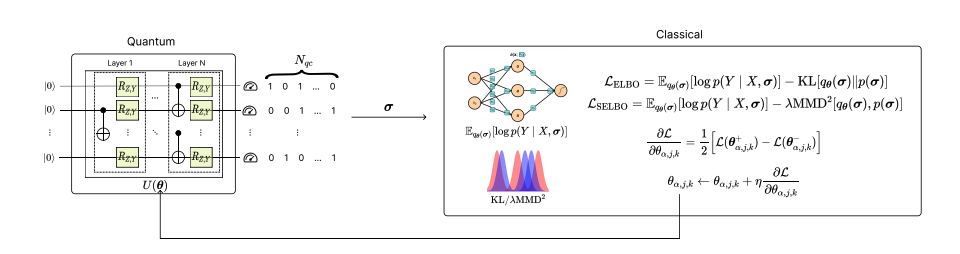
Binary Neural Networks benefit from a new training method utilising HyperNetworks and variational algorithms. This approach connects network training to Bayesian inference via the Evidence Lower Bound, enhanced with a Maximum Mean Discrepancy surrogate for practical applications, demonstrably improving both training efficiency and generalisation performance compared to standard methods.
The pursuit of computationally efficient machine learning models is driving research into novel neural network architectures. Binary Neural Networks (BiNNs), utilising single-bit weights, offer a pathway to reduced memory requirements and power consumption, but their training presents considerable challenges. Researchers are now exploring the application of quantum computing principles to enhance BiNN optimisation. A team comprising Luca Nepote, Alix Lh´eritier and Nicolas Bondoux from Amadeus, alongside Marios Kountouris of EURECOM and Maurizio Filippone from KAUST, detail their work in ‘Variational Inference for Quantum HyperNetworks’. They demonstrate a connection between quantum-enhanced BiNN training and Bayesian inference, employing variational methods and a surrogate loss function based on the Maximum Mean Discrepancy (MMD) to improve both training stability and generalisation performance.
Optimising Neural Networks: From Binarisation to Quantum Approaches
Modern neural networks require considerable computational resources, driving research into methods that reduce both energy consumption and computational cost. A key strategy involves binarisation, where neural network weights are restricted to single-bit precision, substantially reducing memory requirements and computational complexity, though presenting challenges for effective training. Recent work establishes that hypernetworks – networks that generate weights for another network – utilising variational algorithms, offer a pathway to improved optimisation in binarised neural networks.
This approach leverages quantum phenomena – superposition and entanglement – to explore a novel training paradigm. The research demonstrates a clear connection between variational quantum algorithms and Bayesian inference, specifically within the context of training Binary Neural Networks (BiNNs). By framing the generation of binary weights as an approximate Bayesian inference process, the derivation of an Evidence Lower Bound (ELBO) becomes possible when simulating quantum computations with direct access to output distributions, enabling rigorous evaluation. The ELBO represents a lower bound on the marginal likelihood of the model, providing a quantifiable metric for optimisation.
A significant contribution lies in the development of a surrogate ELBO, constructed using the Maximum Mean Discrepancy (MMD). MMD is a metric used to measure the distance between probability distributions. This addresses the practical limitation of accessing implicit output distributions encountered when deploying these algorithms on actual quantum hardware or in resource-constrained environments, expanding the applicability of these techniques. Experimental results confirm the efficacy of this approach, demonstrating performance gains over standard Maximum Likelihood Estimation (MLE), improving both trainability and generalization. MLE seeks to find the parameter values that maximise the likelihood of observing the training data.
Specifically, the proposed variational approach enhances the trainability and generalization capabilities of BiNNs, suggesting that leveraging quantum principles within a Bayesian framework offers a promising strategy for overcoming the challenges associated with training highly compressed neural networks. Future work should focus on scaling these techniques to larger and more complex architectures, investigating the robustness of the surrogate ELBO under varying noise conditions representative of real quantum hardware, and exploring alternative integral probability metrics beyond MMD to potentially refine the approximation of the true ELBO and further enhance performance. Direct implementation and evaluation on available quantum hardware will be essential to validate the practical feasibility and potential advantages of this approach, paving the way for the development of more efficient and sustainable machine learning systems.
👉 More information
🗞 Variational Inference for Quantum HyperNetworks
🧠 DOI: https://doi.org/10.48550/arXiv.2506.05888