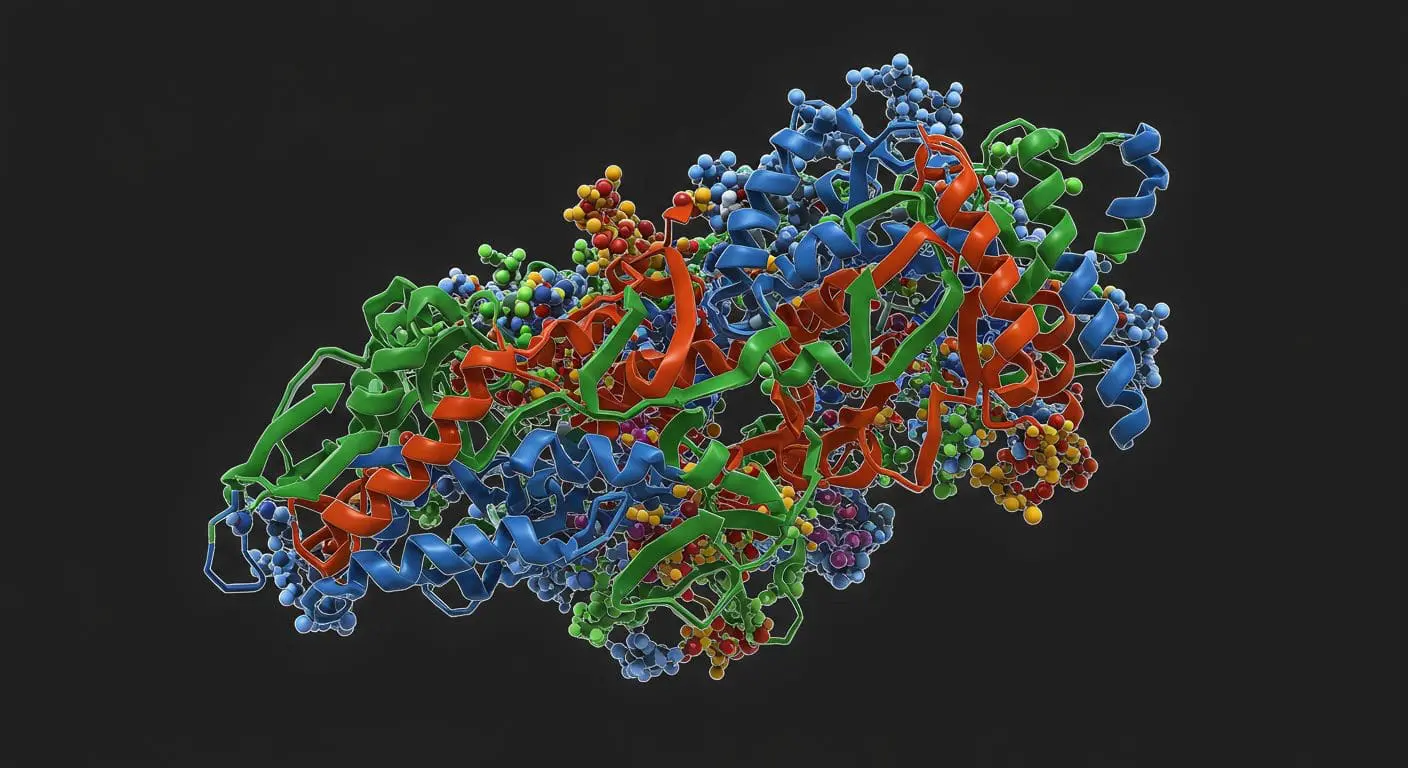
The challenge of predicting how proteins fold into their functional shapes remains a central problem in biology, and accurately modelling dense protein systems presents significant computational hurdles. Anders Irbäck, Lucas Knuthson, and Sandipan Mohanty, from Lund University and Forschungszentrum Jülich, have now demonstrated a powerful new approach to this problem by focusing on simplified protein models confined to minimal grids. Their work reveals that by transforming the folding problem into a mathematical form suitable for both classical and quantum computation, they can rapidly and reliably determine the lowest energy state of surprisingly long protein chains, up to 48 units in length. This achievement represents a substantial step forward, offering a potentially scalable method for exploring the complex energy landscapes that govern protein folding and opening new avenues for both computational biology and the development of novel protein designs.
The research focuses on a single lattice protein confined to a minimal grid with no free sites, presenting a challenging optimization problem analogous to scheduling tasks. Scientists reformulated this problem as a quadratic unconstrained binary optimization (QUBO), a mathematical framework suitable for both classical and quantum solution methods. The team demonstrates that this QUBO formulation can be solved rapidly and consistently for protein chains of length 48, utilising either classical simulated annealing or hybrid quantum-classical annealing on a D-Wave system, with the latter computations completed in approximately 10 seconds. This represents a significant speedup compared to traditional methods, which require considerably longer to achieve the same results.
Protein Folding via Quantum Lattice Optimisation
This research explores a computational approach to predicting and designing protein structures, utilising simplified lattice models and advanced optimization techniques. Proteins, the workhorses of biological systems, fold into specific three-dimensional shapes that dictate their function. Accurately predicting these structures remains a major challenge in computational biology. The team employed lattice models, representing proteins as chains of beads on a grid, to reduce computational complexity while retaining essential folding principles. They then applied various optimization algorithms, including simulated annealing, quantum annealing, and constraint programming, to find the lowest energy conformations within this model.
The study highlights the benefits of combining different optimization techniques, such as using constraint programming to refine solutions found by quantum annealing. Researchers compared the performance of quantum annealing, simulated annealing, and other methods in solving protein folding problems, demonstrating the utility of lattice models as a simplified yet informative representation of protein structures. Furthermore, the integration of machine learning techniques shows promise in improving the accuracy and efficiency of protein design. This research extends to modelling protein phase separation and aggregation, relevant to understanding diseases like amyloidosis, where proteins misfold and accumulate.
Accurate protein structure prediction is crucial for drug discovery, allowing researchers to design molecules that bind to proteins and modulate their function. Understanding protein folding and aggregation is also relevant to designing new biomaterials and understanding diseases like Alzheimer’s and Parkinson’s. This research contributes to advancements in these areas and provides insights into the potential of quantum computing for solving complex scientific problems. The ability to model protein phase separation is important for designing new biomaterials with specific properties.
Protein Folding Solved via Quantum Optimization
Researchers have achieved a breakthrough in solving complex protein structure problems by successfully applying optimization techniques to simplified protein models. The study focused on determining the minimum energy structure of a single lattice protein confined to a compact grid, a challenging problem due to steric clashes that obstruct chain movement. To overcome this, scientists recast the problem as a quadratic unconstrained binary optimization (QUBO), enabling both classical and quantum approaches to find solutions. The team demonstrated that this QUBO formulation could be swiftly and consistently solved for protein chains of length 48, utilising either classical simulated annealing or hybrid quantum-classical annealing on a D-Wave system.
Remarkably, the hybrid quantum-classical annealing computations required approximately 10 seconds to reach a solution, representing a significant speedup compared to exhaustive enumeration techniques, which demand upwards of 10 hours to achieve the same result. The research involved six different amino acid sequences, each 48 amino acids long, studied on a 4x4x3 lattice. These sequences were designed to fold into two distinct topologies, exhibiting varying degrees of structural complexity. The minimum energy values achieved for these sequences demonstrated the method’s ability to accurately determine stable protein conformations. Furthermore, the study compared the performance of the QUBO-based approaches with traditional linear and quadratic programming methods, finding that the latter struggled with the chain constraints inherent in the problem. The success of both simulated annealing and hybrid quantum-classical annealing highlights their potential for tackling complex biomolecular problems where steric clashes are a major obstacle, paving the way for more efficient protein structure prediction and design.
QUBO Solves Protein Folding Efficiently
This research demonstrates a successful application of quadratic unconstrained binary optimization (QUBO) to determine the minimum energy structures of lattice proteins, a challenging computational problem. Scientists have shown that this QUBO-based approach, utilising both classical simulated annealing and hybrid quantum-classical annealing, can swiftly and consistently solve the problem for protein chains of length 48. Notably, the hybrid quantum-classical method achieved solutions in approximately 10 seconds, a performance currently unmatched by other known methods. The team benchmarked these methods against exact solutions obtained through exhaustive structure enumeration, confirming their accuracy and efficiency.
Interestingly, the QUBO-based computations revealed a trend differing from that observed in explicit-chain dynamics, suggesting that the QUBO formulation explores the solution space in a unique manner. This work establishes a promising new avenue for studying dense protein systems and could be extended to investigate more complex phenomena such as protein aggregation and phase separation. Furthermore, the QUBO formulation, originally developed in the 1980s, may prove valuable for tackling other optimization problems involving difficult constraint-fulfilling updates, such as complex scheduling challenges.
🗞 Folding lattice proteins confined on minimal grids using a quantum-inspired encoding
🧠 ArXiv: https://arxiv.org/abs/2510.01890