

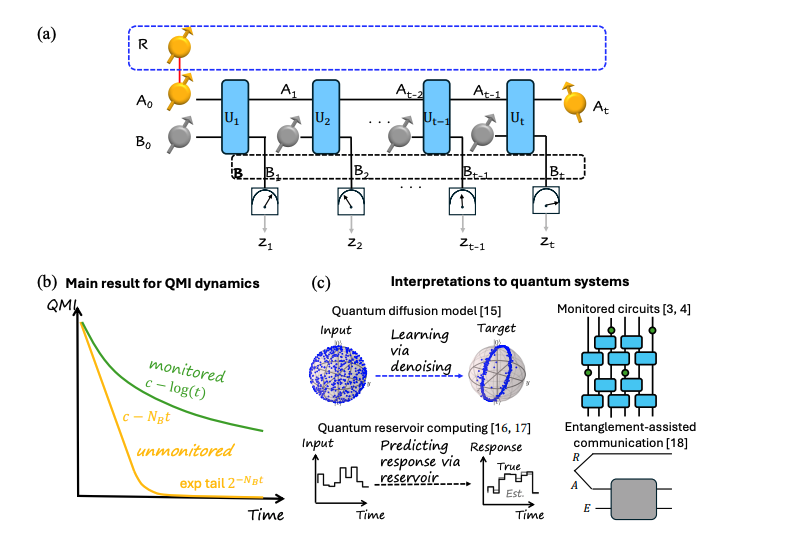
The preservation of quantum information, notoriously susceptible to environmental interference and measurement, presents a significant challenge in the development of quantum technologies. Recent research demonstrates a surprising resilience in quantum information lifetime when systems undergo continuous monitoring via mid-circuit measurements, exhibiting an exponential scaling with system size irrespective of the environmental ‘bath’ size. This contrasts sharply with unmonitored systems, where lifetime increases at best linearly with size and diminishes with increasing bath size. This phenomenon, explored in a paper titled ‘Scaling Laws of Quantum Information Lifetime in Monitored Quantum Dynamics’, is the focus of work by Bingzhi Zhang and Quntao Zhuang from the University of Southern California, alongside Fangjun Hu, Tianyang Chen, and Hakan E. Türeci from Princeton University. Their analytical proofs, validated through numerical simulations utilising both random and chaotic systems, extend to a variety of initial quantum states and offer potential implications for monitored quantum circuits, algorithms such as diffusion models and reservoir computing, and quantum communication protocols. The team further assesses the practical viability of observing these scaling behaviours using current quantum hardware, specifically IBM’s noisy intermediate-scale quantum devices.
Quantum information demonstrates unexpected durability when subjected to continuous monitoring via mid-circuit measurements, establishing an exponential relationship between information lifetime and system size. This challenges established understandings of quantum decoherence, the loss of quantum properties due to interaction with the environment, and suggests new pathways for developing robust and scalable quantum technologies. The research indicates that continuous monitoring effectively stabilises quantum information, irrespective of the size of the environmental ‘bath’, which represents all external interactions affecting the quantum system.
Researchers analytically prove this exponential scaling for systems governed by Haar random unitaries, a mathematical framework representing a broad class of quantum operations. Essentially, these unitaries model the complex transformations quantum information undergoes. This analytical result is corroborated by extensive numerical simulations, extending beyond Haar-random systems to encompass chaotic Hamiltonian systems, further validating the robustness of the observed scaling across diverse quantum systems. Hamiltonian systems describe the total energy of a system and its evolution over time.
The investigation highlights a critical distinction between monitored
The investigation highlights a critical distinction between monitored and unmonitored quantum systems, demonstrating the power of active measurement in preserving quantum coherence, the ability of a quantum system to maintain a definite phase relationship. Without continuous monitoring, information lifetime scales at best linearly with system size and diminishes inversely with bath size, indicating rapid information loss due to environmental interactions. Conversely, continuous monitoring effectively stabilises the quantum information, enabling it to persist for exponentially longer durations as the system grows.
Researchers investigated a diverse range of initial quantum states, confirming the generality of the findings and solidifying the potential for widespread application in various quantum information processing tasks. The exponential scaling of information lifetime holds true regardless of the initial state of the quantum system, further strengthening the claim that continuous monitoring provides a fundamental mechanism for preserving quantum coherence. This versatility makes the technique particularly attractive for implementation in diverse quantum computing architectures.
These findings have significant implications for several areas of quantum information science, offering potential benefits for monitored quantum circuits, algorithms such as diffusion models – probabilistic generative models – and quantum reservoir computing, a type of recurrent neural network. The ability to extend information lifetimes through continuous monitoring represents a crucial step towards building more robust and scalable quantum technologies, paving the way for practical quantum applications. Researchers anticipate that this technique will play a vital role in overcoming the limitations imposed by decoherence.
Researchers assess the feasibility of experimentally verifying these predicted scaling regimes using currently available, albeit noisy, quantum hardware, conducting numerical simulations on IBM quantum hardware to account for the inherent noise present in these devices. These simulations demonstrate that coherence can be maintained even with an increasing number of gates in the circuit, suggesting that the predicted scaling regimes are, in principle, experimentally accessible. This validation is crucial for translating theoretical insights into practical quantum technologies.
Future research will focus on exploring the limitations
Future research will focus on exploring the limitations of this technique and developing strategies to further enhance the coherence of quantum systems. Researchers plan to investigate the impact of different measurement protocols and explore the potential for combining continuous monitoring with other error correction techniques. This ongoing work promises to unlock the full potential of quantum information processing and pave the way for a new era of quantum technologies.
🗞 Scaling Laws of Quantum Information Lifetime in Monitored Quantum Dynamics
🧠 DOI: https://doi.org/10.48550/arXiv.2506.22755


