Ensemble quantum sensing promises highly sensitive measurements of magnetic fields, but achieving peak performance proves challenging due to unavoidable variations in control fields across the sensing material. Suwan I. Kang, Minhyeok Kim, and Sanghyo Park, alongside their colleagues, now demonstrate a method for identifying the optimal subset of spins within an ensemble to overcome this limitation. The team derives a new expression for ensemble sensitivity in non-uniform conditions and introduces a concept of sensitivity thresholds that pinpoint the most effective spins for measurement. This approach delivers up to a tenfold improvement in sensitivity compared to conventional methods, and the researchers successfully implement it using phase-only digital holography with minimal sensitivity loss, paving the way for more precise and reliable quantum sensors in diverse environments.
When applied to both pulsed and continuous-wave magnetometry, selecting this optimal subset delivers up to a tenfold improvement over conventional schemes that rely on nominally uniform regions of the ensemble. The research demonstrates that phase-only digital holography effectively implements this optimal subset selection, with residual aberrations contributing less than 1 dB of sensitivity loss. This framework introduces no fundamental trade-offs and extends quantum sensing capabilities to heterogeneous sensing environments.
Optimal Spin Subset Selection via Holography
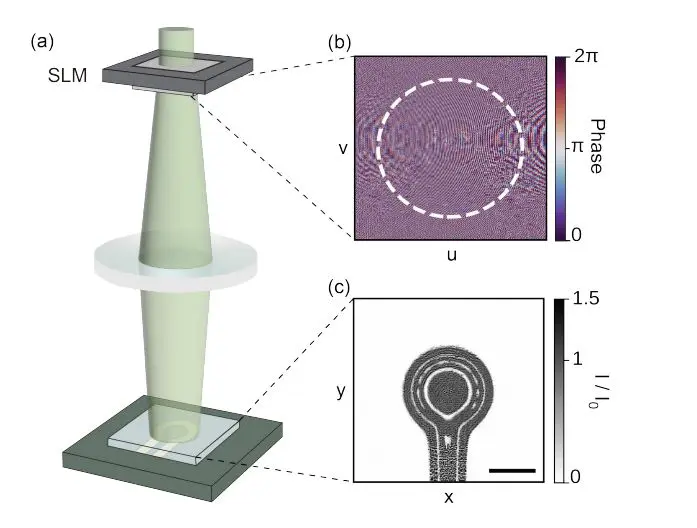
The study addresses limitations in standard spin ensemble magnetometry caused by uneven control field distribution, which prevents achieving maximum sensitivity. Researchers developed a method to identify and address only the optimal subset of spins within the ensemble, significantly enhancing signal detection. This involved deriving an analytical expression to define ensemble sensitivity in non-uniform conditions and establishing sensitivity thresholds to pinpoint the most effective spin population. The team then implemented a phase-only digital holography technique to selectively illuminate this optimal subset, effectively tailoring the excitation field to the most sensitive spins.
To achieve this precise illumination, the researchers engineered a system using a spatial light modulator to generate a structured beam profile. An iterative algorithm refined the hologram, correcting for imperfections in the spatial light modulator and ensuring accurate beam shaping. The resulting structured illumination pattern exhibited a 32. 8% intensity non-uniformity, limited by system artifacts. To quantify the impact of this non-uniformity, the team numerically solved five-level rate equation models, propagating changes in read-out contrast and photon number into calculations of ensemble sensitivity.
These calculations revealed a sensitivity loss of only 0. 71 dB for the observed 32. 8% non-uniformity, demonstrating the robustness of the approach. The team highlights that this method does not introduce fundamental trade-offs, making it well-suited for applications requiring extreme sensitivity, such as detecting superconductivity, monitoring neuronal signals, and inspecting current flows in microchips. Furthermore, the principle of shaping the laser beam to address optimal spins is formally equivalent to implementing a maximum information state for spin-based sensing, opening possibilities for tailoring illumination profiles to complex sensor-sample geometries and even paving the way for quantum sensing in challenging environments.
Optimal Spin Subsets Enhance Sensor Sensitivity
This work presents a breakthrough in enhancing the sensitivity of spin ensemble sensors by identifying and utilizing optimal subsets of individual spins within the ensemble. Researchers discovered that finite drive power inevitably creates spatial gradients in control fields, limiting the sensitivity achievable by conventional methods. They derived an analytic expression for ensemble sensitivity in inhomogeneous spin sensors, revealing a crucial sensitivity threshold that defines the ideal subset of spins for measurement. Experiments demonstrate that applying this threshold to both pulsed and continuous-wave magnetometry delivers up to a tenfold improvement in sensitivity compared to traditional approaches relying on nominally uniform regions of the ensemble.
The team implemented this optimal subset selection using phase-only digital holography, achieving minimal sensitivity loss, less than 1 dB, due to residual aberrations in the system. This framework imposes no fundamental limitations and extends to heterogeneous environments, broadening its applicability. The research details how individual spin sensors contribute unequally to the overall signal due to non-uniform control fields, inducing pulse errors that reduce accumulated phase and fluorescence contrast. However, by identifying a sensitivity threshold, the team pinpointed the optimal subset of spins that minimizes ensemble sensitivity, effectively mitigating the impact of these errors.
Analysis reveals that adding spins beyond this threshold actually degrades sensitivity, as they contribute more noise than signal. Specifically, the team investigated an ensemble positioned on a circular loop antenna, a common geometry for creating near-uniform control fields. They derived local sensitivity equations for both DC and AC magnetometry, accounting for pulse errors induced by field inhomogeneity. Results show that local sensitivity is optimal at the antenna center, where the field is both high and uniform, but degrades significantly near the loop. By selectively utilizing spins near the center, the team achieved substantial improvements in sensitivity, demonstrating the power of this new approach to ensemble quantum sensing.
Optimal Spin Selection Boosts Sensor Sensitivity
This research introduces a new framework for understanding and improving the sensitivity of spin-based quantum sensors, which are used in diverse applications ranging from materials science to biological imaging. Scientists have demonstrated that spatial variations in control fields, inherent in practical sensor designs, limit achievable sensitivity. To address this, they developed an analytical model to determine the optimal subset of spins within an ensemble to maximize signal detection, effectively extending the sensing area beyond regions of uniform control. The team showed that by selectively addressing this optimal subset, sensitivity can be improved by up to a factor of ten compared to conventional methods.
They successfully implemented this approach using digital holography to shape the illumination beam, demonstrating minimal sensitivity loss due to realistic imperfections in the system. Importantly, this improvement does not rely on compromising other performance characteristics, making it broadly applicable to high-precision sensing. The authors acknowledge that the calculated sensitivity loss due to non-uniformity remains small, at less than one decibel, given the level of variation observed in their experiments. Future work could focus on adapting this technique to complex sensor geometries, such as those found in integrated circuits or biological tissues, and potentially incorporating feedback from the sample itself to further optimize performance in challenging environments. This research paves the way for more sensitive and versatile quantum sensors capable of operating in heterogeneous and optically complex settings.
🗞 Sensitivity threshold defines the optimal spin subset for ensemble quantum sensing
🧠 ArXiv: https://arxiv.org/abs/2512.10549