

Quantum interference, a cornerstone of quantum mechanics, typically relies on the superposition of waves travelling along distinct paths, but researchers are now exploring how nonlinear optical processes can create even more complex interference patterns. Yi Zheng, Jin-Shi Xu, and Chuan-Feng Li, at the University of Science and Technology of China, alongside their colleagues, demonstrate a surprising duality between nonlinear and linear optical systems, revealing a fundamental connection between seemingly disparate phenomena. Their work establishes a mathematical link showing that multiple nonlinear processes, such as those occurring in parametric down-conversion, can be elegantly recast as equivalent linear optical networks, preserving the geometry of the original setup. This discovery not only deepens our understanding of quantum interference, but also provides a powerful new framework for designing and optimising advanced photonic devices that operate beyond the limitations of conventional, low-gain systems.
Multi-Photon Interference and Quantum Imaging Foundations
This document presents a comprehensive exploration of quantum optics, focusing on multi-photon interference, quantum imaging, and the underlying theoretical principles. It examines multi-photon interference, extending beyond standard two-photon scenarios, and investigates how manipulating multiple photons impacts quantum imaging and computation. A central theme is the role of indistinguishability and coherence in these processes, alongside quantum imaging techniques that obtain information without directly detecting all photons, relying instead on entanglement and correlations. The work utilizes mathematical formalism, including matrix decompositions and linear algebra, to describe optical systems and quantum states, emphasizing the importance of non-classical light states, particularly squeezed states, for enhancing sensitivity.
It explores the interplay between linear and nonlinear optical processes, with discussions of parametric down-conversion and other nonlinear effects, hinting at potential applications in quantum information processing and computation. The power of transfer matrices to describe optical systems and their properties, such as unitarity and decomposition, are also emphasized. This document is notable for its depth, rigor, and comprehensive coverage of quantum optics topics, providing a powerful framework for analyzing and designing optical systems. It effectively highlights connections between concepts like multi-photon interference, quantum imaging, and squeezed states, and provides valuable historical context.
The work acknowledges practical limitations and challenges, and points towards potential future directions and applications. This document is intended for experts with a strong background in quantum mechanics, optics, linear algebra, and mathematical physics, and will be most valuable to advanced graduate students, postdoctoral researchers, experienced researchers, and faculty teaching advanced courses in quantum optics. Overall, this is a remarkable collection of insights into quantum optics, demonstrating the author’s deep understanding of the field and offering potential as an exceptional textbook or reference work.
Nonlinear Optics Mapped to Linear Systems
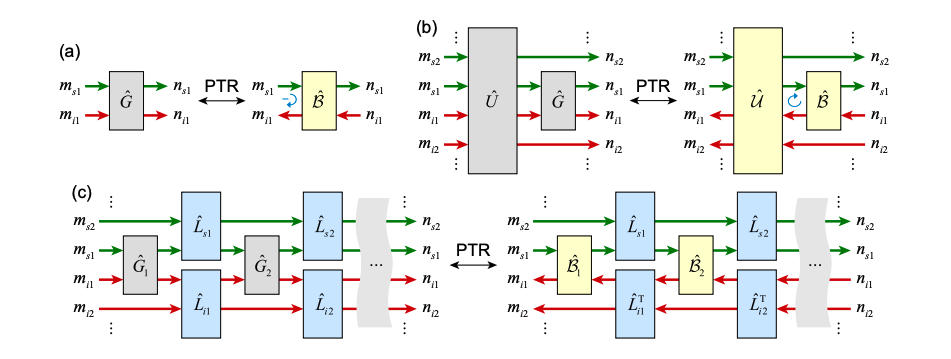
Researchers have developed a methodology that establishes a duality between nonlinear and linear optical systems, simplifying the analysis of quantum optical phenomena and extending understanding beyond traditional perturbative methods. This approach transforms the mathematical description of an optical setup, allowing researchers to treat nonlinear elements as if they were linear components within a modified system, preserving the essential physics while enabling complex calculations. The team demonstrated that this transformation maintains the duality between the original nonlinear system and its linear counterpart, particularly useful for analyzing scenarios where standard approximations break down, such as in high-gain regimes or with complex multi-path interference. A key innovation lies in applying this duality to the analysis of multi-photon processes, specifically focusing on scenarios involving four photons, where researchers reconstruct the behavior of the nonlinear system using only linear calculations.
This involved a detailed examination of photon paths and the application of mathematical tools to account for looping photons within the system, exploring implications for quantum teleportation and providing new insights into its fundamental principles. Furthermore, the methodology offers a unique perspective on post-selection techniques, where researchers extract information about underlying quantum processes by analyzing post-selected states. This approach offers a powerful new tool for exploring the boundaries of quantum optics and developing advanced photonic technologies, allowing researchers to analyze complex nonlinear systems by mapping them onto equivalent linear arrangements. This methodology could lead to the development of more efficient and compact optical devices, paving the way for advancements in areas such as quantum communication and optical computing.
Nonlinear Optics Mirrors Linear Optical Systems
Researchers have demonstrated a fundamental duality between nonlinear optical processes and linear optical setups, revealing a surprising connection between how light interacts with these systems. This work establishes that a complex nonlinear setup, involving processes like parametric down-conversion, can be mathematically replaced by a simpler arrangement of beam splitters and phase shifters, without altering the overall behavior of the light. This duality offers a new way to understand and potentially control light in complex optical systems. The core of this discovery lies in the ability to describe the transformation of light within a nonlinear system using the same mathematical framework as a linear one, meaning that intricate interactions within a down-conversion process can be mimicked by carefully arranging beam splitters.
The researchers found that maintaining this equivalence lies in accounting for subtle phase shifts introduced within the nonlinear system, which can be compensated for by adjusting the properties of the linear components. Importantly, this duality extends to the calculation of key optical properties, allowing researchers to accurately predict the probability of detecting specific light states after passing through a nonlinear system by analyzing the equivalent linear setup, particularly useful when dealing with coherent light sources. The researchers showed that the duality allows for the calculation of the Q-function, a measure of the quantum state of light, using classical methods, offering a powerful tool for characterizing complex optical systems. Furthermore, the research reveals that internal cavities within the nonlinear system introduce additional phase shifts that must be accounted for in the equivalent linear setup, arising from multiple reflections within the cavity and compensated for by carefully adjusting the properties of the beam splitters. The team demonstrated this principle with cascaded down-conversion processes, showing that the overall behavior can be accurately reproduced using a simple arrangement of beam splitters and phase plates, with significant implications for the design and optimization of photonic devices.
Cascaded Conversion Mirrors Linear Optical Duality
This research establishes a duality between nonlinear optical systems involving parametric down-conversion and linear optical setups, demonstrating that these seemingly disparate systems can be mathematically equivalent. The team proves that cascaded parametric down-conversion processes can be accurately represented by cavities constructed from hypothetical beam splitters, preserving the geometry of the original setup and allowing for a novel approach to understanding complex photonic systems. The findings demonstrate that the amplitude of light within these cavities includes contributions from multiple paths, allowing researchers to accurately model complex optical systems using simplified linear arrangements.
🗞 Nonlinear-linear duality for multipath quantum interference
🧠 ArXiv: https://arxiv.org/abs/2508.13855


